|
|
Griechische Maler in der Antike Part 2 (K-Z)
The customary branches of education are in number four; they are- (1) reading and writing, (2) gymnastic exercises, (3) music, to which is sometimes added (4) drawing. Of these, reading and writing and drawing are regarded as useful for the purposes of life in a variety of ways, and gymnastic exercises are thought to infuse courage. Aristotle, Politics * Kadmos Painter (fl. 420–-400 BC) Vase Painter RF * Karkinos Painter Vase Painter RF * Kleitias Painter, (fl. 570-560) Vase Painter BF * Kleophon Painter (fl. 430-–420 BC) Vase Painter RF * Kleophrades Painter (fl. 505–-475 BC) Vase Painter RF Biography , The Kleophrades Painter, by Michael Padgett, Princeton University (Perseus), Kleophrades Painter [21 Vases] * Kora 7th Century BC Artist (w) * Kraton (Κράτων) (before 6th century BC) Painter See: Painting in Sikyon * Lalla 4th Century BC Artist (w) * Leningrad Painter 5th Century BC Vase Painter Leontiskos (Λεοντίσκος)(c. 230 BC) Painter See: Painting in Sikyon * Lydos Painter (fl. 560-540 BC) Vase Painter (and Potter?) BF * Lysippides Painter (fl. 530–-510 BC) Vase Painter BF Biography , Lysippides Painter [11 Vases] * Makron (fl. 490-475 BC) Vase Painter RF * Marsyas Painter 4th Century BC Vase Painter RF Biography , Marsyas Painter [6 Vases] * Melanthios (Μελάνθιος)(fl. 350-320 BC) Painter Student of Pamphilos See: Painting in Sikyon * Meidias Painter (fl. 420–-390 BC) Vase Painter RF Biography , Meidias Painter [25 Vases] * Meleager Painter 400 BC Vase Painter RF * Menelaos Painter (fl. 450–-420 BC) Vase Painter RF * Myson first quarter 5th centrury BC Vase Painter RF * Naples Painter 5th Century BC Vase Painter * Nealkes (Νεάλκης)(c. 250 BC) Painter See: Painting in Sikyon * Nessos (Νέσσος) Painter (630-600 BC) Vase Painter
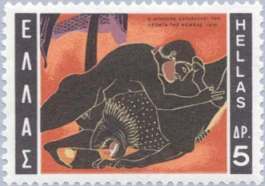
Hercules slaying the Centraur Nessos (or Nessus), Stamp Greece, 1970. Painting of a 1.22 m Early Black-Figure / Late Protoattic Aphora (Nessos Amphora), National Museum of Athens (NM1002). Discovered 1890 in Athens (at the Kerameikos region), the unknown artist named as the "Nessos painter". "He is perhaps the earliest Greek artist whose personality we can grasp" J. D. Beazley * Nikosthenes, (550 – 510 BC) Vase Painter RF * Niobid Painter 5th Century BC Vase Painter * Oltos (fl. 525-–500 BC) Vase Painter (Info) Psykter, Hoplites Riding Dolphins , Oltos [14 Vases] * Omaha Painter 6th Century BC Vase Painter BF Black-Figure Ovoid Neck-Amphora * Onesimos (fl. 505-480 BC) Vase Painter RF * Pamphaios (fl. 520-490) BC Potter * Pan Painter 5th Century BC Vase Painter Artemis and Actaeon c.470 BC , Pan Painter [15 Vases] * Peithinos Painter * Pheidippos Painter * Phiale Painter (fl. 450-425) Vase Painter RF Phiale Painter [9 Vases] , Whiteground calyx-krater, c. 440-430 BC * Phintias Painter (fl. 525-500) Vase Painter Phintias and Euthymides, by Jenifer Neils, Case Western Reserve University (Perseus), Phintias [9 Vases] * Phrynos Painter (c. 560-–540 BC) Vase Painter BF Biography ,Phrynos Painter [1 Vase] * Polion (c. 430-–410 BC) Vase Painter RF ..., for there are figures which are of a moral character, but only to a slight extent, and all do not participate in the feeling about them. Again, figures and colors are not imitations, but signs, of moral habits, indications which the body gives of states of feeling. The connection of them with morals is slight, but in so far as there is any, young men should be taught to look, not at the works of Pauson, but at those of Polygnotus, or any other painter or sculptor who expresses * moral ideas. Aristotle Politics * Polygnotos (fl. 475-455) BC, Painter, Vase Painter OLDER ATTIC SCHOOL Polygnotos (Polygnotus) son of Aglaophon, Thasos and Athens. The first painter of rank sometimes called the founder of Greek painting, because perhaps he was one of the first important painters in Greece proper. He seems to have been a good outline draughtsman, producing figures in profile, with little attempt at relief, perspective, or light-and-shade. His colors were local tones, but probably more like nature and more varied than anything in Egyptian painting. Landscapes, buildings, and the like, were given in a symbolic manner. Portraiture was a generalization, and in figure compositions the names of the principal characters were written near them for purposes of identification. The most important works of Polygnotos were the wall paintings for the Assembly Room of the Knidians at Delphi. The subjects related to the Trojan War and the adventures of Odysseus. Polygnotos and His Group, by Susan Matheson, Yale University (Perseus)
Psiax Painter * Psiax (c. 530-–500 BC) Vase Painter BF * Python (fl. 500-480 BC) Potter * Rycroft Painter (fl. around 510 BC) Vase Painter BF * Sabouroff Painter (fl. around 440 BC ) Lekythos (oil flask), ca. 450 B.C.; white-ground , Loutrophoros and Lekythoi * Skythes Painter * Smikros Painter RF * Sophilos Painter (580-570 BC) Vase Painter and Potter First known who signed an Attic vase * Sosias Painter (fl. 510-500 BC) Vase Painter RF Achilles bandaging Patroclos c. 500 BC Kylix * Sotades Painter (fl. 470-450 BC) Vase Painter Vase with Glaukos und Polyeides * Swing Painter 6th Century BC Vase Painter * Syleus Painter (fl. 490-470 BC) Vase Painter RF * Syriskos (fl. 480-460 BC) Potter/Vase Painter RF * Telephanes (Τελεφάνης) (before 6th century) Painter See: Painting in Sikyon *Thrax Painter * Tleson (Son of Nearchos) c. 550 BC Vase Painter BF * Xenokles Painter * Xenophantos 380 BC Vase Painter Description of an ancient Greek painting the Kentaurides by Philostratus the Elder Re-creating Antiquity in the Renaissance
![]() |
|
|||||||||||||||||