|
|
Griechische Architektur, Tempel: Die Dorische, Ionische und Korinthische Bauart Once upon a time trees were temples of the deities, Der griechische Tempel ist eigentlich kein Gebäude, sondern ein Monolithendenkmal in der Art der Cromlechs. Deshalb ist auch seine Bedachung, insbesondere die Giebelgestaltung, eine primitive und schwache Lösung. Die obligatorische plastische Giebelfüllung mitsamt dem falschen Gebälk ist, architektonisch betrachtet, eine Monstrosität. Walther Rathenau (German Politician). My translation: The Greek temple is actually not a building, but a monolith monument in the kind of the Cromlechs (a neolithic group of stones consisting of one large flat stone supported by several vertical ones). Therefore also its roof covering, in particular the Pediments composition, is a primitive and weak solution. The mandatory plastic Pediment coverage with the wrong timber work is architecturally regarded, a monstrosity. Temple from Templum is the same word as the Greek temenos, from temnw to cut off, means to separate some special place from the rest of the land. Usually religion rites were held outside the temple in front of the temple at an altar. With a few exceptions (for example temple to Apollo on Delos) most temples face east as the priests faced the direction of the rising sun when making offerings to the gods. A shrine is stronger than a tower to save, A shield that none may cleave. Aeschylus The Suppliants Persons were protected in the sacred space of the Temenos, they could not be taken out without their will. They enjoyed the right of asylia (or today asylum, from sylan "to steal", ) (the right not to be taken or stolen out).
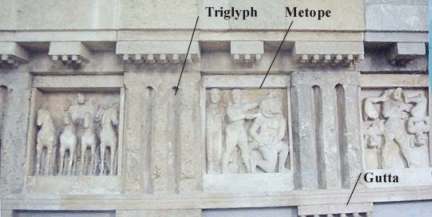
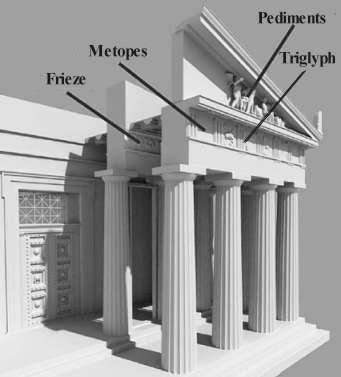
Doric Temples Greek Doric temples have usually a pattern under the pediment known as triglyphs (three cuttings) and metopes. The triglyphs alternate with the metopes across the front of the temple. Triglyphs have three parts, and then in between the triglyphs are the metopes. The frieze often was an alternating set of triglyphs and metopes. The Doric and Ionic Order are the main structural systems of Greeks temples (type of column, decoration, etc). The third so-called Corinthian Order is similar to the Ionic Order with differences mainly in the column decoration. See: (9 columns) Other Temple versions: Tholos, a temple with a circular ground plan. ( |
|||||||||
|
including other Temples (Poseidon, Herakles, Apollo, Hera Akraia, Hermes ...)
|
||||||||||
|
|
Sanctuary of Athena Pronaia (Reconstruction), ) () , |
|||||||||
|
(Temple of Themis, Artemis, etc) |
||||||||||
|
) |
||||||||||
|
) Severe Temple of Hera or Temple E On the Greek mainland facing the Cyclades Islands and the Aegean Sea the Sunium promontory stands out from the Attic land. When you have rounded the promontory you see a harbor and a temple to Athena of Sunium on the peak of the promontory. Pausanias Description of Greece, Book I, Attica |
||||||||||
|
, ) |
Polyclitus (The Sculptor) |
|||||||||
|
of the Corinthian order, Red Army Theater, Capital, 1934-1940, USSR
Asterix at the Olympic Games References, Books
| ||||||||||