|
|
Archaische Griechische Kunst: Der Kouros Part 2
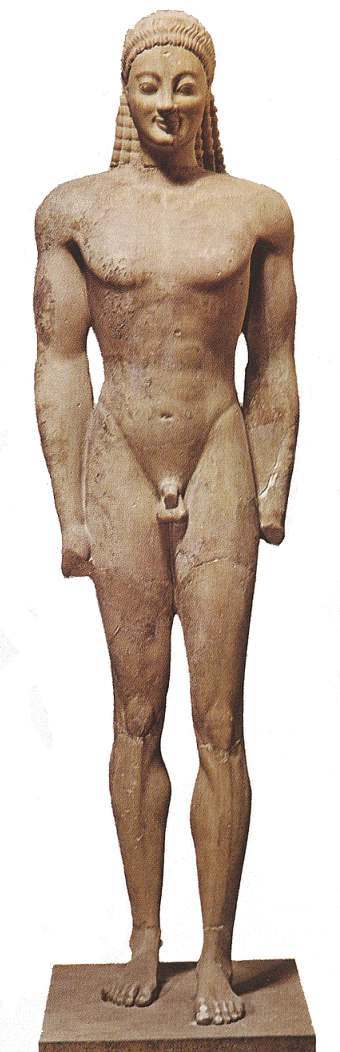
Some consider the Kouros something like a grave marker that was used by Aristocrats that could afford these very expensive sculptures. Why their form remained for a long period relatively unchanged before the sudden revolution towards realism (mimesis) has been discussed by many specialists.
Probably the sculptors used some rules (archaic canon). For example the ratio size head/body = 1/6 that was changed to 1/7 by Polycleitus as described in his “canon” and realized with the Doryphoros
Kouros, Ptoios Apollo Sanctuary,
Dionysermos Louvre Ma3600 (a not nude Kouros like sculpture)
Ptoon Kouros
Ptoon Kouros 515-500 B.C
The Kouros from Thera (Apollo of Thera) National Museum Athens
The Kouros (Apollo ) from Orchomenus National Museum Athens known also as Strangford Apollo The Dipylon Kouros , The Kouros of Paros ,
Image of the Head in the Louvre Greek - Archaic Rampin Horseman another image of the head
Former US president B. Clinton and the Rampin Horseman (Source)
Kouros from the Asclepeion of Paros, c. 540 BC, Louvre. [Source]
Little Kouros Glyptothek Munich
Kouros of Europos from ancient Europos in the Goumenissa municipality
The Aristodikos Kouros 510-500 BC (National Archaeological Museum of Athens) Kouros of Piombino (another image) "A Kouros" from the 1st century BC (archaizing) Kouros from Melos c. 550 BC marble h. 2.14m. The Kritios Boy (Παις του Κριτίου) c. 490-480 BC (Acropolis Museum) probably from the sculptor Kritios. A transitional sculpture, towards more realism who marks the end of the Kouros art. Deborah Tarn Steiner , Images in Mind: Statues in Archaic and Classical Greek Literature and Thought Curiosities http://www.archaeotext.org/kuroi.htm Comparative studies of the development of the Kuroi representation from an anatomical view,a Text in German for “experts in anatomy” Nikolaos Kaltsas, Sculpture in the National Archaeological Museum Athens John Boardman, Greek
Sculpture: The Archaic Period (World of Art)
![]() |
|
|||||||||||||||||