|
|
Hellenistische Kunst. Der Laokoon Do you believe the enemy have sailed away? Or think that any Grecian gifts are free of craft? Is this the way Ulysses acts? Either Achaeans hide, shut in this wood, or else this is an engine built against our walls... I fear the Greeks, even when they bring gifts, Laocoon from Virgil The Aeneid Part 1
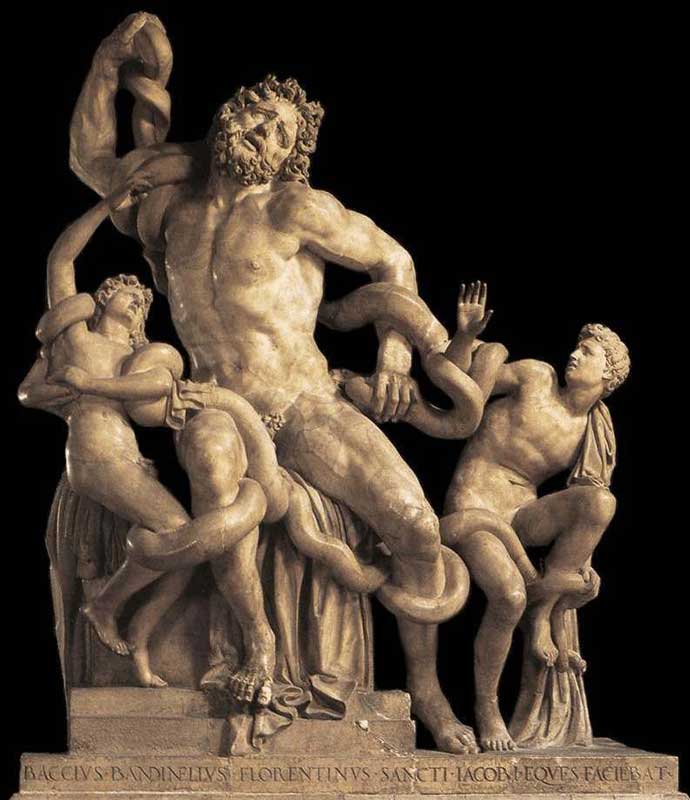
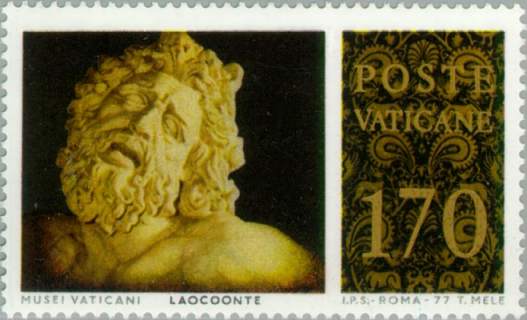
A Laoccon version where the right hand ist higher than the original not reconstructed version (see image of the original below) It was 13 January 1506 when Michelangelo and his friend Guiliano was called by the Pope Julius II to see a sculpture. It was the sculpture of Laocoon. Michelangelo called it a "portento d'arte" and his friend Guiliano said excited "this is Laoocon as described by Pliny the elder!" The Laocoon Group, Laocoon or Laocoön or Laokoon (Λαοκόων) (a brother of Anchises a priest of Apollo) sculpture by Agesander (or Hagesander), Athanodorus and Polydoros of Rhodes a marble copy of a bronze Hellenistic sculpture at 140 BC. Vatican Museum Rome (one of two versions, the other without the restorations of the missing parts).Now it is considered as the work of the three sculptors 1)Athanadoros son of Hagesandros, 2) Hagesandros son of Paionios 3) Polydoros son of Polydoros of Rhodes Pliny describes the work as that of Hagesander, Polydoros and Athanadoros the Rhodians probably because there was another Athanadoros of Hagesander in Rhodes 42 BC whereas the )
The struggle; vain, against the coiling strain
|