|
|
Pergamon an important Hellenistic city since 300 BC, especially due to the Attalids, a Greek speaking dynasty. The name Pergamon means either people or the city of a highland or citadel. The kingdom achieved major importance under Attalus I (d. 197 BC), Eumenes II (d. 160 or 159 BC), and Attalus II (d. 138 BC). Pergamon was founded according to Mythology by Telephos a son of Herakles (Hercules) and Auge a priestess of Athena Alea at Tegea. Pergamon also is a name for Troy which is the home of Aeneas who escaping from Troy was a founder of the Roman state. Pergamon and Rome had therefore according to this story a common origin. The Romans supported Pergamon but tried also to limit its power. Pergamon supported the Romans against the Seleucids and especially against Antiochus III. who lost the battle of Magnesia in 190 BC.
Pergamon Zeus Altar, Region from Space Part of the Pergamon Acropolis, with the altar of Zeus with a horseshoe shape. Pergamon was famous for its Library with 200000 books, the greatest after the Library of Alexandria. All books from Pergamon were transported to Alexandria as a gift from Antony to Cleopatra after the Alexandria library was destroyed indirect by Caesar. In Pergamon we have the Asklepion, a medical center. Patients were cured by physicians like Galen. Patients were treated with music-therapy and the dreams of the patients were analyzed to find possible reasons for their illness. The Altar of Zeus was constructed by Eumenes II (197-159 BC) and after his death by Attalus II as a memorial of the victory against the Galatians and taking the Acropolis of Athens as an example. Its dimensions are 36.4 x 34.2 m. It is composed of four parts and the high relieves on it describe the war between the giants and the gods. The altar was constructed in the period 166-156 BC, although it was not completely finished (around 156 BC king Prusias II attacked Pergamon). The Altar was taken away from Pergamon in 1886 and carried to Germany in Berlin with the permission of the Sultan Abdul Hamid II. In 1948, the frieze of the Zeus Altar, was confiscated by the Soviet Army and taken to Leningrad and it was returned 1958 to the museum in East Berlin as a gift to the people of the German Democratic Republic by the USSR. In the Altar a Gigantomachy is shown with 34 goddesses, 20 gods, 59 giants and 28 animals. Around 1 Million visitors see each year the altar in Berlin which is shown there since 1901 and a special museum since 1930. The altar of Zeus after 10 years of restoration can since 10-June 2004 be visited again in Berlin.
The Pergamon Zeus Altar : The East frieze , South frieze , North frieze and West frieze
The Pergamon frieze is the largest sculptural composition after the famous Parthenon marbles of Athens--now in the British Museum, though it was carved with much larger figures (7.5 feet). By depicting the victory of the Greek gods over the giants, the altar symbolically celebrated the triumph of the city of Pergamon in the newly conquered lands of Anatolia, hence proclaimed the city as the legitimate continuation of the Greek civilization, a second Athens located far from the mainland Greece. This indeed suggests that Pergamon, a city governed by a Greek speaking elite, yet consisting mostly of Lydian natives, referred to classical Athens (5th century BC) as the origin of its own high culture. Perhaps, as an irony of history, the altar lent its glory centuries later to another kingdom which equally idealized ancient Greece. When reconstructed in Berlin in what was then believed to be its original form, the Zeus Altar became one of the symbols of the German Empire. Both as an artistic style and an ideological paradigm, neoclassicism provided forms that came to symbolize the Prussian state in the 19th century, when Prussian architects adopted neo-Greek forms. Hence the Zeus Altar was received with unequaled enthusiasm in Germany. Its reconstruction in Berlin provided the German neoclassical project and German Philhellenism with a sense of authenticity. Historical analogies between ancient Pergamon and modern Germany were also close at hand: just as the kingdom of Pergamon unified the city states of Anatolia under its rule after the conquests of Alexander the Great, so the Prussian Empire, the victor of the 1871 war, was the ruler of the small German states, and a new power in Europe, S.M. Can Bilsel, Zeus in Exile: Archaeological Restitution as Politics of Memory
A war elephant used by the Kings of Pergamon against a Gaul, Louvre
The Dying Gaul protected during World War I
Kneeling youthful Gaul Louvre Ma324 (Dedication on the Acropolis in Athens by Attalus II, a copy)
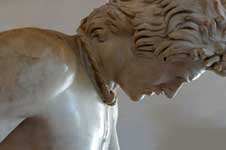
The Gauls are tall, with moist white flesh; their hair is not only naturally blond but they also make artificial attempts to lighten its colour by washing it frequently in lime water. They pull it back from the top of the head to the nape of the neck. Thanks to this their hair thickens until it is just like a horse’s mane............ They wear amazing clothes, tunics dyed in every colour and trousers that they call bracae (breeches). They pin striped cloaks on top of thick cloth in winter and light material in summer, decorated with small densely packed, multi coloured squares, Diodorus Siculus ,1st century BC. The statue was in the possession of Cardinal Ludovisi as early as 1633, along with a group closely allied in style, representing a Gaul and his wife, but nothing is certainly known as to the time and place of its discovery. The restorations are said to be: the tip of the nose, the left knee-pan, the toes, and the part of the plinth on which the right arm rests, together with the objects on it. That the man represented is not a Greek is evident from the large hands and feet, the coarse skin, the un-Greek character of the head . That he is a Gaul is proved by several points of agreement with what is known from literary sources of the Gallic peculiarities--the moustache worn with shaven cheeks and chin, the stiff, pomaded hair growing low in the neck, the twisted collar or torque. He has been mortally wounded in battle--the wound is on the right side--and sinks with drooping head upon his shield and broken battle-horn. His death-struggle, though clearly marked, is not made violent or repulsive. With savage heroism he "consents to death, and conquers agony. Here, then, a powerful realism is united to a tragic idea, and amid all vicissitudes of taste this work has never ceased to command a profound admiration. F. B. Tarbell History Of Greek Art Detail See: http://arthist.cla.umn.edu/aict/html/ancient/GS/GS092.html
Battling Gaul and another battling Gaul
The Pergamon Zeus Altar : The Titanic battle for the survival of culture Dozen of gods together with Hercules and Dionysus in a battle against Ge (or Gaea, mother Earth) and her children the Giants. Which mythological persons are shown in the gigantic Pergamon Zeus Altar? See the East frieze , South frieze , North frieze and the West frieze Sculptures Is the Pergamum Altar a forgery? (In German) If we believe U. Topper today it is not the year 2004 but around 1704 :-) "Celtic" and Mediterranean Interaction Die 'Großen Gallier' - Einführung (German) Andrew Stewart, Attalos, Athens, and the Akropolis. The Pergamene 'Little Barbarians' and their Roman and Renaissance Legacy From Pergamon to Sperlonga: Sculpture and Context (Hellenistic Culture and Society)
![]() |
|
||||||||||||||||||||