|
|
Griechische Kunst: Grabsäulen Πήγαινε στον Κεραμεικό να δείς τα ανάγλυφα με κείνους που μέχρι μιά τώρα ήταν το κέντρο ενός κόσμου, και που αύριο θα είναι άγνωστοι κι αγνοημένοι - τη στιγμή όπου τελειώνει λίγη ζωή και ξεκινά αιώνιος θάνατος (From http://www.athenian.net/d-athena/kerameikos.htm ) My translation: Go to the Kerameikos to see the bas-reliefs of those who were the centre of a world, and who tomorrow will be unknown and ignored - the moment where the short life finishes and eternal death begins.
Farewell and the last touch , Attic Stele Stele (plural Stelai) a grave stone with reliefs. Many Stelai produced in the period 420-317 BC in Attica until Demetrios of Phaleron of Athens passed a law that prohibited the erection of elaborate stelai ( anti-sumptuary decree).
Stele of Dermys and Kitylos, dedicated by Amphalkes to Dermys and Kitylos from Kokali necropolis in Tanagra, early 6th century BC, National Archaeological Museum Athens, NM 56 To see the grave reliefs in greatest number and variety, and to study their significance, we must go to the National Museum. Many as there are, there would have been more Attic gravestones, if a law had not been passed to restrict their erection. Demetrius of Phaleron seems to have been a funeral reformer, who forbade the use of elaborate grave monuments, and who thought three inexpensive varieties would be enough. It was probably owing to earlier interference with the stone-cutter's craft, and not to any pro-longed period of public health, that the production of Attic gravestones fell off in the fifth century, and again, after a period of reaction, under Demetrius at the end of the fourth. Greece - Attic Grave Reliefs
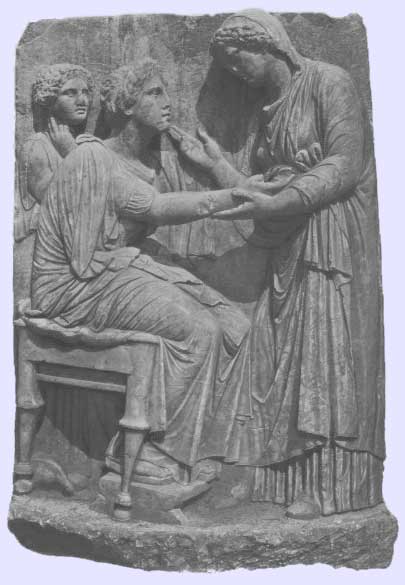
Hegeso (the daughter of Proxenos) Stele, c. 400 BC, National Archaeological Museum of Athens, Pentelic marble Stele for a woman called Hegeso inscribed on the stele. One of the most famous and beautiful pieces of sculpture, located in the Kerameikos Cemetery in Athens. Hegeso seating on a Klysmos chair with her servant facing her offering to her a jewelry box. (Color reconstruction from a lectures Art website, probably the painted jewelry that Hegeso had in her hand missing). http://www.stoa.org/metis/cgi-bin/qtvr?site=kerameikos A virtual Tour of the Kerameikos, including various monuments (Stelai, etc) (Quicktime Movie) Κι από το πρώτο μάρμαρο κι από το πρώτο μνήμα
Ilissos Stele from the bed of the Ilissos River in Athens, c. 340 BC, National Museum, Athens. The young boy maybe represents one of the children of the dead. A grave stele which I find also funny because of the dog that smells the foot of the old man.
Damasistrate, daughter of Polycleides
Another Stele: A baby farewells his dead mother.
Stele and my Sirens and mournful pitcher that hold the little ash of Hades, tell those who pass by my tomb to greet me, whether citizens or from another town, and say that I was buried here, still a bride, and that my father called me Baucis, that I was born in Tenos, that they may know. And tell them too that my companion Erinna engraved this word upon my tomb. I am the grave of Baucis the bride. Passing by my stele, say to Hades beneath the earth,
Plangon Stele, around 320 BC: Text; Plangon Tolmidoy Plataiki. Tolmides Plataeus. "Plangon, wife of Tolmides, from Plataea. Tolmides, the Platean". Probably the stele of a wife who died soon after becoming a mother. Discovered in Oropos. Athens, Athens National Archaeological Museum; NM 749 Stele Mnesarete Glyptothek Munich 491 Stele, hunter, Glyptothek Munich 492 Stele Artemon Glyptothek Munich 493 Stele lyre player Glyptothek Munich
Stele Saida, Louvre Ma3657, Lebanon (Greek inscription) Stele of Thraseas and Euandria Title: Funerary Stele of Demetria and Pamphile, Kerameikos (Athens) Date: 4th c. BC Greek tombstone, with female figure in relief, Esquiline, Rome Tombstone of youth from Salamis, Athens Tombstone Giustiniani collection, Berlin Tombstone of Arkesila, Dresden Tombstone of Sostrate and Euxenides, Copenhagen http://www.getty.edu/art/collections/ Gravestone of a Girl with Her Doll and Pet Goose Stele Guistiani (German Page) Many more examples of Grave Stelai The Hellenistic Grave Stelai from Smyrna: Identity and Self-image in the Polis from
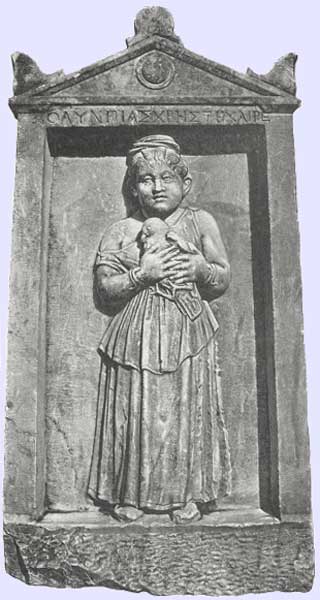
Young girl with a bird
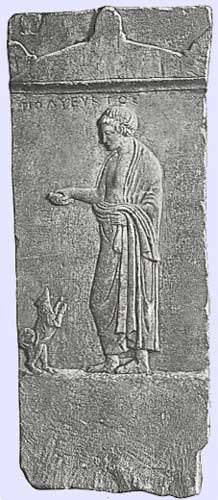
Polyeuktos with his dog, one of many similar stelai
Anthony W., Erich S. Gruen, A.A. Long, and Andrew Stewart, editors Images and Ideologies: Self-definition in the Hellenistic World. Berkeley: University of California Press, c1993 1993. http://ark.cdlib.org/ark:/13030/ft4r29p0kg/ Changing Patterns of FuneraryArt in Greco-Roman Antiquity (PDF File)
|
|