|
|
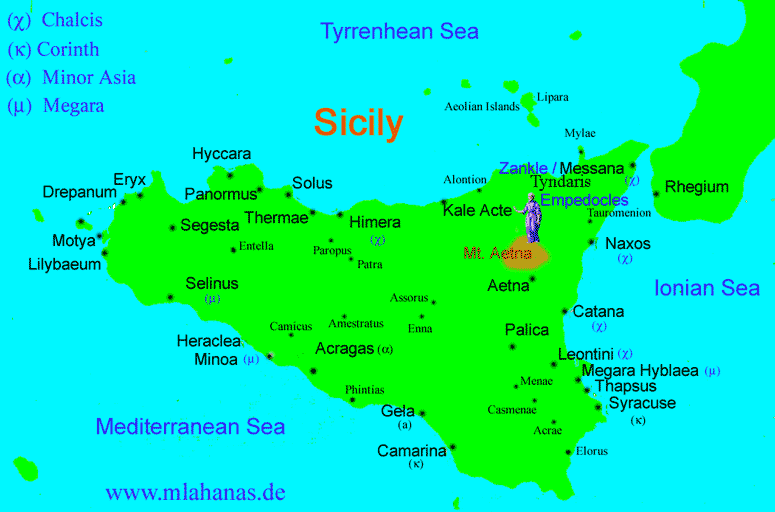
![]() Agrigentum (Akragas), The Valley of Temples, View from Space Agrigentum, (also known as Agrigento, Acragas or Akragas) an ancient Greek city (a colony from Minor Asia Greeks) on the island Sicily . The city was built on a cliff on the south-coast of Sicily, surrounded by two rivers (the Hypsas and the Akragas). This position meant that the city was easy to defend in times of war. Phalaris was tyrant of Agrigentum, c. 570-554 BC.
Phalaris orders the death of Perillus of Athens, the first victim of his invention Agrigentum is the birthplace of the Greek philosopher and politician Empedocles who according to a legend died by jumping into the active volcano, Mount Etna in Sicily. The year 480 BC was a critical year for the Greeks, the Persians attacked Athens and the Greek colonies in Sicily were attacked by the Carthaginians. Theron a tyrant of Agrigentum with help from Syracuse won the Battle of Himera. In 406 BC the city was attacked again by the Carthaginians which started a period of decline. It gained some importance with Timoleon . In 262 BC the Romans attacked Agrigentum controlled by the Carthaginians. The Romans were supported by Hiero II, tyrant of Syracuse. Fifty years later Agrigentum was controlled by the Romans The remains of the ancient city, such as the temple of Concordia, the temple of Zeus (or Olympeion), the temple of Heracles and "Juno Lacinia", are all dated back to the 5th century BC. Especially the temple of Concordia is one of the finest examples of Greek Classicism. The Valley of Temples
Temple of Heracles. Cicero writes that a giant bronze sculpture of Heracles was inside the Temple. It is the oldest of the temples and it differs also having 15 columns along its length, while the other temples have 13 columns. Only 8 columns remained.
The Concordia Temple in front with a drawing of a reconstruction: Photo Clemens Franz, 24.05.2006 (Source)
Temple of Hera (Juno Lacinia ). The Temple was destroyed 406 BC by the Carthaginians, later repaired by the Romans.
Detail from the Temple of Juno at Agrigentum, 1830 , Caspar David Friedrich (1774-1840)
Reconstruction of the Olympeios Zeus Temple with the giant Telamons, R. Koldewey, O. Puchstein, Die griechischen Tempel in Unteritalien und Sizilien, Bd. I, Abb. 143, Berlin 1899 The Temple of Zeus was build around 480 BC by Theron of Agrigentum, after a victory against the Carthaginians at Himera, although it was never completed. Giant Figures were used for the temple. The Temple is much larger than the Parthenon Temple. The columns were at least 17 m large with a diameter of 4 m. One of the giant figures, a Telamon, was reconstructed from the remains. Material was used for other buildings, such as the Porto Empedocle after the year 1750 so that little remains from the Temple described by Diodorus Siculus.
Akrags Coin
Images Images of Water Spouts from Agrigentum Retrieved from "http://en.wikipedia.org/"
![]() |
|
|||||||||||||||||||||||||||||||||||||||||||||||||||||||||||||||||||