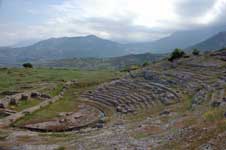
- Aigeira archaeological site
- OeAL - Aigeira (in German)
|
|
Aegeira (Aigeira), a, town of Achaia, and one of the 12 Achaean League cities, situated between Aegae and Pellene, is described by Polybius as opposite Mount Parnassus, situated upon hills strong and difficult of approach, seven stadia from the sea, and near a river. This river was probably the Crius, which flowed into the sea, a little to the W. of the town. According to Pausanias the upper city was 12 stadia from its port, and 72 stadia from the oracle of Heracles Buraicus. (Herod, i. 146; Strab. viii. p. 386; Pol. ii. 41, iv. 57; Paus. vii. 26. 1; Plin. iv. 6.) Pausanias relates that Aegeira occupied the site of the Homeric HYPERESIA ('l.ii. 573, xv. 254; Strab. p. 383 : Eth.'Hyperesieus), and that it changed its name during the occupation of the country by the lonians. He adds that the ancient name still continued in use. Hence we find that Icarus of Hyperesia was proclaimed victor in the 23rd Olympiad. (Paus. iv. 15. 1.) On the decay of the neighbouring town of Aegae its inhabitants were transferred to Aegeira. (Strab. p. 386.) In the first year of the Social war (220 BC) Aegeira was surprised by a party of Aetolians, who had set sail from the opposite town of Oeantheia in Locris, but were driven out by the Aegiratans after they had obtained possession of the place. (Pol. iv. 57, 58.) The most important of the public buildings of Aegeira was a temple of Zeus. It also contained a very ancient temple of Apollo, and temples of Artemis, of Aphrodite Urania, who was worshipped in the town above all other divinities, and of the Syrian goddess. (Paus. vii.26.) The port of Aegeira Leake places at Mavra Litharia, i. e., the Black Rocks, to the left of which, on the summit of a hill, are some vestiges of an ancient city, which must have been Aegeira. At the distance of 40 stadia from Aegeira, through the mountains, there was a fortress called PHELLOE near Zakholi,abounding in springs of water. (Paus. vii. 26. 10; Leake, Morea, vol. iii. p. 387, seq.) The area was founded in the 3rd millennium BC. The city was known as Hyperesia (Greek: Υπερησία, Hyperesia) during Homeric times. In 688 BC, Hyperesia changed to Aegeira. The legend Hyperesia was threatened once, as Pausanias reported by a hostile army from Sicyon. It changed its name to the present name as the defenders achieved victory and the people bounded for the goats and attacked the enemies. The city was destroyed when Achaea became part of the Roman Empire. Alledgely it was destroyed by a flood. Since then, the city is 400 m above sea level. Others said it was destroyed by an earthquake. Archaeology The Österreichische Archäologische Institut, lit. the Austrian Archaeological Institute in 1916 made excavations in Aegira. The team along with Otto Walter (pronunciation: VAHL-tehr) founded the head of the statue of Zeus which was sculpted by Euclid. Walter also founded the left arm, the finger at the right hand later. In 1972, excavations continued by Wilhelm Alzinger and excavated the ancient theatre and a Naiskos (small temple). The soil was decorated with mosaic which showed an eagle.
All text is available under the terms of the GNU Free Documentation License
![]() |
|
|||||||||||||||