|
|
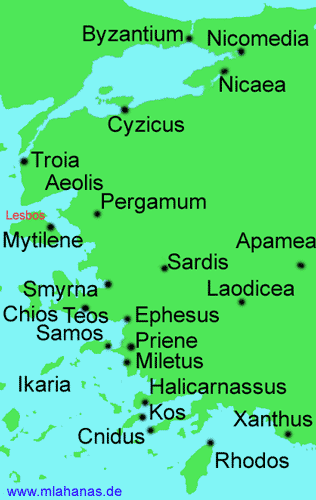
![]() Icaria, also spelled Ikaria, is a Greek island 10 nautical miles (19 km) south-west of Samos. In Greek mythology is derived its name from Icarus, the son of Daedalus, who fell into the sea nearby. It is one of the biggest islands of the eastern Aegean, 255 mile² (660 km²) in area with 102 miles (160 km) in coastline and a population of about 7,000 inhabitants. The topography is a contrast between verdant slopes and barren steep rocks. The island is mountainous for the most part. It is traversed by Aetheras range, whose highest summit is 1,040 metres. Most of its villages are nestled in the plains near the coast, with only some of them on the mountains. Icaria has a tradition in the production of strong red wine. Many parts of the island are covered by large bushes, especially ravines, making the landscape lush with green. There are no rare species of fauna on the island. Besides pets, only small goat herds make their presence known, disturbing the serenity of the island with their bells. Icaria's climate is considered mild. Icaria has been inhabited since at least 7000 B.C. when it was inhabited by the Neolithic pre-hellenic people that Greeks called Pelasgians. Around 750 B.C. Greeks from Miletus colonized Ikaria establishing a settlement in the area of present day Campos, which they called Oenoe for its wine. In the sixth century B.C. Icaria was absorbed by Samos and became part of Polycrates' sea empire. At this time the temple of Artemis at Nas, on the northeast corner of the island was built. Nas was a sacred spot to the pre-Greek inhabitants of the Aegean, and an important port of the island in antiquity, the last stop before testing the dangerous seas around Icaria. It was an appropriate place for sailors to make sacrifices to Artemis, who among other functions, was a patron of seafarers. The temple stood in good repair until the middle of the 19th century when it was pillaged by the villagers of Christos, Raches for marble for their local church. In 1939 it was excavated by the Greek archeologist Leon Politis. During the German and Italian occupation of Icaria in the Second World War many of the artifacts unearthed by Politis disappeared. Local custom has it that there are still marble statues embedded in the sand off the coast. Link Ikaria guide (http://www.travel-to-ikaria.com)
![]() |
|
|||||||||||||||||