|
|
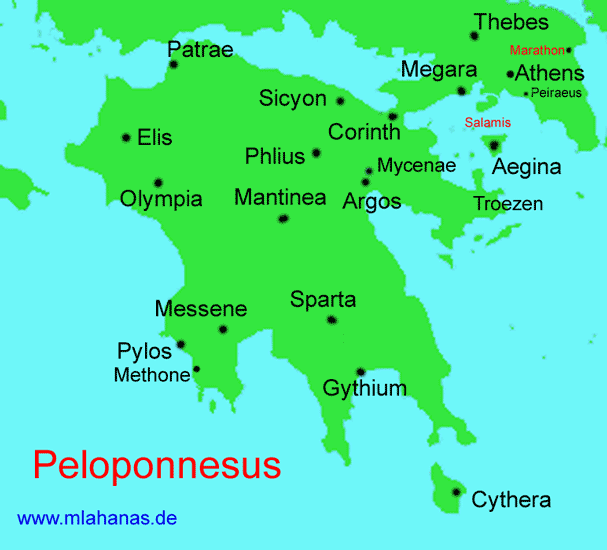
Olympia (Greek: Ολυμπία or Ολύμπια, older transliterations, Olimpia, Olimbia), a city of ancient Greece in Elis, is known for having been the site of the Olympic Games in classical times, comparable in importance to the Pythian Games held in Delphi. Both games were held every olympiad (i.e. every four years), the Olympic Games dating back at least as far as 776 BC. In 394 AD emperor Theodosius I abolished them.
Olympia is also known for its gigantic ivory and gold statue of Zeus, made by Phidias, which was one of the Seven Wonders of the Ancient World. Very close to the temple of Zeus (see photo of ruins below) which housed this statue, the studio of Phidias was excavated in the 1950s. Evidence found there such as sculptor's tools, corroborates this opinion.
Excavation of the Olympia temple district and its surroundings began with a French expedition in 1829. German archaeologists continued the work in the latter part of the 19th century. The latter group uncovered, intact, the Hermes of Praxiteles statue, among other artifacts. In the middle of the 20th Century, the stadium where the running contests took place was excavated.
The Olympic flame of the modern-day Olympic Games is lit by reflection of sunlight in a parabolic mirror at the restored Olympia stadium and then transported by a torch to the place where the games are held.
When the modern Olympics came to Athens in 2004, the men's and women's shot put competition was held at the restored stadium.

Ruins of the Temple of Zeus at Olympia, Greece
The ancient ruins sits north of the Alpheus and lies next to Cronius or Kronios hill (the hill of Kronos, or Saturn). Kladeos, a tributary of Alpheus, flows around the area.
The town has a school and a square (plateia). Tourism is popular throughout the late-20th century. The city has a train station and is the easternmost terminus of the line of Olympia-Pyrgos (Ilia). The train station which the freight yard is west of it is about 300 m east of the town centre.
It is linked by GR-74 and the new road was opened in the 1980s, the next stretch N and NE of Olympia will open in around 2005. Distance from Pyrgos is 20 km E(old: 21 km), about 50 km SW of Lampeia, W of Tripoli and Arcadia and 4 km north of Krestena and N of Kyparissia and Messenia. The highway passed north of the ancient ruins.
The area is hilly and mountains, most of the area within Olympia is forested.
The Krypte (constructed in the Hellenistic period) through which the Hellanodikai and the athletes entered into the stadium of Olympia. The passageway connected the stadium to the sanctuary (which included the Zeus Temple)
Palaestra at Olympia
|
Prefecture:
|
Ilia
|
|
Province:
|
Olympia
|
|
Location:
|
37° 38′ 24″ N 21° 37′ 25″ E
Kvaleberg
|
|
Name of inhabitants:
|
Olympian sing.
-s pl.
|
|
Website:
|
http://www.olympia.gr/
(in Greek and English)
|

4th century BC Olympia Coin, Zeus and the Eagle
Literature
- Panos Valavanis, Games and Sanctuaries in Ancient Greece. Translated by David Hardy. Los Angeles: 2004. ISBN 0-89236-762-8.
Retrieved from "http://en.wikipedia.org/ "
All text is available under the terms of the GNU Free Documentation License
Ancient Greek and Hellenistic Settlements / Places
A - B - C - D - E - F - G - H - I - J - K - L - M
N - O - P - Q - R - S - T - U -V - W - X - Y - Z
|
Ancient Greece
|
Medieval Greece / Byzantine Empire
|
Modern Greece
|
|
Science, Technology , Medicine , Warfare
, Biographies , Life , Cities/Places/Maps , Arts , Literature , Philosophy ,Olympics, Mythology , History , Images
|
Science, Technology, Arts
, Warfare , Literature, Biographies
Icons, History
|
Cities, Islands, Regions, Fauna/Flora ,
Biographies , History , Warfare
Science/Technology, Literature, Music , Arts , Film/Actors , Sport , Fashion
|

|
|