|
|
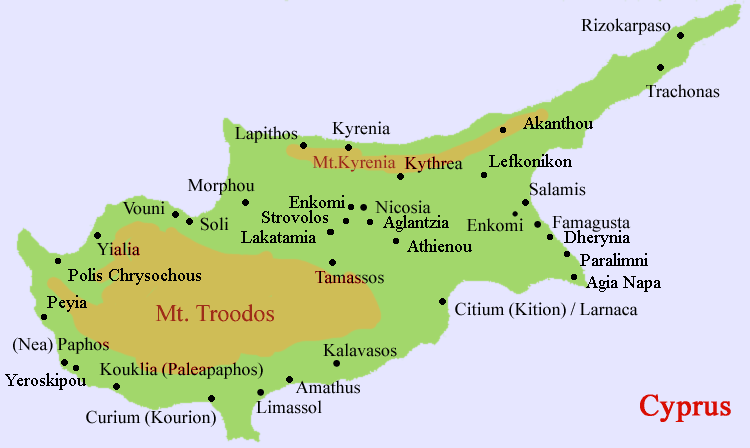
Pafos, usually written Paphos in English, (Greek: Πάφος, Páfos; Turkish: Baf) is a coastal town in the south-west of Cyprus. Pafos is the mythical birthplace of Aphrodite, the Greek goddess of love, sex and beauty. Even the town's name is linked to the Goddess, as Paphos was the name of the mythological daughter of Aphrodite and Pygmalion. Apollodorus of Athens tells us that it was her son Cinyras who founded the city. According to Pausanias it was Agapenor, a king of Arcadia, who founded Paphos. In Greco-Roman times it was the island's capital, and it is famous for the remains of the Roman Governor's palace where extensive, fine mosaics are a major tourist attraction. The Apostle Paul visited the town during the 1st century. The town of Paphos is included in the official UNESCO list of cultural and natural treasures of the world's heritage.
What present Palea Paphos (Greek for old Paphos) are named, is not part of the city self, but is the place where the ruins of the old city have been found, by the town Kouklia. In this city, the Phoenician goddess Astarte will worshipped be, and has been founded possible they by Myceneërs or Phoenicians. In fact, the New Paphos (Nea Paphos) consisted, that far of Palea Paphos lay not, in such a way in the antiquity. Paphos has been inhabited since the Neolithic period. It was founded by King Kinyras in 1400 BC. It was a centre of the cult of Aphrodite and of pre-Hellenic fertility deities. Aphrodite's legendary birthplace was on this island, where her temple was erected by the Myceneans in the 12th century BC. The remains of villas, palaces, theatres, fortresses and tombs mean that the site is of exceptional architectural and historic value. The mosaics of Nea Paphos are among the most beautiful in the world.
Coin from Cyprus, 4th century BC (Text Nikokleou Paphion) The port of Paphos was built by Nicocles, the last king of Paphos, at the time of Alexander the Great. It became the capital of the island replacing Salamis during the Hellenistic, under the successors of Alexander the Great - the Ptolemies and in those days its harbor was a busy, thriving port. Period as its masters, the Ptolemies, favoured a location closer to their capital, Alexandria. It continued as the island's first city for more than seven centuries, retaining its importance under Roman rule here that Apostle Paul converted the Roman Governor of the time, Sergius Paulus, to Christianity.The Romans retained Pafos as the seat of the Roman Governor. But Paphos history dates back a great deal further. In fact the whole area abounds in historical and archaeological treasure. Despite its vulnerability to foreign incursions and raids, the city survived through the centuries, retaining an indefinable, legendary charm through the ages. It even survived the devastating earthquake in the 4th century AD. Paphos, however, was gradually losing much of its attraction as an administrative centre, especially after the Nicosia. The city and its port continued to decline throughout the Middle Ages and Ottoman Rule, as Nicosia, and the port cities of Larnaka and Famagusta were gaining in importance. The city and district continued to lose population throughout the British colonial period and many of its inhabitants moved to Limassol, Nicosia and overseas. The city and district of Paphos had remained the most underdeveloped part of the island until 1974. The Turkish invasion and occupation of the major tourist resorts of Kyrenia and Famagusta led to major investments by the government and the private sector in the district of Paphos. There was rapid economic activity in all fields but especially tourism and the district's population stopped shrinking and indeed showed some signs of increasing. The government invested heavily in irrigation dams and water distribution works, road infrastructure and the building of Paphos International Airport - the second international airport in Cyprus - while private initiative concentrated in hotel, apartment and villa construction and the entertainment infrastructure. Today Paphos, with a population of about 47.300 (end of 2001), is a popular sea and a fast developing tourist resort, home to an attractive fishing harbour. It is divided into two major quarters - Ktima, on the sea terrace, is the main residential district, and Kato Pafos, by the sea, is built around the mediaeval port and contains most of the luxury hotels and the entertainment infrastructure of the city. The harbors of Paphos is not so important: the normal shipping goes via the harbor of Limassol. Just as is the marina of Paphos for fishing and other kinds of interest.
Paphos Castle [Source] The Medieval Castle build by the Lusignans. After partially destroyed by the Venetians it was repaired and modified by the Turks in 1592. Links City of Paphos website (http://www.vtourist.cy.net/paphos/) Retrieved partly from "http://en.wikipedia.org "
![]() |
|
|||||||||||||||||||||||||