Pylos

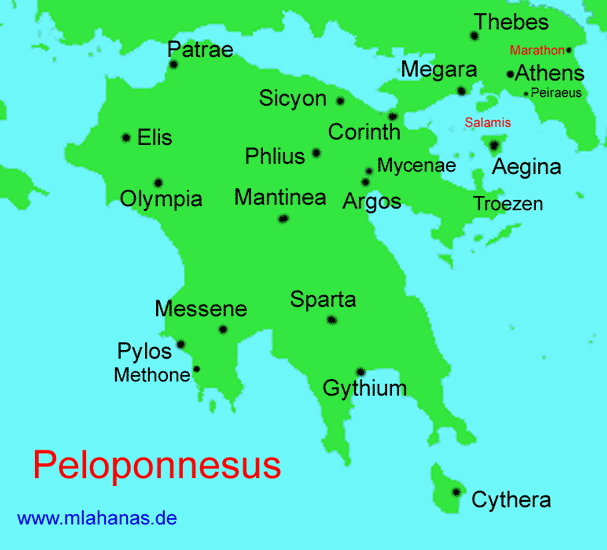
Peloponnesus map

Pylos Area today

When the sun had left the splendid sea and risen up
into an all-bronze heaven, giving light to gods
and mortal men and grain to farmers' fields,
the ship and crew reached Pylos, a well-built city
ruled by Nestor.
  Homer, Odyssey Book 3 (Telemachus Visits Nestor in Pylos)

Pylos (Greek Πύλος) is the name of a bay and a town on the west coast of the Peloponnese, in the district of Messenia in southern Greece. It is also the provincial capital of Pylia. It is formed by a deep indenture in the Morea, shut in by a long island, anciently called Sphacteria, famous for the defeat and capture of the Spartans, in the Battle of Pylos during the Peloponnesian War, and yet exhibiting the vestige of walls, which may have served as their last refuge. This island has been separated into three or four parts by the violence of the waves, so that boats might pass from the open sea into the port in calm weather, by means of the channel so formed. On one of the portions is the tomb of a Turkish saint, or santon; and near the centre of the port is another very small island, or rock." The modern name of the island is Sphagia.

During the period from the 12th to the 15th century when parts of Greece were under the control of Venice, Pylos became known by the Italian name Navarino, called by the Turks Avarin, and the Greeks Neo-Castron. In 1827 the bay of Pylos was the site of the Battle of Navarino during the Greek War of Independence.

It is the supposed birthplace of the venerable Nestor—standing upon a promontory at the foot of Mount Temathia, and overlooking the vast harbour of the same name as the town. It is surrounded only by a wall without a ditch; the height commanding the city is a little hexagonal, defended by five towers at the external angles, which, with the walls, were built by the Turks in 1572, but were never repaired till after the war with the Russians in 1770; the Turks having previously taken it from the Venetians in 1499. At the gate of the fortress is a miserable Greek village; and the walls of the castle itself are in a dismantled condition.

The soil about Navarino is of a red colour, and is remarkable for the production of an infinite quantity of squills, which are used in medicine. The rocks, which show themselves in every direction through a scanty but rich soil, are limestone, and present a general appearance of unproductiveness round the castle of Navarino; and the absence of trees is ill compensated by the profusion of sage, brooms, cistus, and other shrubs which start from the innumerable cavities of the limestone.

The remains of Navarino Vecchio, or ancient Navarino, consist in a fort or castle of mean construction, covering the summit of a hill sloping quickly to the south, but falling in abrupt precipices to the north and east. The town was built on the southern declivity, and was surrounded by a wall, which, allowing for the natural irregularities of the soil, represented a triangle, with the castle at the apex or summit—a form observable in many of the ancient cities of Greece.

The foundation of the walls throughout the whole circuit remains entire; but the fortifications were never of any consequence, though they present a picturesque group of turrets and battlements from below, and must have been very imposing from the sea,—an effect which those of the modern city have recently failed to produce. From the top is an extensive view over the island of Sphacteria, the port, with the town of Navarino to the south, and a considerable tract of the territory anciently called Messenia on the east, with the conic hill, which, though some miles from the shore, is used as a landmark to point out the entrance of the port.

Bronze Age Pylos was excavated by Carl Blegen in 1952. It is located at modern Ano Englianos, about 9km north-east of the bay. Blegen called the remains of a large Mycenean palace found there the "Palace of Nestor", after the character Nestor, who ruled over "Sandy Pylos" in the Homeric poems. Linear B tablets found by Blegen clearly demonstrate that the site itself was called Pylos by its Mycenean inhabitants. This site was abandoned sometime after the 8th century BC and was apparently unknown in the classical period.

Navarino and the island of Sphagia.

The site of classical Pylos was probably on the rocky promontory now known as Koryphasion at the northern edge of the bay of Pylos. This site is described by the Greek historian Thucydides in his History of the Peloponnesian War. In 425 BC the Athenian politician Cleon sent an expedition to Pylos, to seize and occupy the bay. The Athenians captured a number of Spartan troops on the adjacent island of Sphacteria (modern Sfagia, see Battle of Sphacteria). Spartan anxiety over the return of the prisoners, who were taken to Athens as hostages, contributed to their acceptance of the Peace of Nicias in 421 BC.

Pylos

, Images from Pylos

Retrieved from "http://en.wikipedia.org "
All text is available under the terms of the GNU Free Documentation License

Sandy Pylos : An Archaeological History from Nestor to Navarino, Jack L. Davis (editor) University of Texas Press , 1998, ISBN: 0292715951

Ancient Greek and Hellenistic Settlements / Geography of ancient Greece

A - B - C - D - E - F - G - H - I - J - K - L - M

N - O - P - Q - R - S - T - U -V - W - X - Y - Z

 
Web www.mlahanas.de
www.hellenica.de

Ancient Greece

Medieval Greece / Byzantine Empire

Modern Greece

Science, Technology , Medicine , Warfare
, Biographies , Life , Cities/Places/Maps , Arts , Literature , Philosophy ,Olympics, Mythology , History , Images

Science, Technology, Arts
, Warfare , Literature, Biographies
Icons, History

Cities, Islands, Regions, Fauna/Flora ,
Biographies , History , Warfare
Science/Technology, Literature, Music , Arts , Film/Actors , Sport , Fashion

Cyprus

Scientific Web