|
|
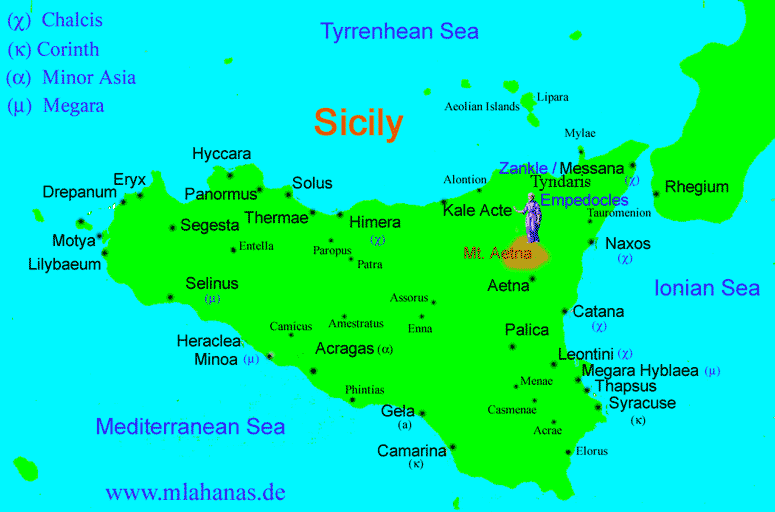
![]() Selinunte is an ancient Greek archaeological site in the south province of Trapani, in the island of Sicily. Selinunte is the modern Italian name for the ancient Selinus. The archaeological site contains five temples centered around an acropolis.
Two Images of the restorated Temple E in Selinus (assumed to be dedicated to Hera ), 460-450 BC. [1] [2] History According to Thucydides, Selinus was founded by people from Megara Hyblaea, a city on the east coast of Sicily, in the 7th century BC. The city had a very short life (about 200 years). During this time its population grew to a total of about 25,000. A wealthy trade center, Selinus was envied by the Carthaginians. Selinus became an ally of Carthage mainly to gain support against Segesta. However, Diodorus Siculus wrote about Hannibal, who in 409 BC destroyed Selinus after a war that counted about 16,000 deaths and 5,000 prisoners. The city was beseiged for nine days by an army of 100,000 Carthaginians. Roman Emperor Trajan died near Selinus while en route to Rome in AD 117
Plan of Selinus
Acropolis, Selinunte
Selinunte Didrachm, Heracles with a bull (river god), the Rivergod Hypsas, c. 450 BC In commemoration of draining swamps by connecting two streams after the advice of Empedocels according to Diogenes Laertius
Selinunte Tetradrachm, Quadriga with Nike, the Rivergod Hypsas in front of an altar 415/409 BC Images Images of Sculptures / Reliefs from Metopes from Temples of Selinus Franco De Angelis, Megara Hyblaia and Selinous. The Development of Two Greek City-States in Archaic Sicily. Oxford University School of Archaeology Monograph No. 57. Oxford: Oxford University School of Archaeology, 2003. Pp. xxi, 247; pls. 34. ISBN 0-947816-56-9. Retrieved from "http://en.wikipedia.org"
![]() |
|
|||||||||||||||||