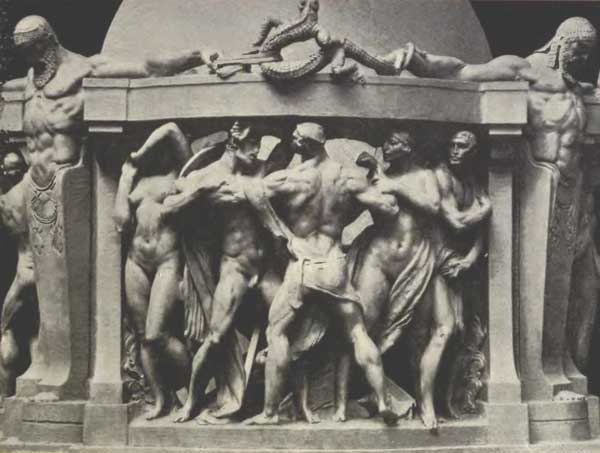
Griechische Philosophen über die Evolution der Arten
And again far-seeing Zeus made yet another generation, the fifth, of men who are upon the bounteous earth. Hesiod,

Darwin
While some say that evolution theory fails to describe many phenomena we should not forget that only 50 years have passed since the DNA structure has been discovered and that there is an evolution of science and evolution theory!
About 2500 years ago, s (1698-1759) writes: “Chance one might say, turned out a vast number of individuals; a small proportion of these were organized in such a manner that the animals organs could satisfy their needs. A much greater number showed neither adaptation nor order; These last have all perished -- thus the species which we see today are but a small part of all those that a blind destiny has produced." Essaie de Cosmologie
But much more earlier we have the following comments by Aristotle about Empedocles (c. 450 BC, who lived at about the same time as Democritus): Empedocles says that the greater part of the members of animals were generated by chance... Why then should it not be the same with the parts in nature, e.g. that our teeth should come up of necessity-the front teeth sharp, fitted for tearing, the molars broad and useful for grinding down the food-since they did not arise for this end, but it was merely a coincident result; and so with all other parts in which we suppose that there is purpose? Wherever then all the parts came about just what they would have been if they had come be for an end, such things survived, being organized spontaneously in a fitting way; whereas those which grew otherwise perished and continue to perish, as Empedocles says his ‘man-faced ox-progeny’ did. Aristotle, , killing a monster and saving the life of the princess
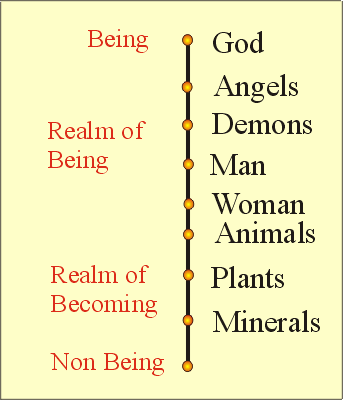
The Hierarchical Scale the Great Chain of Being according to Aristotle extended further by various Religions
Part from
Ancient and Modern Science: Some Observations
by Ian Johnston
Medieval Science: The Great Chain of Being
The development of science after the Greeks and the Romans (who did not significantly advance Greek speculations about nature) is a long and complex story, which we can only quickly and inadequately summarize here. Generally speaking, early Christianity in the first ten centuries had little interest in anything we might call science. The Greek inheritance had largely been lost (in Western Europe), the organized centres of education had been closed, and the emphasis in early Christianity on the supreme and exclusive authority of the word of God as revealed in the sacred writings (eventually codified in the Bible) offered no encouragement to rational speculations about the nature of the world. Everything one needed to know (or was able to know) was in the sacred text. Besides, this world was for many a distraction from the really important concern of life: preparing for the next world beyond death.
Another important factor in this early neglect of science was the Christian attitude to nature itself. Unlike the Greeks, the Christians firmly rejected any notion that nature was divine and that, therefore, speculations about nature were, in themselves, a way of apprehending the nature of God. According to scripture, God stood over and apart from nature. Nature was His creation, and it was entirely appropriate that one should acknowledge His divinity in the beauty and variety of the natural world. But God did not exist in nature, and any attempt to worship nature was the most serious heresy (this firm rejection of nature worship, which the Christians appropriated from the Jewish tradition, sets Christianity in opposition to all sorts of non-Christian beliefs). This is a key distinction between Christian thought and pagan Greek thought. The fact that so much pagan religion was very closely associated with nature made many early Christians all the more suspicious of those who might be overzealous in their celebration of the natural world. It is a common observation to note that in pagan religion there were no holy people, only holy places (e.g., sacred groves, grottos, and mountains where many of the most important religious rituals took place). In early Christianity the emphasis is reversed: there were no naturally holy places, only holy people. If a particular location had a special religious significance, that came about because someone very holy had done something there or had left a part of his body there. There was no particular holiness in nature itself.
However, once the Greek influence began gradually to reassert itself, Christian thinkers started to make a synthesis of the Greek rational understanding of nature (especially as manifested in the works of Aristotle) with Christian doctrine. Again, this is a long, rich, and complex development, which there is not time to review here. What is important for our purposes is the major image of the world which this tradition produced and which became the most fundamental organizing principle for all rational inquiry into the natural world: the Great Chain of Being, the single most long-lasting and historically important scientific principle in the history of Western thought.
The Great Chain of Being derived from two Greek ideas. The first originated (so far as we know) in Plato and is called The Principle of Plenitude. It states that, since God is perfectly good, therefore He must have created all possible forms of life. Any deficiency in the created variety of the world would be a mark of incompleteness, something incompatible with God. The second idea derives from Aristotle and is called The Ladder of Life. It states that all forms of natural phenomena exist on a hierarchical scale, rising very gradually by degrees from the lowest forms of inanimate matter (like rocks), to simple forms of life, to more complex forms, to human beings, and (as later developed by Christian thinkers) to the planets and fixed stars through all the various orders of angels right up to God Himself. Thus, every natural and spiritual phenomenon has its own particular ranked place in the comprehensive scheme of God's creation.
This model lent itself very readily to an understanding of astronomy. At the centre of this scheme stood the Earth, with the lowest point of the universe at the centre (in many depictions the centre of the Earth was the location of Hell, the place furthest removed from God). On the Earth the various forms of life existed in a hierarchical order, and, as one moved away from the earth, the orbits of the planets (which moved in perfect concentric circles around the Earth) marked the different levels of spiritual being, until, at the very highest point one reached the Heavens, the dwelling place of God.
The Great Chain of Being was an organizing metaphor, a classification system, into which one could fit each individual element of God's creation. The hierarchy was essentially a moral scheme, too. The higher the position of a particular entity, the closer it was to God, and thus the more spiritual value it possessed. Everything existed between higher and lower forms and participated in (this idea, as we shall see, is vital) a single unified creation, with a clear sense of its place. For human beings the central moral purpose of life was to acknowledge one's position on the scale (which included various levels for the different ranks of human beings) and to live up to one's responsibilities to those forms of life below and to one's obligations to those above one on the scale. The greatest error of all was to aspire to a position higher than the one appointed; hence, pride and disobedience to one's natural superiors in an attempt at personal self-aggrandizement were the greatest sins of all (that's why the last circle of Hell in Dante's great poem, the eternal home of the worst sinners, is reserved for those who betrayed their masters, those to whom they had a special obligation).
It is important to stress that the Great Chain of Being was a complete and closed and static system. It was not subject to change. All forms of life were eternally a part of the scheme. This idea meshed well with the doctrine in Genesis that God had created everything in the six days of creation and thus that there was no sudden development of new life or disappearance of old life. The natural world, like the entire cosmos, was a beautifully ordered static arrangement ordained by God. Its presence was a wonderful manifestation of His power and goodness.
For the person with an interest in the natural world, the Great Chain of Being provided a means of fitting in all observed phenomena into a preordained scheme in which the central point was the clear linkage between everything and God Himself. The metaphor was designed above all to keep at the centre of the thinker's consciousness the overall moral purposiveness of God's creation, that is, to reinforce a sense of the Final Cause in every natural event. The image did not encourage one to believe that there was any possibility of applying one's thinking to changing the ordained order; in fact, such an idea was considered a manifestation of pride, the deadliest of sins.
Since human beings were a part of this wonderfully divine order, their role as observers and thinkers about nature was to celebrate it as a manifestation of God's power and goodness, of the moral purposiveness with which all natural activities were filled and in which human beings, as part of the natural order, participated. To tamper with this given order, as mentioned above, was to go against the given purposes of God. Hence, the development of new inventions to alter the human being's relationship with the world around him were, in some way, wrong. Even something quite common to us, like wearing glasses to compensate for failing vision or draining swampland to make more arable fields, could produce fierce opposition.
The Great Chain of Being was much more than a scientific metaphor in any narrow sense. It was for centuries the fundamental organizing principle of understanding politics and of communicating an artistic understanding of nature (for example, Dante's cosmology in his epic poetry or Hildegard's imagery in her paintings). The metaphor of a great hierarchy of life organized in a series of concentric circles from the lowest forms up to God Himself provided at the same time a classification system, a moral understanding of one's duties and responsibilities, and a pleasing sense of the beauty and coordination of God's entire creation.
Presentation Speech by F. Henschen, member of the Staff of Professors of the Royal Caroline Institute, on December 10, 1933 The Nobel Prize in Physiology or Medicine 1933 for Thomas H Morgan
As long as human beings have existed they will have observed children's resemblance to their parents, the resemblance or non-resemblance of brothers and sisters, and the appearance of characteristic qualities in certain families and races. They will also early have asked for an explanation of these circumstances, which has produced a kind of primitive theory of heredity chiefly on a speculative basis. This has been characteristic of the theories of heredity right up to our time, and as long as there existed no scientific analysis of the hereditary conditions, the mechanism of fertilization remained impenetrable mysticism.
Old Greek medicine and science took much interest in these questions. In Hippocrates, the father of the healing art, you can find a theory of heredity that probably can be traced back to primitive ideas. According to Hippocrates, inherited qualities, in some way or other, must have been transmitted to the new individual from different parts of the organisms of the father and the mother. Similar ideas of the transmission of qualities from parents to children are to be found in other Greek scientists, and, modified, also in Aristotle, the greatest biologist of the olden times.
Later on, this so-called transmission theory has been dominating. The only theory of heredity that has perhaps rivalled it, is the so-called preformation theory, an old scholastic idea that can be followed back to Augustine, the father of the Church. This theory maintained that, by the creation of the first woman, all following generations were also preformed in this first mother of ours. In modified form the preformation theory dominated the biology of the eighteenth century. Nevertheless, the transmission theory survived. Its last great representative was Darwin. He also seems to have understood heredity as a transmission of the personal qualities of the parents to the offspring through a kind of extract from the different organs of the body.
( - English article from Pravda
, Princeton University Press (October 1, 2001) ISBN: 0691089779