Mycenaean civilization

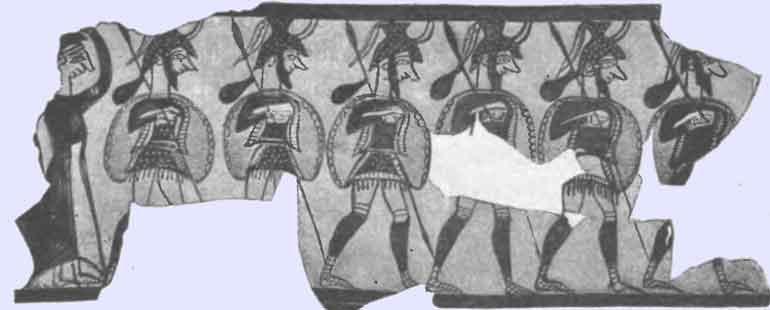
Mycenean Soldiers with a bottle wine on their spears as the poet Archilochus explains in his poem

The Mycenaean period fell between the arrival of the Greeks in the Aegean around 1600 BC and the collapse of their Bronze Age civilization around 1100 BC. The collapse is commonly attributed to the Dorian invasion, though some archaeologists and historians doubt that any such invasion took place.

Mycenaean Helmet (Ivory Head sculpture)

Mycenaean civilization was dominated by a warrior aristocracy. Around 1400 BC the Mycenaeans extended their control to Crete, center of the Minoan civilization, and adopted a form the Minoan script called Linear A to write their early form of Greek. The Mycenaean era script is called Linear B.

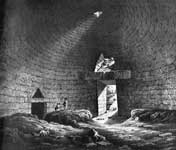
The Mycenaeans buried their nobles in beehive tombs (tholoi), large circular burial chambers with a high vaulted roof and straight entry passage lined with stone. They often buried daggers or some other form of military equipment with the deceased. The nobility were frequently buried with gold masks, tiaras, armour, and jeweled weapons. Mycenaeans were buried in a sitting position, and some of the nobility underwent mummification.

Around 1100 BC the Mycenaean civilisation collapsed. Numerous cities were sacked and the region entered what historians see as a dark age. During this period Greece experienced decreasing population and they lost their literacy. Historians have traditionally blamed this decline on an invasion by another wave of Greek people, the Dorians, although the historical validity of this theory is now doubted.

Citadel of Tiryns

Archaeology

The pottery is characterised by dark paintings on a light background. The beginnings of the Mycenean decorated pottery on the Greek mainland date to the beginning of the Late Bronze Age (Late Helladic I). The typology of the Mycenean pottery was created by the Swedish archaeologist Arne Furumark based on the material from the excavations of Asine. He provided a list of pottery-shapes as well (Furumark 1-333) that is used internationally in the description of Mycenean and Minoan pottery.

Table 1 provides the approximate dates of the Late Helladic phases (LH) on the Greek Mainland.

Approx. date Period

1000 protogeometric
1000-–1060 submycenean
1090–-1060 LHIIIC late
1130–-1090 LHIIIC middle
1190–-1130 LHIIIC early
1320–-1190 LHIIIB2
1300–-1320 LHIIIB1
1350-–1300 LHIIIA2
1400–-1350 LHIIIA1
1450–-1400 LHIIB
1500–-1450 LHIIA
1550–-1500 LHI

LHI

The LHI pottery is known from the fill of the shaft graves of Lerna and the settlements of Voroulia and Nichoria (Messenia), Ayios Stephanos, (Laconia) and Korakou. Furumark divided the LH in phases A and B, but Furumark's LHIB has been reassigned to LHIIA by Dickinson.

LHII

The description of the LHIIA is mainly based on the material from Kourakou East Alley. Domestic and Palatial shapes are distinguished. LHIIB sees a lessening of Cretan influences. Pure LHIIB assemblages are rare and originate from Tiryns, Asine and Korakou.

LHIII

The uniform and widely spread LHIIIIA1 pottery was originally defined by the material from the Ramp house at Mycenae, the palace at Thebes (now dated to LHIIIA2 or LHIIIB by most researchers) and Triada at Rhodes. There is material from Asine, Athens (wells), Sparta (Menelaion), Nichoria and the 'Atreus Bothros', rubbish sealed under the Dromos of the Treasury of Atreus at Mycenae as well.

The LHIIIA2 pottery marks a Mycenaen expansion covering most of the Eastern Mediterranean. There are many new shapes. The motifs of the painted pottery continue from LHIIIA1 but show a great deal of standartisation.

The definition of the LHIIIB by Furumark was mainly based on grave finds and the settlement material from Zygouries. It has been divided into two subphases by E. French, based on the finds from Mycenae and the West wall at Tiryns.

LHIIIB2 assemblages are sparse, as painted pottery is rare in tombs and many settlements of this period ended by destruction, leaving few complete pots behind.

The dating of the LH IIIC hinges on the destruction of Ugarit. The beginning of LH IIIC is now commonly set into the reign of Queen Twosret. The LHIIIC has been divided into LHIIIC1 and 2 by Furumark, based on materials from tombs in Mycenae, Asine, Kephallonia and Rhodes. In the 1960ies, the excavations of the Citadel at Mycenae and of Lefkandi in Euboia yielded stratified material that allowed the subdivision of the LHIIIC into three phases. There is a lot of regional variation in the LCIII, especially in the later phases. Late LH CIII pottery is found in Troy VIIa and a few pieces in Tarsus.

A Mycenaean funeral mask known as the "Mask of Agamemnon"

Submycenean

The submycenean pottery (called LHIIIC2 by Furumark) already belongs to the early Iron age. It is best known from the cemeteries of Kerameikos in Athens, Salamis in Attica and Skoubris in Lefkandi (Euboia) and the settlements of Athens (Agora), Tiryns and Mycenae. The term was introduced in 1934 by T. C. Skeat.

The Lion Gate at Mycenae

Mycenaen Gold

See also

Mycenae, Mycenaean language, Linear B
Achaeans
Helladic, Bronze Age
Aegean civilization

Mycenaean Vaphio Cup, c. 1500 BC

Further reading

  • Chadwick, John (1976). The Mycenaean World. Cambridge UP. ISBN 0521290376.
  • Mountjoy, P.A. (1986). Mycenaean Decorated Pottery: A Guide to Identification. Studies in Mediterranean Archaeology 73. Göteborg: Paul Åströms Forlag. ISBN 9186098322.
  • Mylonas, George E. (1966). Mycenae and the Mycenaean Age. Princeton UP. ISBN 0691035237.
  • Podzuweit, Christian (1982). "Die mykenische Welt und Troja". In: B. Hänsel (ed.), Südosteuropa zwischen 1600 und 1000 v. Chr., 65-88.
  • Taylour, Lord William (1964). The Mycenaeans. Revised edition (1990). London: Thames & Hudson. ISBN 0500275866.
  • Nicolas Grguric, Angus McBride (Illustrator), The Mycenaeans C.1650-1100 BC (Elite S.) , Osprey Books (NY) (September 30, 2005) . ISBN: 1841768979

Links
Retrieved from "http://en.wikipedia.org/"
All text is available under the terms of the GNU Free Documentation License

Ancient Greece

Medieval Greece / Byzantine Empire

Modern Greece

Science, Technology , Medicine , Warfare
, Biographies , Life , Cities/Places/Maps , Arts , Literature , Philosophy ,Olympics, Mythology , History , Images

Science, Technology, Arts
, Warfare , Literature, Biographies
Icons, History

Cities, Islands, Regions, Fauna/Flora ,
Biographies , History , Warfare
Science/Technology, Literature, Music , Arts , Film/Actors , Sport , Fashion

Cyprus - World

Greek-Library - Scientific Library