Did Jesus speak Greek? Some arguments

It was subtle of God to learn Greek when he wished to become an author -- and not to learn it better. F. Nietzsche, Beyond Good and Evil, 1886


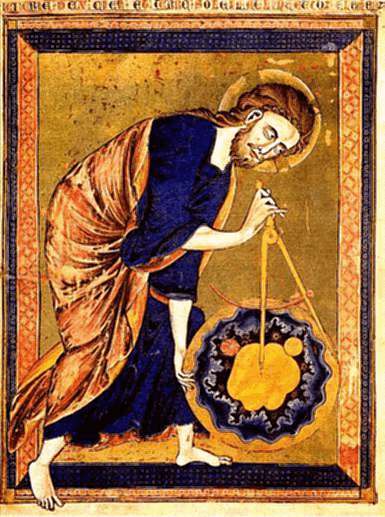
Jesus as a Geometer.. The shape of the object he keeps looks like the Mandelbrot set.. and one could say we have Jesus as a Fractal Geometer. The object is a deformed view of the Earth and the Ikone is influenced by ancient Greek Geometry and Greek Orthodox Religion. Information for this Image I have: Clark, Kenneth, The Romantic Rebellion. NY. Harper, 1972. p. 52 (http://www.dartmouth.edu/~matc/math5.geometry/unit10/unit10.html )

Following part from John W. Burgeson

1. At the turn of the millennium, Greek was a widespread language, as was Latin. We know Jesus was an educated person; it is therefore expected that he would speak these languages, in addition to Aramaic and Hebrew.

2. We know that Jesus traveled to Egypt as a child and was back in Palestine by the time he was twelve. It is possible that he was partially educated in Egypt, where the languages of Palestine were not common.

3. The oldest N.T. we have is written in Greek. And the Greek Septuagint translation of the O.T. was well established by the time of Jesus.

4. Many of the sayings of Jesus refer to the Greek word "aletheia," meaning "the true, the beautiful & the good." It may also mean "ultimate reality," in the sense that Plato seems to have used it. To make "aletheia" a translation of some earlier Aramaic or Hebrew term does not always make sense in context.

5. John 14:15 (and others) refer to a "paraclete," which is a Greek term for an advocate, a legal counselor in court. This concept did not exist in a Hebrew court, where "Judges ask, people respond." Many translations translate "paraclete" as "holy spirit."

6. In many places in John's gospel Jesus makes use of the distinction between the two Greek words for knowing something, "gnosis," or knowledge through logic and reason, and "whid," or intuitive perception. For example, John 14:15-23 quotes Jesus as saying, in part, (Greek words in parenthesis) "Yet a little (micron) and the created order no longer will perceive (whid) me, but you will perceive (whid) me. Because I am alive you shall be alive. On that day you will comprehend (gnosis) that I am in my father ... ."

7. The word "agape," meaning a "god-like love" is derived from Plato; it is actually a pre-illiad term. Nothing like it exists in Aramaic or Hebrew. Or English, for that matter.

8. In John 18:6, Jesus says to the Jews, "Ego Ami." He repeats that in vs 7. "I AM WHO I AM." a powerful way of claiming God-ship.

9. A reference to Socrates' hemlock cup in John 18:11. One has to admit that Jesus seems to have known the Socrates story well, and assumed his listeners also knew and understood it! Mention Socrates' cup to a random group of today's "educated" Americans; how many will give you a blank stare? But these people, all of them, knew the story well enough that Jesus did not need to explain his literary allusion. Hard to believe he spoke about it in anything else than Greek!

10. See John 19:12. The Jews cried out "If you set this one free..." The word "one" is neuter, not masculine, as a way (in Greek) to show contempt. (This argument suggests the Jews, at least the officials, also spoke Greek in public discourse. This is probable.)

11. See John 20:24. The Mar-Thoma church had this story, but not the rest of the N.T., when they were first encountered in the 18th century by English missionaries. This argument goes along with the idea that Jesus was well-traveled, going to India for 6 to 8 years in his 20s, as some writings found in India seem to assert. If so, he'd have to know world languages, Greek being the most widely used; Latin the most often used (most people).

12. See John 24:29. The word "blessed" used by Jesus here can be translated how fortunate" and is quite similar to an Epicurean concept. That concept makes good sense here.

13. Likely that the "fish story" in John 21 carries a buried pun and led to the fish as a Xtian symbol.

14. The Peter-Jesus discourse in John 21:15-19. Jesus: "Do you agape me?"

Peter: "You can perceive (whid) I philia (am bonded) to you."

Jesus: "Do you agape me?"

Peter: "You can perceive (whid) I philia (am bonded) to you."

Jesus: "Are you philia (bonded) to me?

Peter: "You can perceive (whid) everything, so you know (gnosis) that

I philia (am bonded) to you."

This discourse makes good sense in Greek; in translation, something gets lost.

15. The "whid-gnosis" interplay happens all through John's gospel, but always seems to lose something in translation to English. Or other languages. Including Aramaic.

16. In Phillipians, Jesus is called the "morpheus" of God, not the "eidos."

17. In Phillipians 4:2 Paul talks of his "lawyerly counsel to Euodia," a concept foreign to the Hebrews, who did not have "lawyers," much less "para-legal assistants."

18. In Phillipians 4:9 the word "beheld" is a Greek word meaning "to see physically and perceive intellectually."

19. In John 1:32, the text reads "And Johanes has given an attestation..." (or deposition). This is a legal term, known well to Greek courts; unknown to the Hebrews.

20. Jesus' words in John 3:16-19 depend greatly on the word "Kosmos" for "created order." This is an ancient Greek term with rich meanings. But there is no concept comparable to the Greek notion of Kosmos in early Hebrew, in late Hebrew, or in Aramaic. Nor are any of the O.T. references to "earth" translated as "Kosmos" in the Greek Septuagint.

21. The Greek term for "living water" is "running water."

22. The word "sin" is usually the Greek term "hamartia," which means "missing the mark." A "hamartia" in archery is not just missing the bull's-eye, but missing the target altogether. Jesus seems to use it often in the sense of "pointlessness." Going in the wrong direction. Hence the word "repent, which means "to turn around."

23. John 6:28 "They therefore said to him, "What sort of doings (reckoning) (life-strategy) must we use...?"

24. The Greek word "daemon" and the Latin word "Genius" are synonyms. Socrates spoke of "his personal daemon" meaning a spirit that gave him his genius (he was not a modest man). Jesus said in one of his arguments with the Jewish officials hat they were accusing him of having a "bad daemon." Hard to have that conversation in anything else than Greek. See also John 10:19-21. The Greek term there means "inferior deity" in the sense that Socrates used it.

25. John 8:11. Jesus uses a Greek law-court word here. He does NOT say "condemned," for that's another Greek word. He uses the legal term for "pass sentence on."

26. John 8:23. The phrase here is an idiom, going back to the Illiad.

27. "Aletheia," in addition to meaning "the good, the true and the beautiful," also means "true reality."

28. In John 8:49-50, Jesus says "I do not seek to frame my own philosophic opinion (doksa)..."

29. Christianity is not a "head game."

30. "Blasphemy" means "to speak mindlessly, lazily."

31. There is a play on words in John 10:38. "...trust the deeds themselves, in order that you may reach first-order comprehension..." In other words, "kindergarten level religious trust."

32. Paul was influenced by Stoic teachers and used the Greek language in stoic patterns. But also the teachings of Jesus as reported by John are framed in Stoic language.

33. General agreement that John's first letter was strongly influenced by Plato.

34. There is no word for the Greek term "blasphemy" in either Hebrew or Aramaic. In order to bring a charge of blasphemy against Jesus, the Jews at the Jerusalem power center would have HAD to speak Greek!

35. Stoic vocabulary spoken by Jesus (it had to be spoken in Greek) may be found (among other places) in John 11:8-10.

36. One place in John which seems to echo Aramaic thought is in the story of Lazurus, John 11:17-46.39. The future is not what it used to be! (joke, son!)

37. Abigail Van Buren's motto:

Different is OK. Tolerance is essential. The closest you will ever get to godliness is standing up for those who are not like you.

Jesus seems to have preached this -- "Two commandments, love God & love neighbor." But these ideas are not O.T. "mainstream," but are found (at least in seed form) in Greek thinking of the era.

38. Joseph's profession was "architect-builder," not "carpenter." As such, high middle class, implying high educational levels in both the Jewish and secular worlds.

All of the above is brief & unedited; musings on the subject one Friday afternoon. Much of the above comes from the teachings of Dr. Ken Hamstra, an Austin professor of philosophy, teaching at our church. Ken has good knowledge If the Greek of the N.T. and Plato's time, as well as Hebrew and some Aramiac. Also English, German, and probably a few other languages as well.

It is an irony that Greek scholars migrating after the fall of Constantinople in 1453 to Italy had a very important influence for the European history. The work of ancient Greeks which was brought to various Libraries were studied by European philologists and Scientists. Desiderius Erasmus (1466-1536), the greatest humanist of the Renaissance translated the New Testament into Latin and his edition of the original Greek version influenced the Protestant Reformation.

Did Jesus Speak Greek?

Review of Dennis R. MacDonald, Does the New Testament Imitate Homer? Four Cases from the Acts of the Apostles.

Why was the New Testament written in Greek instead of Hebrew?

ST. JUSTIN MARTYR THE DISCOURSE TO THE GREEKS

THE SIGN OF THE CROSS IN THE GREEK CHURCH

 
Web www.mlahanas.de
www.hellenica.de

Ancient Greece

Medieval Greece / Byzantine Empire

Modern Greece

Science, Technology , Medicine , Warfare
, Biographies , Life , Cities/Places/Maps , Arts , Literature , Philosophy ,Olympics, Mythology , History , Images

Science, Technology, Arts
, Warfare , Literature, Biographies
Icons, History

Cities, Islands, Regions, Fauna/Flora ,
Biographies , History , Warfare
Science/Technology, Literature, Music , Arts , Film/Actors , Sport , Fashion