|
|
“If we don’t preserve a world in which we can read Homer, then the world is not worth preserving” from a Lecture Homer the hypothetical author of Odyssey and Iliad, the number of works about him most of speculative character is inverse proportional to what we really know about him, not even the ancient Greeks knew much more. Maybe he was a revolutionary Aoidos who modified writings of the priests. For this reason maybe not respected much by Plato.
Greek Stamp of Homer 1998, (Stamp of 1954, 1983) (Compilation from various sources) Homer was blind and this may represent a sign that blind often exhibit; remarkable memory and sensitivity, necessary for a poet such as Homer. The name Homer (Όμηρος, Homeros) in Greek is a common noun meaning "hostage", and the possibility of hostages being blinded as a precaution against escape, as well as spying, seems plausible. But was he a real person?
Seen this way, Homer's distinction is that his performance was recorded. There may have been hundreds of poets in Homer's day, who performed hundreds of versions of the epics, but only one of these was committed to writing and survived to this day. Albert Lord's student Gregory Nagy has taken the oralist hypothesis even further, and argued that a canonical text of the Homeric poems as "scripture" did not exist until the Hellenistic period. The fixed nature of the Homeric poems emerged gradually, he argues, as competition in their recitation became more and more rigorous at Panhellenic festivals like the Panathenaea. A great many scholars, however, maintain their belief in the reality of an actual "Homer". So little is known or even guessed of his actual life, that scholars joke the poems "were not written by Homer, but by another man of the same name," and the classicist Richmond Lattimore, author of a good poetic translation to English of both epics, once called a paper Homer: Who Was She? Similarly, Robert Graves speculated on a female Homer. Samuel Butler was more specific, theorizing a young Sicilian woman as author of the Odyssey (but not the Iliad). Another question is: do the tales have a factual basis? The commentaries on the Iliad and the Odyssey written in the Hellenistic period (3rd to 1st century BC) began exploring the textual inconsistencies of the poems. The excavations of Heinrich Schliemann in the late 19th century began to convince scholars there was an historical basis for the Trojan War. Research (pioneered by the aforementioned Parry and Lord) into oral epics in Serbo-Croatian and Turkish languages began to convince scholars that long poems could be preserved with consistency by oral cultures until someone bothered to write them down.
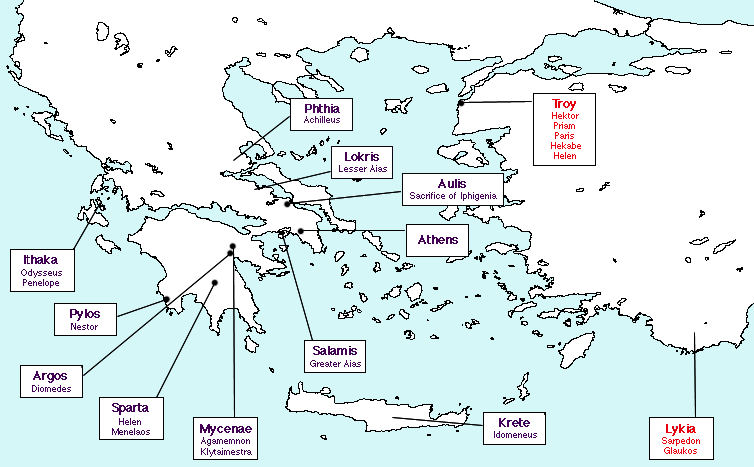
Iliad and Troy relevant Map by Daphne Kleps. Troy or Ilios (derived probably from Wilusa) is considered to be a city known today as Troy VIIa destroyed by the Greeks in 1180 BC. The naval Greek force of 1186 ships started the expedition from Aulis. Map: Travels of the eponymous hero of Homer's Odyssey The decipherment of Linear B in the 1950s by Michael Ventris and others convinced scholars of a linguistic continuity between 13th century BC Mycenaean writings and the epic poems attributed to Homer. While there is a historical basis for the Trojan war we do not know if Homer really existed or who produced (if not Homer) the stories attributed to him. We know that the ancient Greeks admired Homer and they certainly believed his existence and that he was the author.
1827, Jean Auguste Dominique Ingres, Apotheosis of Homer. In the center Homer surrounded by Alcibiades, Apelles, Alexander the Great, Aristotle, Aristarchus, Euripides, Sappho, Menander, Sophocles, Aesop, Shakespeare, Plato, Herodotus, Pindar, Orpheus, Pheidias, Michelangelo, Dante, Hesiod, Raphael, Mozart, .... and others. The two women sitting below Homer are on the left side the Iliad and on the right side Odyssey. See Who is Who for more Information
Homer on a throne close Iliad and Odyssey, right side a figure called Mythos, from a work of Archelaos LINKS Information from Stanford of the Trojan war and especially the stories of women involved WHAT SOME WRITERS SAID ABOUT THE ODYSSEY , ODYSSEUS IN IRELAND? from ODYSSEUS IN THE HEBRIDES,OR WHERE DID ODYSSUES GO? , Aristotle Contemplating the Bust of Homer Paliki, Homer's Ithaca ( a recent theory about the Ithaca of Homer)
A Homeric Reciter
Homer, Odyssey III, c. AD 1, Brit. Mus. Pap. 271
Homer Iliad (Townley Homer) AD 1059, Brit. Mus. Burney MS 86
Homer, Batrachomyomachia Laonico Cretese 1486
Individual Books: Book 1: The Quarrel by the Ships , Stanley Lombardo reads Homer's The Iliad, Book I in ancient Greek (Real Audio)
Plot Outline for Homer's Iliad and List of Principal Characters Plot Outline for Homer's Odyssey
The Presence of Night in Homer’s Iliad The Conflicting Views of Helen
Map of Places of Achean and Trojan Heroes , Troy and Mythology
Deaths in the Iliad Information why who died in the Illiad
Homeric Singing - An Approach to the Original Performance UC grad student shows Homer's report accurate Archelaos and his work: The Apotheosis of Homer Homer's Odyssey a translation into Modern Greek
Images From Homer a modern Interpretation by Bernard McWilliams J. H. Ramberg Images from Homer's Iliad 1871 (some less serious) . In German Homer tops poetry bestseller list Notes on Homer's Iliad and Odyssey: What does Aristotle say? Homer in Donald Duck Comics from a German Journal of Classical Archaeology U. Quatember, Homer und Entenhausen. Zur Antikenrezeption in den Donald-Duck-Comics von Carl Barks, Forum Archaeologiae 17/XII/2000 (http://farch.net). Odyssey I: 1-10 read in Greek (RealAudio)
Who Killed Homer? actually many Greeks believe it was Wolfgang Petersen the director of the film Troy who killed Homer!
Homer in Chinese Phonetic Translation, A Chinese Odyssey
QUOTES Among others who were brought to Alexandria by the fame of Philadelphus' bounty was Zoilus, the grammarian, whose ill-natured criticism on Homer's poems had earned for him the name of Homeromastix, or the scourge of Homer. He read his criticisms to Philadelphus, who was so much displeased with his carping and unfair manner of finding fault, that he even refused to relieve him when in distress. The king told him, that while hundreds had earned a livelihood by pointing out the beauties of the Iliad and Odyssey in their public readings, surely one person who was so much wiser might be able to live by pointing out the faults S. Rappoport, History of Egypt
Το γαρ οράν το φως ηλίου ζην εστί (living is to see the light of the sun) Homer, Iliad, a proof that Homer was not born blind, like his descriptions of colors, etc.
Homer describes in the Odyssey also a blind singer and lyre player, an aoidos (actually a poet):
The inhabitants of Ios point to Homer's tomb in the island, and in another part to that of Clymene, who was, they say, the mother of Homer.
When the Electra is crossed, there is a spring called Achaia, and the ruins of a city Dorium. Homer states that the misfortune of Thamyris took place here in Dorium, because he said that he would overcome the Muses themselves in song. But Prodicus of Phocaea, if the epic called the Minyad is indeed his, says that Thamyris paid the penalty in Hades for his boast against the Muses. My view is that Thamyris lost his eyesight through disease, as happened later to Homer. Homer, however, continued making poetry all his life without giving way to his misfortune, while Thamyris forsook his art through stress of the trouble that afflicted him. Pausanias Description of Greece
710 BC. Lycurgus, brings the poems of Homer out of Asia into Greece. Sir Isaac Newton, A short chronicle: From the First Memory of things in Europe to the Conquest of Persia by Alexander the Great ...the most beautiful, all-embracing theme is that of the Odyssey. It is greater, more human, than that of Hamlet, Don Quixote, Dante, Faust. I was twelve years old when we took up the Odyssey at school; only the Odyssey stuck in my memory. James Joyce IIn the Odyssey, Calypso directs Odysseus, in accordance with Phoenician rules for navigating the Mediterranean, to keep the Great Bear "ever on the left as he traversed the deep" when sailing from the pillars of Hercules (Gibraltar) to Corfu. Yet such a course taken now would land the traveller in Africa. Odysseus is said in his voyage in springtime to have seen the Pleiades and Arcturus setting late, which seemed to early commentators a proof of Homer's inaccuracy. Likewise Homer, both in the Odyssey [1] (v. 272−5) and in the Iliad (xviii. 489), asserts that the Great Bear never set in those latitudes. Now it has been found that the precession of the equinoxes explains all these puzzles; shows that in springtime on the Mediterranean the Bear as just above the horizon, near the sea but not touching it, between 750 B.C. and 1000 B.C.; and fixes the date of the poems, thus confirming other evidence, and establishing Homer's character for accuracy. [1] (In Greek!) Plaeiadas t' esoronte kai opse duonta bootaen 'Arkton th' aen kai amaxan epiklaesin kaleousin, 'Ae t' autou strephetai kai t' Oriona dokeuei, Oin d'ammoros esti loetron Okeanoio. George Forbes, History of Astronomy. Science and Homer
Oscillations of heart rate and respiration synchronize during poetry recitation American Journal of Physiology Heart and Circulatory Physiology, why Homer and Greek poetry is good for heart disease patients. (only for subscribers unfortunately) but a preprint available (PDF) Increase of Complexity from Classical Greek to Latin Poetry (PDF File) A mathematical analysis of Greek (including Homer) and Roman poetry! Can information theory decide whether the Iliad and Odyssey are written by the same author?
Bibliography about Homer, Iliad and Odyssey Reports in Greek Η χρονολογία των πρώτων Ολυμπιακών και ο Ομηρος Τι λέει η Ιστορία για τον Τρωικό Πόλεμο James M. Redfield Nature and Culture in the Iliad: The Tragedy of Hector , Duke University Press; Expanded edition (June, 1994)
FILMS The History Channel Presents: Troy: Unearthing the Legend DVD set
|
|
||||||||||||||||||||