|
|
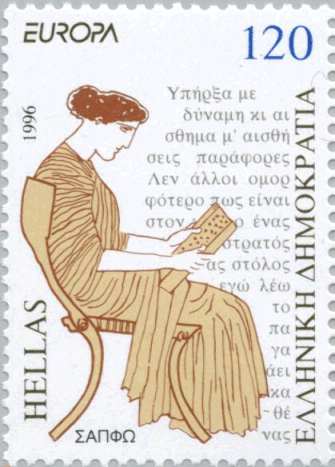
someone will remember us
Reconstructed and extended image from red-figure hydria by the Group of Polygnotos, 440-430 BC. A seated woman, reading. The reader's name is on her right: SAPPWS, with space for one letter before, but no letter is visible. Significant words on the rolled part of the scroll: EPEA PTEROETA and on the open sheet: THEOI HERIWN EPEWN ARKHOMAI. Sappho (c. 630/612 c. 570 BC) was the child of an aristocratic family from the island of Lesbos (in Eressos). We know that she was productive during the 42th Olympiad period. Her father Skamandronymos, a merchant, died when Sappho was a child. She had three brothers: Charaxos, Eurygus and Larichos (Ἐρίγυιον καὶ Λάριχον, πρεσβύτατον δὲ Χάραξον, ὃς πλεύσας εἰς Αἴγυπτον ). Most of her poems (Aeolic dialect), which were always set to music, describe erotic passion and its consequences. She was a lyric poet who developed her own particular meter, known as sapphic meter, and she was credited for leading an aesthetic movement away from classical themes of gods, to the themes of individual human experience. Sappho speaks in the first person and describes her own experiences. She was considered by the Greeks to be on an equal footing with Homer. Plato referred to her as the "tenth Muse". Her poetry was collected three hundred years after her death at the Library of Alexandria in nine books. Some of her poems were known to be hundreds of lines long. Only Fragments of her poems survived. Sappho's books were burned by Christians in the year 380 AD at the instigation of Pope Gregory Nazianzen and again in 1073 AD by Pope Gregory VII who ordered the destruction of the remaining traces of her work. Was this because she was assumed to be a “lesbian” as Cicero for example said because in her poems she expresses her feelings for other women? It is interesting that we know more in the last 1-2 centuries of her poems from discoveries of Papyrus fragments in Egypt. Some scholars consider the case of Sappho like an enigma especially since she was a woman and poetry in her period was not written down. Poems were presented to the public in various occasions many times and thus somehow memorized (surprisingly even works as large as the entire Iliad and Odyssey!, see Faraday 457) and preserved for many centuries until one day some of these poems written on Papyrus or Parchment. In 2004 Michael Gronewald and Robert Daniel announced the discovery of a fourth poem from a Papyrus from the University of Cologne (Köln) in Germany. Except the previous 3 poems around 264 fragments of her poems survived from which 63 are complete lines.
Sappho in Raphael's Parnassus Some consider that Sappho's poems show that the the society of Mytilene was different than in other Greek cities, especially the role of women in the Aristocratic society. The epithalamium ((pl. epithalamia), a Greek word for “upon the bridal chamber,” a kind of poem originally performed at weddings in honor of the bride and groom) is identified as a literary form with Sappho.
Sappho and Alkaios each with a Barbitos (a kind of lyre instrument) , Kalathos, Brygos Painter, c. 470 B.C. (Munich, Germany) Munich, Antikensammlungen Munich 2416
Ἔρος δ΄ ἐτίναξέ μοι φρένας͵ ὠς ἄνεμος κὰτ ὄρος δρύσιν ἐμπέτων Translations by Julia Dubnoff Some say an army of horsemen, It’s very easy to make this clear and sailed to Troy, Aphrodite. For easily bent... I would much prefer to see the lovely
Sappho by Sir Lawrence Alma-Tadema 1881, probably showing her school (thiassos) for girls before they get married where Sappho was a teacher of poetry, music and dance. The poet Alkaios (or Alcaeus) is shown, a lover of Sappho. Some say that Sappho had a daughter Kleis and was married with Cercylas from Andros who died when Sappho was young (around 35 years). Alma-Tadema knew that Sappho is described as a short dark-haired woman “τὴν δὲ μορφὴν εὐκαταφρόνητος δοκεῖ γεγονέναι καὶ δυσειδεστάτην, τὴν μὲν γὰρ ὄψιν φαιώδης ὑπῆρχεν, τὸ δὲ μέγεθος μικρὰ παντελῶς” . More informations hidden in this work: The Temple of Sappho, as re-imagined by Sir Lawrence Alma-Tadema (1836-1912)
Sappho , (Le coucher de Sappho), Charles Gleyre, 1867
Sappho, World Noted Women. New York: D. Appleton and Company, 1883. That man to me seems equal to the gods, and your enticing laughter but my tongue is frozen in silence; A cold sweat covers me, /**
Immortal Aphrodite, on your intricately brocaded throne, But come here, if ever before, yoking your chariot of gold. Rapidly they came. And you, O Blessed Goddess, and what did I especially desire For even if she flees, soon she shall pursue. Come to me now once again and release me
The other 9 muses Calliope (Beautiful Voice) epic poetry. (Mother of Orpheus) (Orpheus Illustrations) Sappho was the title of comedies by Ameipsias, Amphis, Antiphanes, Dïphilus, Ephippus, and Timocles Music Sir Granville Bantock (1868-1946) Sappho and Sapphic Poem Giovanni Pacini (1795-1867), Saffo, Opera Sappho De Mytilene , Angelique Ionatos
One of many images inspired probably by Sappho Quotes The isles of Greece, the isles of Greece! Where burning Sappho loved and sung. Where grew the arts of war and peace,-- Where Delos rose, and Phoebus sprung! Eternal summer gilds them yet, But all, except their sun, is set. Lord Byron The Isles of Greece, (George Gordon Noel Byron) in Don Juan (canto III, st. 86) Every one honours the wise’. Thus the Parians have honoured Archilochus, in spite of his bitter tongue; the Chians Homer, though he was not their countryman; the Mytilenaeans Sappho, though she was a woman; the Lacedaemonians actually made Chilon a member of their senate, though they are the least literary of men; Alcidamas, Aristotle Rhetoric Book 2 Helen of Troy had a wandering glance; LINKS
Sappho and the Songs of Bilitis ( a "lesbian" poetess invented by Pierre Louÿs) Eresos Website (English and Greek) Sappho's Daughter" by Theo Dorgan reviewed by Cyclops The
Laughter of Aphrodite: A Novel About Sappho of Lesbos Catullan Voices in Heroides 15 : How Sappho Became a Man (PDF) Paintings (Victorian Neoclassicism and other) John William Godward (1861-1922) In the Days of Sappho Sappho et Phaon Chantant Leurs Amours Dans Une Grotte, Martin Drolling (1752-1817) Literature Women poets in ancient Greece and Rome, by Ellen Greene (Editor), University of Oklahoma Press ISBN: 0806136642
|
|
||||||||||||||||||||||||||