Part 1: Instruments Music "the art of combining tones in a manner to please the ear" [Webster]. ..and there the Greeks can be our masters and teachers, as they have been our masters and our teachers in so many other things. They can show us the way back to a consciousness of that universality that underlies all human achievements. They can make us once more realize that nothing in this world exists quite in and by and for itself, but that everything pertaining to the human spirit is correlated and interrelated with everything else. And by so doing they can once more give us a feeling for something that is in truth the beginning and end of all wisdom. Griechische Musik - Instrumente
A copy of a work of Myron, Marsyas desirous of picking up the aulos thrown away by Athena. Pythagoras is the Father of Music Theory. The link between numbers and music was observed by Pythagoras by analyzing the vibrations of strings of various lengths. According to legend he discovered the mathematical rationale of musical consonance from the weights of hammers used by smiths. He found that the interval of an octave is rooted in the ratio 2:1, that of the fifth in 3:2, that of the fourth in 4:3, and that of the whole tone in 9:8. The Pythagoreans applied these ratios to lengths of a string on an instrument called a canon, or monochord ( a board with two bridges between which a string is stretched and a third bridge that divides the string in two parts), and thereby were able to determine mathematically the intonation of an entire musical system. For a description of the mathematical theory of music of ancient Greeks see this PDF File See also The Development of Musical Tuning Systems (PDF File , use right mouse pressed and target save as)
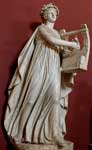
"There is surely no more impressive site in the world than the Temple of Apollo at Delphi on Mount Parnassus; of all the glorious holy places, this site of the Oracle of Delphi established the link between music and mystery.... The word music itself comes for the Greek word musiki, meaning all the arts of the nine Muses. Apollo, son of Zeus, was the leader of the Muses, as master athlete and warrior as well as master musician. Mount Parnassus came to be thought of as the home of music." Yehudi Menuhin, The Music of Man Ancient Greek Musical Instruments Μουσικά όργανα της αρχαίας Ελλάδας Lyre (λύρα)
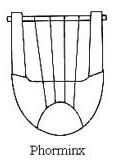
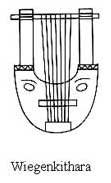
Family of Instruments. The Lyre, with 3 strings, according to mythology was invented by Hermes and was given to Apollo (who some say added another 4 strings). Most common probably was the lyre with 7 strings but there are versions with more strings for example 9 strings (Theophrastus of Piera), 10 strings (Histaeus of Colophon) or 12 strings (Melanippides) The elements of a lyre: The soundbox (echeion), the 2 arms peichis (πήχεις ) or kerata. The crossbar (zygon) joining the 2 arms, the strings (chordai or neurai), gut or linen, attached to the chordotonion or chordotonos, situated in the lower part of the soundbox. The strings passed over a bridge (magas) and stretched to reach the zygon, where they were fixed by mobile leather or cotton rings or pegs called kollaboi and kollopes. Orpheus obtained the Lyre from Apollo when he was a child and lessons how to play it. Historical it is an instrument that was known at least around 3000 BC in Ur. The lyre was known in Crete at least before 1400 as the Agia Triada Sarcophagus fresco shows a musician who plucks at a seven-stringed lyre with a plectrum (and also an Aulos player is shown). According to a story Orpheus Lyre was thrown in a river and after a journey reached Apollo's temple in Lesbos. Apollo asked Zeus the Lyre to become a constellation, the Lyra constellation, with the known star Vega that once was the polar star. (Strange but it is called by the Britons also King Athur's Harp Star). Amphion is said to have built Thebes by the music of his lyre.
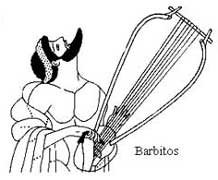
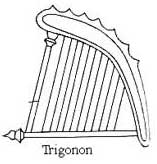
Harp
|
|
|
|
Flute
Bone Flutes from Laconia, Artemis Orthia Sanctuary, c. second half of 7th century BC There is a meaning also in the myth of the ancients, which tells how Athene invented the flute and then threw it away. It was not a bad idea of theirs, that the Goddess disliked the instrument because it made the face ugly; but with still more reason may we say that she rejected it because the acquirement of flute-playing contributes nothing to the mind, since to Athene we ascribe both knowledge and art. Aristotle, Politics
Other Instruments
A sanctuary of Athena Trumpet they say was founded by Hegeleos. This Hegeleos, according to the story, was the son of Tyrsenus, and Tyrsenus was the son of Heracles and the Lydian woman; Tyrsenus invented the trumpet, and Hegeleos, the son of Tyrsenus, taught the Dorians with Temenus how to play the instrument, and for this reason gave Athena the surname Trumpet. Pausanias, Description of Hellas
Sambyke
Seistron, Prepalatial period , Heraklion Archaeological Museum
Of course this list is far from complete. Some instruments not classified yet
Dancer with krotala (crotala), flute case, and walking stick, Attic red figure kylix, ca. 480 B.C
Aeolian Harps, named after the Greek God of Wind, 'Aeolus', first appeared in Grecian culture circa 6 BC, when Orpheus, the 'original' poet, held poetry readings accompanied by the music of Wind Harps. Much later, artisans of the Renaissance era re-discovered Aeolian Harps, fascinated with both their physical and etheric properties. Much experimentation with the Aeolian principle, i.e., the vibration of strings by wind, led to a variety of designs and installations as illustrated by these two towers.(circa 1695 AD) http://www.harmonicwindharps.com/ , The Aeolian Harp . Were such instruments build by the ancient Greeks and if not was the instrument and its name (based on Greek mythology) just invented only in the 17th century? From the Lyre derived Lyric poetry (a term not used before the Hellenistic times) refers to a song accompanied usually by the lyre (and/or the aulos). Forms of Lyric songs sometimes in combination with dance depending on the occasion are: Dithyramb, choral song (hymns in honor of Dionysus) at the Dionysia festival, improvised early with the chorus dressed like animals (goats) from which the tragedy (Greek word for song of goats) developed (Herodotus) Phallic songs (phallika) Prosodion, liturgic, thanksgiving “these were sung at festivals by groups of men and woman carrying flowers, sacred emblems, and sacrifices to the gods. Often, the processions were formal and showy and might have been accompanied by other dancers and chorus singers. The prosodia was a recognized form of religious poetry for which many poets composed and even received rewards at festivals”
Monodic Lyric (performed by a single person) Choral Lyric (performed for the public, (festivals, religious or athletic) by a choir) Comments by Autumn Gurgel Running head: Roots and Theories of the Doctrine of Ethos
The musical education of the Greeks is stressed by all writers. It must be remembered, however, that the word "music" had a much wider application at that time than it now has. The Greek word mousike at first referred to the arts of the nine Muses. Gradually its meaning was extended to include everything connected with the training of the mind, just as the word gymnastike included everything pertaining to the training of the body. To speak of a Greek as having a good "musical education" is equivalent to saying that he was trained in all the liberal arts, including mathematics. The Greek ideal of education was based upon the idea of universality, of the integration of all branches of learning. "Musical training," Plato said, "is a more potent instrument than any other, because rhythm and harmony find their way into the inward places of the soul, on which they mightily fasten." To this he added gymnastics, insisting, however, that even physical exercise should be performed for the benefit of the soul, since the soul demands a temple worthy of its occupancy. The combination of music and gymnastics, he said, produces a harmonious balance between soul and body. Physical training develops courage and fortitude; music develops a love of the beautiful, and affords the mental and moral discipline necessary to the acquirement of philosophical knowledge. He considered music, however, as the more important of the two, describing it as the fortress of the State. He warned all intelligent rulers to pay careful attention to the development of music in their state, never allowing bad qualities to creep into it, as these would affect the mental and moral stamina of the citizens who listened to it. Finally he insisted that all art be subordinated to ethics and used as a means of moral education. Ancient Greek music, Martin Litchfield West Ancient Greek music: a new technical history, Stefan Hagel Apollo's lyre: Greek music and music theory in antiquity and the Middle Ages, Thomas J. Mathiesen Woman's songs in Ancient Greece, Anne Lingard Klinck
![]() |
|
|||||||||||||||