From
“Mythos” to “Logos”
But if there is no solace in the fruits of our research, there is
at least some consolation in the research itself. Men and women are
not content to comfort themselves with tales of gods and giants, or
to confine their thoughts to the daily affairs of life; they also
build telescopes and satellites and accelerators, and sit at their
desks for endless hours working out the meaning of the data they
gather. The effort to understand the universe is one of the very few
things that lifts human life a little above the level of farce, and
gives it some of the grace of tragedy.
Steven
Weinberg The First Three Minutes
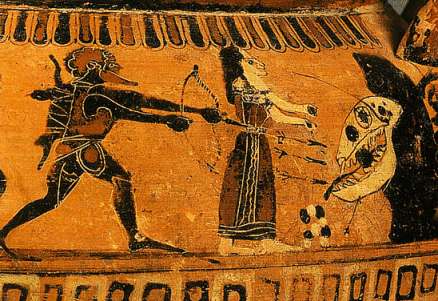
A 550 BC image of Hercules, killing a monster and saving the life of the princess Hesione from Troy. Adrienne Mayor consider the monster to be a fossil found by ancient Greeks and used by the artist. Such fossils were considered by ancient Greeks as evidence of the existence of mythological monsters.
God was invented to explain mystery. God is always invented to
explain those things that you do not understand. Now, when you
finally discover how something works, you get some laws which you're
taking away from God; you don't need him anymore. But you need him
for the other mysteries. So therefore you leave him to create the
universe because we haven't figured that out yet; you need him for
understanding those things which you don't believe the laws will
explain, such as consciousness, or why you only live to a certain
length of time -- life and death -- stuff like that. God is always
associated with those things that you do not understand. Therefore I
don't think that the laws can be considered to be like God because
they have been figured out.
Richard
Philip Feynman, quoted by P. C. W.
Davies and J. Brown in Superstrings: A Theory of Everything, p. 208
ADRIENNE MAYOR a classical folklorist specializing in legends about natural history describes in her book “The First Fossil Hunters: Paleontology in Greek and Roman Times (Princeton University Press)”. Adrienne Mayor argues that the Greeks and Romans used fossil evidence—the enormous bones of long-extinct species—to support existing myths and to create new ones. The idea that mythology explains the natural world is an old idea," said Thomas Strasser, an archaeologist at California State University, Sacramento, who has done extensive work in Crete. Mayor makes a convincing case that the places where a lot of these myths originate occur in places where there are a lot of fossil beds," said Strasser. "She also points out that in some myths monsters emerge from the ground after big storms, which is just one of those things I had never thought about, but it makes sense, that after a storm the soil has eroded and these bones appear."
A
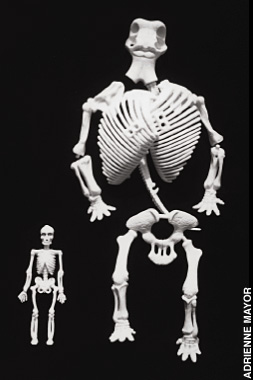
scale model of a mammoth skeleton rearranged to demonstrate how the
ancient Greeks could have interpreted immense and unfamiliar animal
fossils as the remains of giants and heroes (Adrienne Mayor)
The second-century A.D. Greek geographer Pausanias described the excitement that surrounded the supposed discovery of the bones of the great Greek champion Ajax, who fought in the Trojan War. According to the Iliad, Ajax's grave was at Rhoeteum, where the Greek ships had landed to attack Troy. Bones of heroic dimensions were found and people took them to be the remains of Ajax. An eyewitness explained to Pausanias how the sea had washed out the beach, revealing a jumble of big bones. "Ajax's kneecaps were exactly the size of a discus for the boy's pentathlon," wrote Pausanias. A boys discus was about five or six inches across. Kneecaps big enough to be worthy of the hero Ajax would most likely belong to a Miocene era (ca. 8 million years ago) mastodon or rhinoceros; the remains of both animals have been found in the region around Rhoeteum.
Ancient accounts of the bones of heroes like Ajax, as well as giants and monsters from the remote past, can be explained by the presence of the fossil remains of mastodons, mammoths, giant giraffes, rhinoceroses, cave bears and other large animals found in the eastern Mediterranean region. Not suprisingly, modern paleontology demonstrates that prehistoric fossils exist in the very places where myths about giant beings first arose. As the Greek author Philostratus (ca. A.D. 218) remarked, it was logical to accept that "giants once existed, because their awesome remains could be seen all around the world."

Also some living creatures like two-headed snakes, such as the example of Thelma and Louise at the San Diego Zoo, that are not very rare may have contributed to the mythological stories.
From Thales to the Hellenistic period myths are becoming less important but still exist. ';document.write(h); //-->