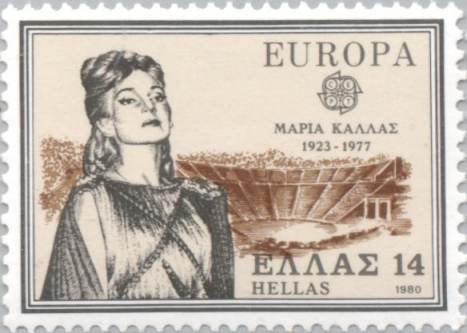
Maria Callas

Maria Callas in Epidauros.

Maria Callas (Greek name: Μαρία Καλογεροπούλου; December 2, 1923 – September 16, 1977) was an American-born Greek soprano and perhaps the best-known opera singer of the post-World War II period. She combined an impeccable bel canto technique with great dramatic gifts, making her the most famous singing actress of the era. An extremely versatile singer, her repertoire ranged from classical opera seria, such as Spontini's La Vestale to late Verdi and the verismo operas of Puccini.

Maria Callas Family

Born Maria Anna Sofia Cecilia Kalogeropoulos to Greek parents in New York City, she moved with her mother to Athens, Greece, at the age of 13. There she received her musical education and became a pupil of the well-known soprano Elvira de Hidalgo at the Athens Conservatory. After a few appearances as a student and in secondary roles, she made her professional debut at the Athens Opera on July 4, 1941, as Tosca, going on to sing Santuzza and Leonora during the next three years. In 1947, Callas made her Italian debut at the Verona Arena in La Gioconda under the baton of Tullio Serafin. Together with Serafin, Callas subsequently recorded and performed many bel canto operas, contributing greatly to the bel canto revival of the 1950s.

Throughout the 1950s, Callas made numerous appearances at the world's great houses: La Scala in Milan, Opera Garnier in Paris, the Metropolitan Opera in New York City, Dallas Opera (Dallas, Texas), Royal Opera House in London, Mexico's Palacio de las Bellas Artes, and the Teatro Colón in Buenos Aires. After shedding an enormous amount of weight, by 1954 Callas startled her public by attaining an utterly glamourous appearance. It is thought by many that the loss of body mass made it more difficult for her to support her voice, and triggered vocal strain which became apparent later in the 1950s. Her later stereo recordings evidence masterly musical interpretations with an increasingly unstable higher register that wobbled uncontrollably at times. Her last new production at La Scala was Donizetti's Poliuto in 1960. The role was well chosen for her vocal capacities. The premiere was on La Scala's traditional opening day, 7th December, Saint Ambroise Day. It was a great success and is still remembered today as a model.

In her final years as a singer, there were performances of Medea, Norma and Tosca , most notably her Paris, New York, and Royal Opera House Covent Garden Toscas of January–February 1964 and, her last performance on stage, on 5th July 1965 at Covent Garden.

A television film of Act 2 of the famous Covent Garden Tosca of 1964 was broadcast in Britain on 9th February of that year. It gives a rare view of Callas in performance and, specifically, the extraordinary on-stage relationship which Callas had with Tito Gobbi; it is a wonderful record of what would be one of her last performances on stage. The film is available on DVD.

In 1969 the Italian filmaker Pasolini cast Callas in her only non-operatic acting role, playing the legendary Greek sorceress Medea in his film of the same name. The production was gruelling and Callas is said to have fainted after a day of strenuous running back and forth on a mudflat in the sun. Unfortunately the film was not a success in any commercial sense, but is nevertheless as cinematically interesting as any Pasolini film. Callas' only film appearance offers clear evidence of her legendary and charismatic stage presence: her ability to hold an audience's attention while standing still, revealing an economy of gesture and movement that makes her stand apart from most other opera performers.

From October 1971 to March 1972, Callas gave a series of master classes at the Juilliard School in New York. (These classes later formed the basis of Terrence McNally's 1995 play Master Class). In 1972, George Moore, president of the Met board, offered her the job of Artistic Director. She turned it down to stage a series of comeback recitals in Europe in 1973 and in the US, South Korea and Japan in 1974 with the tenor Giuseppe Di Stefano, but it was a musical disaster due to both performers' outworn voices. However, it was an enormous popular success as audiences thronged to hear the these performers who often appeared together in their vocal prime. Her final public performance was on 11th November 1974 in Sapporo, Japan.

Callas was romantically involved for many years with the Greek shipping tycoon Aristotle Onassis, and their love affair received much publicity. She was introduced to him in 1957, after a performance in Donizetti's Anna Bolena, at a party given in her honor by Elsa Maxwell. In November 1959, she left her husband, Giovanni Battista Meneghini, for Onassis. According to one of her biographers, Nicholas Gage, Callas and Onassis had a child, a boy, who died hours after he was born on 30th March 1960. The relationship ended nine years later, when Onassis left Callas for Jacqueline Kennedy, widow of assassinated US president John F. Kennedy.

Heartbroken ("First I lost my voice, then I lost my figure and then I lost Onassis," she once said), Callas spent her last years living largely in isolation in Paris, and died in 1977 from a heart attack at the age of 53. The funeral service was held at the Greek Orthodox Church on Rue Georges-Bizet on 20th September 1977, and her ashes were buried in the Père Lachaise cemetery. After being stolen and later recovered, they were scattered into the Aegean Sea, off the coast of Greece.

In late 2004, opera and film director Franco Zeffirelli made a bizarre claim that Callas may have been murdered by her confidante, Greek pianist Vasso Devetzi, motivated by Callas' $9,000,000 USD estate. A more likely explanation is that Callas' death was due to heart failure brought on by overuse of Mandrax (methaqualone), taken for sleep. As described by biographer Stelios Galatopoulos, Devetzi insinuated herself into Callas' trust and acted virtually as her agent. It is a fact corroborated by Lakintha (Jackie) Callas in her book Sisters that Devetzi conned the gullible sister out of control of her half of the estate, while promising to establish the Maria Callas Foundation, to provide scholarships for young singers. After hundreds of thousands of dollars vanished, Devetzi eventually established the foundation. [1]

Greatly admired by many opera fans, disliked by others, Callas was a controversial artist. Her supporters called her "La Divina" and raved about the dramatic intensity and ravishing portayals she instinctively brought to the opera stage. Her vocal instrument was not classically beautiful in the manner of Tebaldi, Scotto, Caballe, or Sutherland, a fact which causes her detractors to miss the totality of her portrayals. However, critics examining historical recordings of famous arias will find in those of Callas excitingly fresh and true interpretations.

Norma

Trivia

Maria Callas is the subject of the epistolatory song "Callas Went Away", which can be found on Enigma's debut album MCMXC a.D. (released in 1990). A vocal sample of Callas' 1963 recording of the aria "Qui m'aurait dit ... Des cris joyeux" from Jules Massenet's opera Werther, can be heard around the 03:04 mark.

In the song "E-Bow the Letter" by REM from their album New Adventures in Hi-Fi, Michael Stipe's lyrics refer to "Dreaming of Maria Callas, whoever she is."

In the song "Horseradish Road" by The Mountain Goats on the album The Coroner's Gambit, John Darnielle's lyrics refer to "the Maria Callas records on the stereo all the time."

In the film Philadelphia Maria Callas' voice is heard when Tom Hanks stops Denzel Washington in the middle of preparing him for his testimony. The aria they listen to is "La Mamma Morta" from Umberto Giordano's Andrea Chénier.

On October 28, 1956, Maria Callas made her debut at the Metropolitan Opera as the title role in Bellini's Norma. Although first resented by the New York Crowd, she won them over, and by the end of the evening, she received 16 curtain calls. This mark is second only to Luciano Pavarotti 17 curtain calls in Donizetti's La fille du régiment at the Metropolitan Opera

Notable recordings

All recordings are in mono unless otherwise indicated. Live performances are typically available on multiple labels: see the complete discography and list of currently available recordings for further information.

  • Verdi, Il trovatore, conducted by Guido Picco, live performance, Mexico City, June 20 1950
  • Verdi, Aida, conducted by Oliviero de Fabritiis, live performance, Mexico City, July 3 1951
  • Verdi, Macbeth, conducted by Victor De Sabata, live performance, La Scala, Milan, December 7 1952
  • Bellini, I puritani, conducted by Tullio Serafin, studio recording for EMI, March-April 1953
  • Mascagni, Cavalleria Rusticana, conducted by Tullio Serafin, studio recording for EMI, August 1953
  • Puccini, Tosca, conducted by Victor De Sabata, studio recording for EMI, August 1953
  • Cherubini, Medea, conducted by Leonard Bernstein, live performance, La Scala, Milan, December 10 1953
  • Donizetti, Lucia di Lammermoor, conducted by Herbert von Karajan, live performance, Berlin, January 18 1954
  • Leoncavallo, Pagliacci, conducted by Tullio Serafin, studio recording for EMI, June 1954
  • Verdi, La traviata, conducted by Carlo Maria Giulini, live performance, La Scala, Milan, May 28 1955
  • Verdi, Rigoletto, conducted by Tullio Serafin, studio recording for EMI, September 1955
  • Bellini, Norma, conducted by Antonio Votto, live performance, La Scala, Milan, December 7 1955
  • Verdi, Il trovatore, conducted by Herbert von Karajan, studio recording for EMI, August 1956
  • Puccini, La Boheme, conducted by Antonio Votto, studio recording for EMI, August-September 1956
  • Rossini, Barber of Seville, conducted by Alceo Galliera, studio recording for EMI in stereo, February 1957
  • Bellini, La sonnambula, conducted by Antonio Votto, studio recording for EMI, March 1957
  • Donizetti, Anna Bolena, conducted by Gianandrea Gavazzeni, live performance, La Scala, Milan, April 14 1957
  • Bellini, La sonnambula, conducted by Antonio Votto, live performance, Cologne, July 4 1957
  • Verdi, Un ballo in maschera, conducted by Gianandrea Gavazzeni, live performance, La Scala, Milan, December 7 1957
  • Verdi, La traviata, conducted by Franco Ghione, live performance, Lisbon, March 27 1958
  • Mad Scenes (excerpts from Anna Bolena, Bellini's Il pirata and Ambroise Thomas's Hamlet), conducted by Nicola Rescigno, studio recording for EMI in stereo, September 1958
  • Ponchielli, La Gioconda, conducted by Antonio Votto, studio recording for EMI in stereo, September 1959

Famous Quotes

  • On Tebaldi: "When she can sing a Walkure and Puritani back to back, then you can compare us. Until then it is like trying to compare Coca Cola to champagne."

  • "First I lost my voice, then I lost my figure and then I lost Onassis."

  • "Don't talk to me about rules, dear. Wherever I stay I make the goddam rules."

  • "I would not kill my enemies, but I will make them get down on their knees. I will, I can, I must."

  • "You are born an artist or you are not. And you stay an artist, dear, even if your voice is less of a fireworks. The artist is always there."

  • "Some say I have a beautiful voice, some say I have not. It is a matter of opinion. All I can say, those who don't like it shouldn't come to hear me."

  • "My poor sight gives me an advantage. I can't see the people in the audience who are scratching their heads while I am lost in my role and giving everything I have to the drama."

  • "If I have stepped on some people at times because I am at the top, it couldn't be helped. What should I do if someone gets hurt ... retire

Further reading

  • Ardoin, John, The Callas Legacy, Duckworth, London, 1977.
  • Edwards, Anne, Maria Callas, An Intimate Biography, St. Martin's Press, New York, 2001.
  • Gage, Nicholas, Greek Fire: The Story Of Maria Callas and Aristotle Onassis (ISBN 0446610763)
  • Galatopoulos, Stelios, Maria Callas, Sacred Monster, Simon and Schuster, New York, 1998.
  • Lowe, David A. (ed.), Callas: As They Saw Her, New York, Ungar Publishing Company, 1986.
  • Stancioff, Nadia, Maria Callas Remembered: An Intimate Portrait of the Private Callas, E. P. Dutton, 1987.
  • Stassinopoulos, Arianna, Maria Callas: The Woman Behind the Legend, Simon and Schuster, New York, 1981.

Maria Callas in Pasolini's "Medea" (1969).

Reference

  • Greek Fire: The Story Of Maria Callas and Aristotle Onassis by Nicholas Gage. (ISBN 0446610763)

Links

Retrieved from "http://en.wikipedia.org/"
All text is available under the terms of the GNU Free Documentation License

Greek Music


A - B - C- D - E - F - G - H - I - J - K - L - M

N - O - P - Q - R - S - T - U - V - W - X - Y - Z

 
Web www.mlahanas.de
www.hellenica.de

Ancient Greece

Medieval Greece / Byzantine Empire

Modern Greece

Science, Technology , Medicine , Warfare
, Biographies , Life , Cities/Places/Maps , Arts , Literature , Philosophy ,Olympics, Mythology , History , Images

Science, Technology, Arts
, Warfare , Literature, Biographies
Icons, History

Cities, Islands, Regions, Fauna/Flora ,
Biographies , History , Warfare
Science/Technology, Literature, Music , Arts , Film/Actors , Sport , Fashion

Cyprus

Scientific Web