Ancient Greece: Paraleipomena, Strange, Funny and Unknown Facts

Michael Lahanas

It is a very sad thing that nowadays there is so little useless information. Oscar Wilde

Medicine

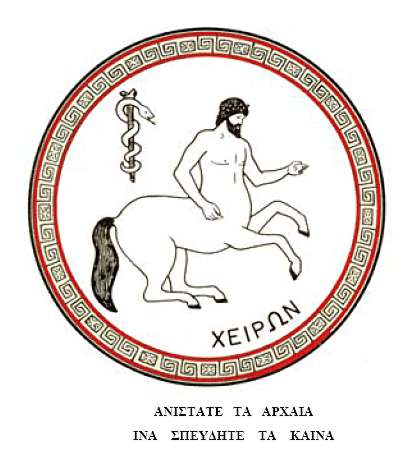
Chiron

(From The Proceedings of the 10th Annual HISTORY OF MEDICINE DAYS The Proceedings of the 10th Annual March 23rd and 24th, 2001, FACULTY OF MEDICINE THE UNIVERSITY OF CALGARY)

When the plague broke out at Ephesos and there was no stopping it, the Ephesians sent a delegation to Apollonios asking him to heal them. Accordingly, he did not hesitate, but said, "Let's go," and there he was, miraculously, in Ephesos. Calling together the people of Ephesos, he said, "Be brave; today I will stop the plague." Then he led them all to the theater where the statue of the God-Who-Averts-Evil had been set up. In the theater there was what seemed to be an old man begging, his eyes closed, apparently blind. He had a bag and a piece of bread. His clothes were ragged and his appearance was squalid. Apollonios gathered the Ephesians around him and said, "Collect as many stones as you can and throw them at this enemy of the Gods."The Ephesians were amazed at what he said and appalled at the idea of killing a stranger so obviously pitiful, for he was beseeching them to have mercy on him. But Apollonios urged them on to attack him and not let him escape. When some of the Ephesians began to pitch stones at him, the beggar who had his eyes closed as if blind suddenly opened them and they were filled with fire. At that point the Ephesians realized he was a demon and proceeded to stone him so that their missiles became a great pile over him. After a little while Apollonios told them to remove the stones and to see the wild animal they had killed. When they uncovered the man they thought they had thrown their stones at, they found he had disappeared, and in his place was a hound who looked like a hunting dog but was as big as the largest lion. He lay there in front of them, crushed by the stones, foaming at the corners of his mouth as mad dogs do..... Philostratos, Life of Apollonios of Tyana, c. 190 CE from Paul Halsall Ancient History Sourcebook: Accounts of Personal Religion, c. 430 BC - 300 AD

Censored Images


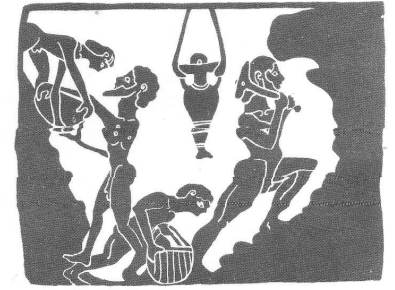
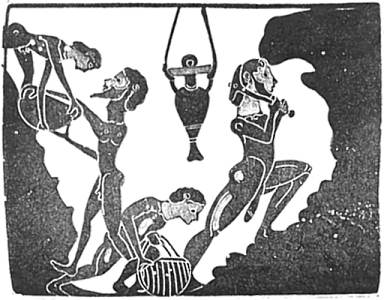
This image is usually described as a scene of slaves in a cooper mine, but in a TIME-LIFE series in the book Matter (Ralph E. Lapp) in 1965 the author says that it shows gods at work from a ceramic work from the 6th century BC! On the right Hermes in the center Amphitrite (looks to me not like a woman) and on the left Poseidon with some other young god. I was impressed because I could not imagine that gods work so hard and especially when the Greeks are criticized as lazy all the work done by slaves. The right image is from another source (some differences, but not all , are due to the scanner). Do you see why the TIME-LIFE image (left) is censored (at least the Greek edition which I have)? Maybe the Penis of “Hermes” was too large! I do not know from where the author had the information about who these “gods” are, which I think is not correct, but I was shocked by this manipulation more than all US-Americans combined together with the exhibit of a breast of J. Jackson in some sport event!

The Greek Text for the left figure which describes which gods are shown.

In man the scrotum is clearly asymmetrical, the right testicle usually being placed higher than its opposite number. Chang et al (1960) found that the right testis was the higher in 62.1% of 486 men, and the left testis higher in 27.4%, the two being equal in height in the remaining 10.5%. Antliff and Shampo (1959) found an essentially similar result in 386 men, the right testis being higher in 65.1% and the left higher in 21.9%. The two sets of authors differ in their findings as to the effect of handedness, Chang et al claiming that the relationship is reversed in left-handers, whilst Antliff and Shampo found no such reversal. There is also evidence that in the bull the right testis tends to be the higher of the two. From 187 sculptures, the majority of which are from ancient Greece, the data being pooled from two separate studies. In the single largest group the right testicle is placed higher (and thus correctly), but simultaneously the left testicle is made larger, the reverse of the correct anatomical situation. Winckelmann was partly correct when he observed of Greek sculpture that, “Even the private parts have their appropriate beauty. The left testicle is always the larger, as it is in nature; so likewise it has been observed that the sight of the left eye is keener than the right”, I C McManus Right-left and the scrotum in Greek sculpture

The first Greek doctor to work in Rome, Archagathus of Sparta (Αρχάγανθος), was known as ‘the butcher’ because of his fondness for surgery and cautery (Pliny NH 29.13). The activities of him and his kind prompted Cato to think that sending healers to Rome was one way in which the Greeks’ sought revenge on their captors (Plutarch Cato 23).

Etymology, Words


Roughly 60% of all English words and 90% of technical and scientific terms are derived from ancient Greek and Latin.


The word right means correct but also a direction. In modern Greek Dexios is a right person and dexia is the direction- In ancient Greek dexios Δεξιός means the well-educated Δεξιός: ὁ εὐπαίδευτος. καὶ Δεξιοί, οἱ εὐπαίδευτοι

The planet Uranus was discovered in 1781, by William Herschel. a musician who had become both the director of the orchestra at the celebrated spa, Bath, and a first class astronomer. His fame was crowned by the discovery of a new planet, named Uranus after Urania, the muse of astronomy and geometry. Info .About the name of the Planet Uranus around 30000 websites say it was given the name of the Greek God Uranus but 300 websites say it was given the name of Urania. This is unusual as almost all other planets have the names of Gods but Urania is a muse. Nevertheless I think this is true as Herschel was a musician and he knew the muses.


That's Greek to me means I do not understand the language. In Spain one would say that some who speaks a language not undersandable is a Greek or a “Griego”. From this later was derived the word “Gringo”. In France one says “etre grec a “ i.e. “I know from” connecting Greek with knowledge or “je ne suis pas grand grec en..” I have no idea about...

The word paradise comes from the Greek paradeisos and this from the persian pairi-daeza which means surrounding walls used commonly in gardens in Persia.

The Arctic and Antarctic were named by Aristotle. The landmass to the north "lay under the constellation of Arktos, the bear; so must the southern lands be under the opposite: Antarktikos," he wrote. Optimists of the 16th Century supposed that the Antarctic would be an idyllic place. At the Ends Of the Earth. Kieran Mulvaney, A History of The Polar Regions

"Plato" is a nickname “platis” meaning capacious, broad, abundance. There are several stories about how he acquired this nickname. One is that Ariston, the Argive wrestler, called him Plato because of his robust build. (Dionysius Laertius, 3.4). Another is that Plato refers to the breadth of his style; another to the shape of his forehead.

According to the historical records, the island Chios has probably taken its name from the nymph Chiona or because it was snowing (snow=chioni) a lot, when Chios, the son of Poseidon, was born. However, there is another version, which says that the name Chios means mastic, in the Syrian language. From http://www.greek-tourism.gr/chios/

The horse is an animal admired by Greeks and Romans. Many names contain the word horse: Speusippus, Phillipos, Hippocrates,Thrasippus, Xanthippe, etc. Philippos or Philipp means friend of horses. One question is if the name of the Philippines has some Greek origin. The horse of Alexander the Great called Bucephalas (bull-head) is well known and Alexander named a city after his horse.

Alexander was said to have paid seventy-eight thousand denarii for his horse Bucephalas, who, when equipped for battle, would allow no other rider. Once, grievously wounded and dying from a loss of blood, the animal safely removed Alexander from the battle and then fell down dead. In his honor, a city was built and named Bucephalon (V.3).” Aulus Gellius, Attic Nights Encyclopedia Romana

Not to forget Caligula and his horse Icinatus that he wanted to give the title of a senator. Some say that Diomedes the Thracian fed his horses with human flesh. From 300 BC Greek physicians specialized in animal medicine exist and for the horses we have the Hippiatros, or horse doctor. Hippocrates a common name can be translated as holder of horses. Xanthippe, the wife of Socrates, means blond horse. Socrates says: To live with such a woman can be sometimes useful like breaking in a wild horse: then you are better prepared to face the others in the fighting area. Of course Gods had their own horses the so called immortal horses or Ippoi Aqanatoi. More than 200 horses are shown in the Parthenon. And what about the modern Greeks? I am not sure about the etymology of the modern Greek name of the horse, ἄλογον, probably it means a-logon, i.e. (animal) without reason or simply stupid animal. The Horse and the Maiden

An anagram is formed by taking the letters of a word, name or phrase and changing their order to come up with another word or set of words. All letters in the first name must be used in the second, an example LEMON and MELON. The phenomenon of anagrams was first discovered by the Greek Poet Lycophron (Λυκόφρων ) in 260 B.C. The study of anagrams has been called the Great Art because the word ANAGRAMS can be transposed to produce ARS MAGNA, i.e. Great Art.

Jean Baptiste van Helmont, in Ortus Medicinae, published posthumously, concluded that plants derive their sustenance from water, demonstrated that acid digestion was neutralized by bile thus proving that physiological changes have chemical causes, coined the name 'gas' from the Greek chaos, distinguished gases as a class with liquids and solids, and showed that metals dissolved in the three main mineral acids could be recovered.

Homer - principal figure of ancient Greek literature, the first European poet. Two epic poems are ascribed to him, the Iliad and the Odyssey. Among the greatest works of Western literature, they are the prototype for all later epic poetry. Modern scholars generally agree that they were written for an aristocratic audience by a single poet in Asia Minor before 700 B.C


Tartaros in Greek a name for the underworld was used to name the Mongolian soldiers of Dschingis Khan as Tartars. More than 1 million died in Europe from the Mongolian attacks under the command of general Subotai, only 100000 died in the battle of Pest in 1241.


Mythology


Mosaic in North Africa showing two female centaurs crowning Venus,
The Discovery of the African Centaurs of Aphrodite

A photo of a living centaur woman


The Ichthyocentaurs , Image

The Egyptian Androspinx and the Greek Sphinx

The Lamias


Zeus was not the father of Athena but her mother!


What happened to Odysseus after his return to Ithaca? According to the Telegony of Eugamon of Cyrene Odysseus was killed by Telegonus, his son by Circe, who then married Penelope and Telemachus married Circe and if they did not die they still live today.

The philosopher Wittgenstein said once that there is something odd about all teachers, and that the old Greek myth that made Chiron the teacher of Achilles a centaur was a parable of the teacher not being like other men.

There is an ancient Greek folktale still very popular in Greece today that there is a mermaid that constantly plows the wide seas and asks every captain whether Alexander the Great is still alive. If the captain dare answer "No, he died long time ago," the mermaid immediately raises a storm and sinks the ship.


Biographies


The 'Father of Tragedy,' Aeschylus was born in 525 B.C. in the city of Eleusis. Legend has it that Aeschylus met his death when an eagle mistook his bald head for a rock and dropped a tortoise on it.

Homer was blind and this may represent a sign that blind often exhibit; remarkable memory and sensitivity, necessary for a poet such as Homer. The name Homer or homeros in Greek is a common noun meaning "hostage", and the possibility of hostages being blinded as a precaution against escape, as well as spying, seems plausible.

Pythagoras was not only a mathematician but also a boxer! According to Diogenes Laertios: “But Eratosthenes says, as Favorinus quotes him, in the eighth book of his Universal History, that this philosopher (Pythagoras), of whom we are speaking, was the first man who ever practised boxing in a scientific manner, in the forty-eighth Olympiad, having his hair long, and being clothed in a purple robe; and that he was rejected from the competition among boys, and being ridiculed for his application, he immediately entered among the men, and came off victorious. And this statement is confirmed among other things, by the epigram which Theaetetus composed: Stranger, if ever you knew Pythagoras, Pythagoras, the man with flowing hair, The celebrated boxer, erst of Samos;


Eratosthenes a native of Cyrene, who came to Alexandria from Athens to be the chief librarian of Ptolemy Euergetes. He was not merely an astronomer and a geographer, but a poet and grammarian as well. His contemporaries jestingly called him Beta the Second, because he was said through the universality of his attainments to be "a second Plato" in philosophy, "a second Thales" in astronomy, and so on throughout the list.


According to Diogenes Laertius, Aristotle fell away from his teacher while Plato was still alive, whereat Plato remarked, "Aristotle has kicked me, as foals do their mothers when they are born." While there is evidence that Aristotle never lost his high personal regard for Plato, the fact remains that in his later writings he never mentions Plato except to refute his doctrines, maintaining that the Platonic method is fatal to science.


Themistocles, the son of Neocles from the Lycomid clan, urged the Athenians to strengthen their navy while Aristides the Just, the other general said that the Athenians should increase their land forces. It became clear that one of the two leaders had to left the town, to avoid the outbreak of civil war. All the Athenians gathered together in the agora to vote for or against the banishment of one of the leaders. Aristides was walking about among the voters, when a farmer stopped him. The man did not know who he was, but begged him to write his vote down on the shell, for he had never even learned to write. “What name shall I write?” asked Aristides. “Oh, write ‘Aristides,’” answered the farmer. “Why do you want him sent away? Has he ever done you any harm?” asked Aristides. “No,” said the man, “but I’m tired of hearing him called the Just.” Without saying another word, Aristides calmly wrote his own name on the shell. When the votes were counted, they found six thousand against him: so Aristides the Just was forced 482 BC to leave Athens and go into exile.

Aristotle was considered by the Arabic philosophers, who called him Aristutalis or Aristu, as a very important philosopher characterized by Ibn Rushd in Comm. Magnum in Arist. De anima III, as an exemplar quod natura invenit ad demonstrandum qultimam perfectionem humanam.

During the military operations of the Athenians at Potidæa, when Socrates was not quite forty years old, he remained standing motionless in one place from early morning of one day until sunrise on the next, unaffected by a hard frost during the night. He had an inner "voice," or daemon, whose injunctions he followed.

One night in the year 407 BC, Socrates had a dream. He saw a graceful white swan flying toward him with a melodious song trilling from its throat. The next morning Plato came to him and asked to become his pupil.

Diogenes, a philosopher, lived in a big barrel, instead of the traditional house. He spent his nights wandering from house to house with a lantern, knocking on peoples' doors to find out if there was "an honest human inside." With his audacious intrusion in peoples' private affairs, he meant to show them that no honest person could be found anywhere in his city. When Alexander the Great went to meet him, he found him sitting in front of his barrel, facing the sun. As a great admirer of Diogenes, Alexander then asked him if there is anything he could give him, which today might be equivalent to being asked whether you would like to win the lottery. Diogenes thought for a while, and then asked politely if the Great King could simply... step aside, because by standing over him with his horse, he was hiding the sun from his face! This answer so impressed Alexander, that he exclaimed that if he were not Alexander, he would have liked to be Diogenes!

Experiments of Alexander the Great with humans? “The liquid kind, which they call naphtha, is of a singular nature; for it the naphtha is brought near fire it catches the fire; and if you smear a body with it and bring it near to the fire, the body bursts into flames; and it is impossible to quench these flames with water (for they burn more violently), unless a great amount is sued, though they can be smothered and quenched with mud, vinegar, alum, and bird-lime. It is said that Alexander, for an experiment, poured some naphtha on a boy in a bath and brought a lamp near him; and that the boy, enveloped in flames, would have been nearly burned to death if the bystanders had not, by pouring on him a very great quantity of water, prevailed over the fire and saved his life.” Strabo, Book16


Sport


Ancient Greek playing with a ball around 400 BC (More examples of "Ancient" Sport)


While Athenians did not allow girls to exercise thinking that this is not appropriate Spartans allowed girls to exercise even nude

No medals were given to the athletes winning in the Olympic Games but only a honorary olive wreath. Some of the Olympionikes were fed at public expense and most of them were known and admired.


Life


Ancient Greeks did not eat tomatoes, potatoes, oranges and lemons since these were unknown at that time.


Do we need to revise history? Was the agora really the most important place for the ancient Greeks, where they exchanged their ideas? Or is it the barbershop? I was reading the following story: In Greece, barbers came into prominence as early as the fifth century, BC. These wise men of Athens rivaled each other in the excellence of their beards. Beard trimming became an art and barbers became leading citizens. Statesmen, poets and philosophers, who came to have their hair cut or their beards trimmed or curled and scented with costly essences, frequented their shops. And, incidentally, they came to discuss the news of the day, because the barber shops of ancient Greece were the headquarters for social, political, and sporting news. The importance of the tonsorial art in Greece may be gathered from the fact that a certain prominent Greek was defeated for office because his opponent had a more neatly trimmed beard. (from http://www.barberpole.com/home.htm )


Military


Alexander the Great employed 1000 archers, half of them Macedonian, half of them from Crete. The Cretans had a reputation for being the best bowmen of their era.

Greek armies had used little or no cavalry. There was not one “Greek” horse at the battle of Marathon in 490 BC.

The Indian army of Porus resisted the army of Alexander the Great much more than any other army. The 200 war elephants were responsible for 75% of the Alexanders soldiers that were killed in the fight.

It was reported that small army's move faster and the army of Alexander the Great did over forty miles a day during the pursuit of Darius in 330 BC. Armies as large as Arrian records - assuming they could survive at all - would have been incredibly slow. King Darius marched from Babylon to his base camp near in Issus within three months - a distance of 1200 kilometers or 750 miles at least. It seems that Napoleon somehow succeeded to move his army so fast that this was one of the most important reasons for his military success. A Greek soldier carried 60-70 pounds on his back. With soldiers carrying one-third the load that would be normally hauled by animals, an army of 50000 men required 6000 fewer pack animals than it would have needed, along with 240 fewer animals to haul the feed for the other animals. By requiring the soldier to carry his own equipment and food, Alexander created the lightest, most mobile, and fastest army the world had ever seen. In eleven years Alexander's army covered 11000 miles.

Some say that Alexander the Great died from Malaria, coming from the words “Mala Aria” or bad air as the Romans described the cause of this disease. It is funny to think that a small insect killed Alexander the Great and probably so changed the history of mankind.

Themistocles, c.524-c.460 BC, one of the greatest statesmen of Athens, was the creator of the Athenian navy and, through it, of the Athenian empire. In 483 he persuaded Athens to build a fleet with revenue from newly discovered silver mines. Some reports alleged that Themistocles committed suicide when called upon to take part in a naval war against the Athenians. "


History


The Emperor Theodosius turned the Parthenon into a Christian Church dedicated to the Virgin Mary. In 1687, while the Turks were using it as a powder magazine, a German lieutenant fired the fatal shot which reduced this crowning glory of Grecian art to a mere skeleton.

All writing published during the lifetime of Aristotle (384-322) is lost. The „Corpus Aristotelicum“ was only rediscovered 200 years after his death – These writing comprise „lecture notes“ which were compiled by his students e.g. Peripatos and Theophrastos, they were used for teaching purpose and not meant to be published. Before reaching our Western scholars his works passed through too many hands to remain immaculate. From Theophrastus they passed to Neleus, whose heirs kept them mouldering in subterranean caves for a century and a half. After that his manuscripts were copied and augmented by Apellicon of Theos, who supplied many missing paragraphs, probably from his own conjectures. Aristotle wrote 170 books (chapters in modern terms), 47 of which survived.

Plato was the founder of the Academy, named from the hero Academos owner of the grove where the Academy was built. The emperor Justinian closed the school in AD 529. Its remaining members looked for protection under the rule of Sassanid king Khosrau I. Some members found sanctuary in the pagan stronghold of Harran, and their students contributed the Arab Renaissance.

While the ancient Greek science was important for the “enlightenment” of the West, Greece herself was "left in the darkness". Greek schools were forced during the 400 years of Turkish occupation until 1827 to go underground, hidden inside churches, where they operated strictly at night. This gave rise to a popular song still sang in Greece today about children attending school secretly at night: "My dear shining Moon, light my way so I can walk (at night), to be able to go to school, to learn letters, letters and studies, which are God's things".


The Great Seal of California with the word “Eureka” for the discovery of Gold. According to a famous anecdote Archimedes leapt naked from his bathtub and ran through the streets of Syracuse shouting "Eureka" ("I have found it") after solving a problem to find if for a crown of a King only gold as material was used.


Others


The Cretan leader Idomeneus was returning from Troy when he was caught in a storm. Vowing to kill sacrificially the first thing he met upon reaching home safely, the first person he saw was his own son

Why the restriction of Pythagoras against beans? Pythagoras says that eating beans is evil and it is like eating the heads of your mother and father. The custom actually existed in Egypt prior to its adoption by the Pythagoreans and Pythagoras likely borrowed it from them after his stay in Egypt. One theory is that at the beginning of creation, when the earth was new, the bean arose. The evidence for this is that if one chews a bean to a pulp and exposes it to the sun for a certain time, it will emit the odor of human seed. In addition, we can take the bean and its flower, moisten it and then plant it in the earth. After a few days, if we dig it up again we will see that it looks like a womb. If we examine it very closely, we will also see what looks like a baby's head growing within it. Another theory states that beans have tiny souls in them. Flatulence is simply those souls trying to escape from your body. Some recent scholars have interpreted this restriction in a much different form. They feel that "Abstain from beans" may actually mean to "Avoid politics." Beans, black and white, were once used as a means of voting. The Pythagoreans did have trouble mixing politics in their philosophy so this is also a possibility. Another somehow related story I have found (but cannot confirm): Astronauts are not allowed to eat beans before they go into space because passing wind in a spacesuit damages them.

Before Professor Schliemann died, he expressed his firm conviction that Atlantis had been the cradle of the human race. His son, devoting fifteen years to submarine exploration around the African coast, found as he supposed many relics of Atlantis: wall-fragments, representing a ceremonial dance; a cave-temple of highly artistic construction; two great high-roads, and several unexplained lighthouses on the African coast which he believed were built by Atlantean navigators.

Graffiti by an ancient Greek mercenary soldier in the leg of one of the colossal statues at Abu Simbel in Egypt.

"...Athenaus reports out of Aristotle's book de Ebrietate, that elephants will be drunk with wine. .."


"...I remember in Plutarch's works, what is worth relating that I read there, that by the Pigeon sent forth of the Ark, in Deucalions flood, was shown, that the waters were sunk down, and the storms past...."

"...as Diogenes writes; "the Indians call them Brackmans (Brahmans), in their own tongue; but in Greek they call them Gymnosophists, as much to say as naked philosophers..."

The ancient Greeks and Romans believed that diamonds were the tears of ‘gods’ and splinters from falling stars.

Diamonds Are A Girls Best Friends


Not only Pythagoras believes in reincarnation. Ludwig Poehlmann according to his own self description is "The King of Science" and the greatest living scientist. According to him the Universe is a giant plutonium atom, and the part of the universe we are able to observe from Earth, including Earth itself, is somewhere in its outer electron shells. In 1994 he realized that he was the reincarnation of Archimedes and he changed his name to Archimedes Plutonium.


Many Greek coins seems not to have any number showing their value like today coins. The variety is very large and many coins show animals, goats, eagles, horses, owls, the Pegasus or strange creatures like the man-headed bull (representing a river god), see A Manual of Greek Numismatics. In the Hellenistic and Roman times and later, kings or politicians are shown.

From a lecture: Athenian mines were exhausted by end of 1st century AD. Athenian miners had excavated more than 2 million tons of materials. According to Charles Singer less than 60 ounces of pure silver per ton of ore was extracted. Charles Singer, ed. A History of Technology. Vol 2: The Mediterranean Civilization and the Middle Ages. Oxford: The Clarendon Press, 1956

 
Web mlahanas.de