Physicist / Astronomer Stamps

M


The Austrian physicist and philosopher Ernst Mach investigated the flight of projectiles both theoretically and photographically and noted the dynamic processes that occurred once the speed of sound was exceeded. His name lives on with the Mach number, the ratio of an object's speed to the speed of sound in the medium in which it travels. The sonic boom, which can sometimes be heard, is due to the compressed sound waves ahead of the plane, intersecting with the ground below


  • Marci Marcus Johannes (1597-1667)


  • Marconi Guglielmo (1874-1937) Italy


    1909 Nobel Physics prize in recognition of contributions to the development of wireless telegraphy


Born: 13 June 1831 in Edinburgh, Scotland

Died: 5 Nov 1879 in Cambridge, Cambridgeshire, England


The Scottish physicist did revolutionary work in electromagnetism and the kinetic theory of gases. After graduating (1854) with a degree in mathematics from Trinity College, Cambridge, he held professorships at Marischal College in Aberdeen (1856) and King's College in London (1860) and became the first Cavendish Professor of Physics at Cambridge in 1871.

Maxwell's first major contribution to science was a study of the planet Saturn's rings, the nature of which was much debated. Maxwell showed that stability could be achieved only if the rings consisted of numerous small solid particles, an explanation still accepted. Maxwell next considered molecules of gases in rapid motion. By treating them statistically he was able to formulate (1866), independently of Ludwig Boltzmann, the Maxwell-Boltzmann kinetic theory of gases. This theory showed that temperatures and heat involved only molecular movement.

Maxwell's most important achievement was his extension and mathematical formulation of Michael Faraday's theories of electricity and magnetic lines of force. In his research, conducted between 1864 and 1873, Maxwell showed that a few relatively simple mathematical equations could express the behavior of electric and magnetic fields and their interrelated nature; that is, an oscillating electric charge produces an electromagnetic field. These four partial differential equations first appeared in fully developed form in Electricity and Magnetism (1873). Since known as Maxwell's equations they are one of the great achievements of 19th-century physics.

Maxwell also calculated that the speed of propagation of an electromagnetic field is approximately that of the speed of light. He proposed that the phenomenon of light is therefore an electromagnetic phenomenon. Because charges can oscillate with any frequency, Maxwell concluded that visible light forms only a small part of the entire spectrum of possible electromagnetic radiation. Maxwell used the later-abandoned concept of the ether to explain that electromagnetic radiation did not involve action at a distance. He proposed that electromagnetic-radiation waves were carried by the ether and that magnetic lines of force were disturbances of the ether. Heinrich Hertz discovered such waves in 1888.


Biography


    1963 Nobel Physics prize for discoveries concerning nuclear shell structure


    1984 Nobel Physics prize for decisive contributions to the large project, which led to the discovery of the field particles W and Z, communicators of weak interaction


1907 Nobel Physics prize for his optical precision instruments and the spectroscopic and metrological investigations carried out with their aid. Michelson born December 19, 1852 in Strelno, Germany, is known for measuring the speed of light. A single event in November 1877 stamped a pattern on his life. While preparing a lecture demonstration of Foucault's method for determining the velocity of light, Michelson realized that if he collimated the beam he could get a much longer optical path-length and thus a great increase in sensitivity. In the next two years he did the experiment, aided by his enthusiasm and mechanical talent, and also by a grant from his father-in-law, amounting to $2000 (the equivalent of ten times as much today). Encouraged by success and by the advice of the prominent astronomer Simon Newcomb, Michelson resolved on a career in physics. He went to Europe for two years of study.At Helmholtz's laboratory in Berlin Michelson designed and built a fundamental experiment. He had in mind a new sort of interferometer, sensitive enough to measure the second-order effects depending on the velocity of the earth's motion through the ether—that odd, stiff fluid which physicists of the day required as a medium to carry the vibrations of light. Michelson got a null result, and was disappointed. He felt that he had failed to measure the ether. In 1882 he took a position at the Case School of Applied Science. He collaborated with the chemist Edward Morley in several researches, of which the most important was a repeat, now far more sensitive, of the Berlin experiment. Morley, a skilled experimentalist, made major contributions to the design and execution. The result was another discouraging "failure"; it seemed impossible to detect any motion through the ether. This experiment of Michelson and Morley was quickly recognized as the most striking and significant of several different kinds of attempts to measure the ether, which together prepared the ground of doubts and opinions among European physicists from which Einstein's theory of relativity sprang. Michelson later acknowledged the importance of Einstein's work, but to the end of his life he could never believe that light was not a vibration in some sort of ghostly ether. He was the first American to receive the Nobel prize in physics, 1907.


    1923 Nobel Physics prize for his work on the elementary charge of electricity and on the photoelectric effect

    Robert A. Millikan was the most famous American scientist of his day. In 1923 he became the second American after A. A. Michelson (1907) to win the Nobel prize in physics. Millikan is best known to physicists for measuring the charge of the electron with his oil-drop experiment; he also made significant contributions to the study of the photoelectric effect, hot-spark spectra and, above all, cosmic rays. He was more than a research scientist; between the wars he headed the new California Institute of Technology (Cal Tech), advised industrial corporations and philanthropic foundations and played a key part in the development of Federal policy for academic science.
    Millikan was born in 1868 in Illinois and was raised from the 1870's in Maquoketa, Iowa. He showed no particular early scientific inclinations. At Oberlin College he pursued a standard classical curriculum; his move toward physics came when his professor of Greek, impressed with Millikan's abilities, invited him to teach an introductory physics course in the preparatory school run by the college. (When Millikan protested that he knew nothing about the subject, the professor replied, "Anyone who can do well in my Greek can teach physics.") He went on to Columbia University, where he was the only graduate student in physics. One summer he worked under Michelson at the University of Chicago. Having earned his doctorate in physics at Columbia, Millikan spent a postdoctoral year in Europe, where his teachers included Max Planck, Walther Nernst and Henri Poincare; he acquired what was on the whole a better than average training for an aspiring American physicist at the turn of the century.
    Joining the University of Chicago faculty in 1896, Millikan poured his considerable energies into developing the physics curriculum. Millikan wrote or co-authored a variety of books and laboratory manuals that became classroom standards. At that time American students in both high school and college relied on foreign textbooks.
    He was a pioneer in developing links between industry and academic physics: he became a consultant to the research department of Western Electric, primarily to advise the company on vacuum-tube problems, and he pointed a number of his students toward careers in industry. Early in 1917, to help mobilize science for defense, Millikan went to Washington as a vice-chairman and the director of research of the newly established National Research Council in the National Academy of Sciences. Millikan engaged in defense research during World War I. As a lieutenant colonel in the Army Signal Corps, he directed work in meteorology, aeronautical instruments and communications, and in his National Research Council capacity, he played an important role in initiating and advancing a major project to develop devices for the detection of submarines.
    In 1921 Millikan moved to Pasadena to become head of the new and munificently financed Cal Tech and director of its physics laboratory. Millikan's traits, fused with astrophysicist George Ellery Hale's vision, the physical chemist Arthur A.Noyes's wisdom and all that money, made Cal Tech virtually an overnight success. Millikan remained at Cal Tech until his death in 1953. He taught a course in atomic physics and maintained an active research program almost to the end.


  • Milionschikov Mikhail (1903-1973)


Russian physicist


  • Minckelers Jan Peter (1748-1824)


Dutch physicist, author, educator, priest - Netherlands B33


  • Mitchell Maria (1818-1889)


American astronomer, journalist, educator - Born August 1, 1818 in Nantucket, Massachusetts. She died June 28, 1889 in Lynn, Massachusetts. Maria Mitchell, the first person, male or female, appointed to the Vassar faculty (1865), was arguably the most famous American scientist of the 19th century. Born in Nantucket, Massachusetts, in 1818, she became interested in astronomy through her father, William Mitchell, and assisted him in his observatory. In the late 1830s she was appointed librarian at the Nantucket Athenaeum, using its collection to educate herself while she worked with her father in the evenings. In 1847 she discovered a new comet, named for her -- she was the first person to record a comet sighting - and was subsequently awarded a gold medal by the King of Denmark. She was the first woman appointed to the Academy of Arts and Sciences (1848) the first woman named to the Association for the Advancement of Science (1850) the first woman to become an astronomy professor in the U.S. (1865) and the first woman elected to the American Philosophical Society (1869).

Mitchell was a marvelous teacher whose students adored her because she held them to a very high standard of intellectual achievement (despite the fact that they were "only" women!) and because she believed in them. Mitchell is famous for asking generation after generation of Vassar students: "Did you learn that from a book or did you observe it yourself?"

What it meant for Maria Mitchell and her students in 1878 was a journey across country to see the total solar eclipse for themselves. Mitchell, her sister (Mrs. Phebe Kendall), and four Vassar graduates traveled over 2,000 miles by train in the heat of July, wrangled with stationmasters over lost luggage, pitched their tents on a hill outside Denver, Colorado, and pointed their telescopes to the center of the solar system. All that-to witness an event that would last exactly two minutes and 40 seconds. Stamps - Gambia 604


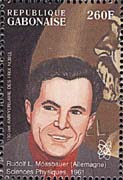
    1961 Nobel Physics prize for his researches concerning the resonance absorption of gamma radiation and his discovery in this connection of the effect which bears his name


    1977 Nobel Physics prize for fundamental theoretical investigations of the electronic structure of magnetic and disordered systems
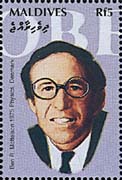


    1975 Nobel Physics prize for the discovery of the connection between collective motion and particle motion in atomic nuclei and the development of the theory of the structure of the atomic nucleus based on this connection
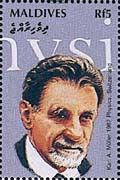


    1987 Nobel Physics prize for important break-through in the discovery of superconductivity in ceramic materials


L - M - N

Biographies of Physicists and Astronomers