|
|
V
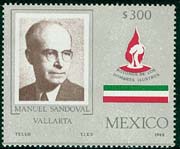
Manuel Sandoval Vallarta was born in Mexico City. In 1924, at age 25, he received his PhD at MIT. His dissertation, on Niels Bohr's atomic model from the standpoint of general relativity, was written under the guidance of Edgar Bright Wilson. After postdoctoral studies in Berlin and Leipzig, Sandoval Vallarta was appointed a professor at MIT. Sandoval Vallarta made basic contributions in several fields, including the theory of electric circuits, relativistic and nonrelativistic quantum mechanics, and gravitation, but his main impact was in the study of cosmic radiation. His studies on the nature and composition of cosmic radiation and on geomagnetic effects on its constituents gave him a distinguished place in the international scientific community and recognition as one of the authorities in the field. Georges Lemaitre and Sandoval Vallarta developed a theory of the latitude and azimuthal dependence of cosmic radiation, which was later corroborated experimentally by Luis Alvarez (working under the guidance of Arthur Compton). Sandoval Vallarta was interested in the extragalactic origin of cosmic rays and, in collaboration with Richard Feynman (then one of his students) he analyzed the scattering of cosmic rays by the stars of a galaxy. He kept in constant touch with young Mexicans interested in physics, and supervised some of them in their graduate work at MIT. After returning permanently to Mexico in 1943, Sandoval Vallarta was a leader in the formation of the first organization to promote science in Mexico. He was the president of the Commission for the Promotion of Scientific Research from 1943 to 1951, when the commission became the National Institute of Scientific Research; he then continued on in the presidency until 1963, when the institute was replaced by the present National Council of Science and Technology. He collaborated with Abdus Salam, Robert Oppenheimer, and Victor Weisskopf to develop the project that gave rise to the Abdus Salam International Centre for Theoretical Physics (ICTP) in Trieste, Italy. The ICTP is now one of the most important centers for the development of science in the third world.
Scientist, physicist, educator, author, translator.
Alessandro Volta, inventor of the electric battery (history's first source of a continuous, reliable electric current), is born one of nine children in Como, Italy, in a noble family that had fallen on hard times. Volta did not talk until he was four, which mistakenly convinced his family that he was retarded.
|
||||||
|
|