|
|
Part 5
A provocative idea is that all the Greek or Roman sculptures are not pieces of art, because the ancient Greek “artists” were only craftsmen and not “intellectuals” like today artists who do art for art (if there is someone who really believes this). There is the idea that “Arts” as we understand it today is something developed in the 18th century, and the “artists” before were actually artisans. The description of works of art became a highly developed literary exercise, and the results are often as formulaic as the epigrams about Myron’s cow. Those that give the best idea of the way in which, in the real world, cultivated people looked at works of art is the collection known simply as Pictures by the orator Philostratus. These little essays purport to record extemporaneous speeches made by the author in front of the paintings in his patron’s collection for the edification of the patron’s ten-year-old son. One of the most extensive and remarkable concerns a picture of a boar hunt. In addition to the descriptive naturalism, Philostratus admires the arrangement of episodes: the skill with which the story is told. He is especially responsive to the characterization of the hunters: “one shows in his face a touch of the palaestra, another shows grace, another urbanity, and the fourth, you will say, has just raised his head from a book.” He also notes the conceptual complexity of the picture: the four hunters are led by a fifth, a boy of great beauty, with whom they are obviously all in love, so that the pursuit of the boar is paralleled by their pursuit of him. Surprised by the intensity of his absorption, Philostratus exclaims: How I have been deceived! I was deluded by the painting into thinking that the figures were not painted but were real beings, moving and loving – at any rate I shout at them as if they could hear and I imagine that I hear some response – and you did not utter a single word to me to turn me back from my mistake, being as much overcome as I was . . .Antiquity and the Middle Ages, Chapter 1 , (some evidence that it is: The ears of the horses are like that of Bucephalas, the horse of Alexander the Great) Hellenistic Art - Hellenistische Kunst Hellenistic Art (often despised by the academical world) was not anymore so conservative as the classical Greek Art. The Art is characterized by its dynamic character ( ) even in the case of the sleeping Satyr. There is an attention on a specific moment, a greater almost perfect realism and we have also complex interacting group of sculptures (symplegmata).
(the beauty of Apollo and at the end a link with information about the beauty of Jesus Christ) chooses five models from
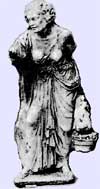
Old Market Woman
|