|
|
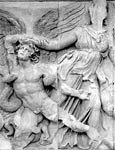
166-156 BC, the Zeus Altar “...we cannot fail to be impressed with the Titanic energy which surges through this stupendous composition “ The Pergamum Zeus Altar : The Titanic battle for the survival of culture , Gigantomachy in Ancient Greek Sculpture Historians consider Phyromachos of Athens as one of the leading sculptors of the Zeus Altar. Phyromachos although unknown today was a famous sculpture of the Hellenistic period. In Antiquity children learned that the greatest Greek sculptors were: Myron, Pheidias, Polyclet, Scopas, Praxiteles, Lysippus and Phyromachos. Dozen of gods together with Hercules and Dionysus in a battle against Ge (or Gaea, mother Earth) and her children the Giants. A fight between the rational behaviour represented by the gods and the raw immoderate Nature. The victory represents a metamorphosis of a barbaric world to a more civilized. Information which mythological persons are shown in the gigantic Pergamon Zeus Altar in the East frieze , South frieze , North frieze and West frieze Pergamon was a state who supported and was supported by the Romans. The Attalids helped the Romans against the Seleucids, although the Romans tried to keep the power of Pergamon within limits. It was the Telephos myth and Pergamos another name of Troy that symbolized a common origin of the Roman state (through Aeneas of Troy) and Pergamon.
The provocative sleeping Satyr
Sleeping Eros, Hellenistic sculpture. The sleeping satyr, the sleeping Ariadne, sleeping but not static: In sleep the body does not feel, but the soul awake knows everything; she sees what is to be seen, hears what has to be heard, walks, touches, grieves, remembers— in a word, all the functions of body and soul alike are performed in sleep by the soul.
Laocoon a marble copy produced by the sculptors 1) Athanadoros son of Hagesandros, 2) Hagesandros son of Paionios, 3) Polydoros son of Polydoros of Rhodes (the original was a bronze sculpture around 140 BC)
Laocoon and his sons and the aesthetics of pain (including some old and modern versions by other artists)
Girl with dove, Musei Capitolini MC738
Belvedere Torso, 2nd -1st century BC, Apollonius the son of Nestor from Athens, Citta del Vaticano, Sala delle Muse
A civilized hellenistic centaur Running Athlete from Cyme 50-30 BC, late Hellenistic The Three Graces or Charites (Hellenistic version) , Raphael Version , Peter Paul Rubens Version , Sir Edward Burne-Jones Version , Other Versions
The Polyphemus Group of Sperlonga, The Cyclops Polyphemus and Odysseus The Farnese Bull was a marble sculpture stolen by the Romans from the island Rhodes. It was probably a work produced for Attalos II Philadelphus and Eumenes II of Pergamon. A Roman version found 1546 in Italy was produced probably for the Emperor Claudius with an additional figure of Antiope with some similarities with the Venus Genetrix believed to represent the Emperor's mother Antonia Augusta. It is possible that the emperor, his brother Germanicus and his mother are represented by the figures of the sculpture Amphion, Zethus and Antiope. Sculptures from Sikyon (A place close to Corinth and important center of Arts) Quotations. The Legacy of Ancient Greece: Everyone must sculpt their own statue. Do you think that Greek art ever tells us what the Greek people were like? Do you believe that the Athenian women were like the stately dignified figures of the Parthenon frieze, or like those marvellous goddesses who sat in the triangular pediments of the same building? If you judge from the art, they certainly were so. But read an authority, like Aristophanes, for instance. You will find that the Athenian ladies laced tightly, wore high-heeled shoes, dyed their hair yellow, painted and rouged their faces, and were exactly like any silly fashionable or fallen creature of our own day. The fact is that we look back on the ages entirely through the medium of art, and art, very fortunately, has never once told us the truth.—Oscar Wilde , The Decay of Lying What Is “Hellenistic” about Hellenistic Art? Funerary Sculptures, Stelai These tombstones were not made for or by distinguished people; they were made for everyday people by everyday workmen. We must treat them as gravestones, not as achievements of art. They were not made for competitive exhibition in this Museum. Nevertheless it is remarkable to what an extent technical ability had been developed, and that so many sculptors could be found in Greece capable of doing such excellent work. Some of them pass beyond the ordinary level, and exemplify the highest artistic skill. (http://www.oldandsold.com/articles21/greece-12.shtml)
Go to the Kerameikos to see the bas-reliefs of those who were the centre of a world, and who tomorrow will be unknown and ignored - the moment where the short life finishes and eternal death begins (From http://www.athenian.net/d-athena/kerameikos.htm ) Attic Grave Reliefs : The Hegeso, Dexileos and Ilissos Stelai
![]() |
|
|||||||||||||||||