
Oeneus, Heracles, Nessus and Deianeira
Deïaneira or Deïanira (Greek Δηϊάνειρα or Δῃάνειρα, Δηιάνειρα ,lit. 'husband-destroyer') was the third wife of Heracles, best-known for her role in the story of the Tunic of Nessus.
She was the daughter of Althaea and Oeneus ('wine-man' and thus civilized), the king of Calydon, and the sister of Meleager. However, according to R. Graves, her father was in fact Dionysus. Her father betrothed her to the fearsome river god Achelous, horned and bull-like. Now Deianira was no passive blushing princess. "This Deianira drove a chariot and practised the art of war", noted Apollodorus (Library and Epitome, book i, 8:1) But she wanted nothing to do with her suitor, who was able to take the form of a sepent or a bull. Heracles, the greatest hero of the dawning Olympian world of gods and men, had to defeat the river god to win her as his bride.
Like many mortal women in Greek mythology, Deianira (also Deianeira) occupied a perilous threshold position between the daylit world of Olympian gods and heroes and the dark chthonic primordial world of primitive earth magic.
Guido Reni, Abduction of Deianira, 1620-21, Louvre Museum. Painted in Guido's studio in Bologna, one of a set of four decorations painted for Ferdinand Gonzaga's villa "La Favorita" near Mantua. Dianeira and the Centaur Nessus ("probably a "Pony" Centaur version ")
Deianira's own struggle with the chthonic forces was not over. Later, a wild centaur named Nessus attempted to kidnap Deianira as he was ferrying her across the river Evenus, but she was rescued by Heracles, who shot the centaur with a poisoned arrow. As he lay dying, Nessus lied to Deianira, telling her that a mixture of the semen that he had dropped on the ground and his heart's blood would ensure that Heracles would love her forever. Deianira believed his words and kept a little of the potion by her. Heracles fathered illegitimate children all across Greece. When she became uncertain if Heracles would remain true to her in his fashion, Deianira smeared some of the blood on Heracles' famous hide shirt. Heracles' servant, Lichas, brought him the shirt and he put it on. The centaur's toxic blood killed Heracles. In despair, Deianira committed suicide.
Etruscan Relief of Dianeira
The rape of Deianeira and the battle of centaurs, Michelangelo Buonarroti
The rape of Deianeira, Antonio Pollaiuolo
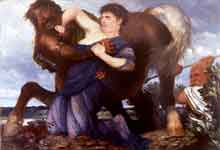
Nessus and Deianeira, Arnold Böcklin, 1898
Nessus and Heracles, Jules-Elie Delaunay
Deianera, Evelyn de Morgan
Nessus and Deianeira based on a work of Rubens
Official Wives of Heracles
Megara | Omphale | Dianeira | Hebe
List of Children with other women
References
- Harry Thurston Peck, Harper's Dictionary of Classical Antiquities, 1898
- Robert Graves, The Greek Myths, 1955
Retrieved from "http://en.wikipedia.org "
All text is available under the terms of the GNU Free Documentation License
 Disclaimer
  Privacy Policy