|
|
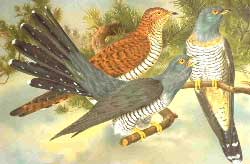
The Common Cuckoo (Cuculus canorus) is a member of the cuckoo order of birds, the Cuculiformes, which also includes the roadrunners, the anis, the coucals, and the Hoatzin. It is a widespead summer migrant to Europe and western Asia, and winters in Africa. It is a brood parasite, which lays its eggs in the nests particularly of Dunnocks, Meadow Pipits, and Reed Warblers. Female Cuckoos are divided into gentes, that is populations favouring a particular host species nest and laying eggs which match those of that species' in colour and pattern. The exception is in the case of the Dunnock, where the Cuckoo's egg has no resemblance to its hosts' blue eggs. This is thought to be because the Dunnock is a recent host, and has not acquired the ability to distinguish eggs. Male cuckoos breed with females without regard to gens. This results in gene flow between the gentes and maintains a common gene pool for the species. An ideal habitat for Cuckoos is where there are reed beds and trees. Female cuckoos are teritorial and spend a long time watching over the read beds. A individual female cuckoo's territory will cover upto about 20 reed warbler's nests. The female cockoo is very good at watching the behaviour of the reed warblers as they build their nests and start their broods. The female cuckoo has to time her egg laying to just the right time when the the reed warblers start to lay eggs. It is not sure how the hen cuckoo gets the timing right, as she can not see the reed warblers eggs from the trees, but it is likely that is it from the behaviour of the reed warblers. At the appropriate moment the hen cuckoo flys down to the reed warblers nest, pushes one reed warbler egg out of the nest, lays an egg and flys off. The whole process on the nest is achieved in only about 10 seconds. At 14 days old the cuckoo chicks are about 3 times the size of the adult reed warblers. Cuckoo chicks fledge after about 20 days after hatching, which is about twice as long as for reed warblers. If the hen cuckoo is out-of-phase with a clutch of reed warbler eggs she will eat them all so that the reed warblers are forced to start another brood. The cuckoo chick will roll the other eggs out of the nest by pushing the egg with its back over the edge of the nest. If the reed warbler's eggs hatch before the cuckoo's egg, the cuckoo chick will push the other chicks out of the nest in a similar way. Once the reed warbler chicks are out of the nest the parent reed warblers will completely ignor them. The cuckoo chick which hatches from the egg laid in the other species' nest methodically evicts all other occupants of the nest using a combination of behaviour and anatomical adaptation that was first described by Edward Jenner resulting in him being elected Fellow of the Royal Society in 1788, well before he invented vaccination. This is necessary since it is a much larger bird than its hosts, and needs to monopolise the parents' food supplies. This cuckoo is a greyish bird with a slender body, long tail and strong legs. The females only are sometimes brown, the “hepatic” phase. It looks like a small bird of prey in flight, although the wings stay below the horizontal. It is a bird of open country. Its food is insects, with hairy caterpillars, which are distasteful to many birds, being a speciality. The cuckoo group gets its English and scientific names from the call of the male Common Cuckoo, usually given from an open perch, goo-ko. The female has a loud bubbling call. In England, hearing the call of the Cuckoo is regarded as the first harbinger of spring, and The Times newspaper notoriously features correspondence every year reporting the first calls. In Russia, there's a popular belief that a cuckoo can predict how many more years a person will live. If a person hears a cuckoo in the woods, he or she usually asks "Cuckoo, cuckoo, how long will I live?". It is believed that a person will live as many years as a cuckoo cuckooed. The word "cuckold" derives from the Cuckoo's practice of tricking other birds into raising its young. The cuckoo (kókkyx ) appears in the play of Aristophanes' The Birds: PITHETAERUS The cuckoo was king of Egypt and of the whole of Phoenicia. When he called out "cuckoo," all the Phoenicians hurried to the fields to reap their wheat and their barley. EUELPIDES Hence no doubt the proverb, "Cuckoo! cuckoo! go to the fields, ye circumcised." A bird that had been associated with Hera on an archaic level, where most of the Aegean goddesses were associated with "their" bird, was the cuckoo, which appears in mythic fragments concerning the first wooing of a virginal Hera by Zeus. Pausanias: The statue of Hera is seated on a throne; it is huge, made of gold and ivory, and is a work of Polycleitus. She is wearing a crown with Graces and Seasons worked upon it, and in one hand she carries a pomegranate and in the other a sceptre. About the pomegranate I must say nothing, for its story is somewhat of a holy mystery. The presence of a cuckoo seated on the sceptre they explain by the story that when Zeus was in love with Hera in her maidenhood he changed himself into this bird, and she caught it to be her pet. This tale and similar legends about the gods I relate without believing them, but I relate them nevertheless.
Retrieved from "http://en.wikipedia.org/"

![]() |
|
||||||||||||||||||||||||||||||||||||||