|
|
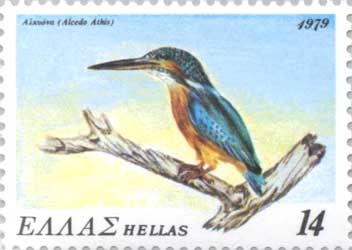
The European Kingfisher or Common Kingfisher, Alcedo atthis, is widely distributed in Europe, Africa, and Asia. It is resident except in northern areas where the rivers freeze. It will then move to milder regions. In most of its European range it is the only kingfisher. The scientific name Alcedo Atthis is derived from Alcyone , the daughter of Aeolus.
The general colour of the upper parts of the adult bird is bright metallic blue, cobalt on the back, and showing greenish reflections on the head and wings. The ear coverts and under parts are warm chestnut, the chin and sides of neck white. The bill is black and reddish orange at the base; the legs are bright red. In the young the bill is black. Length averages 19 cm (7.5 inches) and wings average 7.5 cm (2.95 inches). The flight of the Kingfisher is rapid, the short rounded wings whirring until they appear a mere blur. It usually flies near the water, but during courtship the male chases the female through and over the trees with loud shrill whistles. From February onwards the male has a trilling song, a modulated repetition of many whistles. He also signals with a whistle to the female when he is feeding her, this being his share of the nesting duties. This whistle is produced even when his bill is loaded with food, yet is clear and distinct. The female will reply and emerge from the nesting hole, and may fly to meet him, take the fish from him in the air, and return to the nest. The bird has regular perches or stands from which it fishes. These may be a few inches or many feet above the water. It sits upright, its tail pointed downwards. It drops suddenly with a splash and usually returns at once with a struggling captive. Large fish are beaten on a bough or rail; small fish and insects are promptly swallowed. A fish is usually lifted and carried by its middle, but its position is changed, sometimes by tossing it into the air, before it is swallowed head downwards. The Kingfisher sometimes hovers over the water, with body held almost vertical, the tail and head bent slightly forward and the bill inclined downward. It is a bird of the waterside, since it feeds entirely upon aquatic animals. It is frequent beside lakes, ponds, canals or dykes and streams. In winter, especially when inland waters are icebound, it may move to tidal marshes and the shore, taking its stand on the mussel or limpet covered rocks and diving into the shallow pools. Fish, aquatic insects and crustaceans are eaten. It eats numerous freshwater shrimps Gammarus. The nest is a tunnel in a sandy bank, usually, though not always over water. Both birds excavate, except when an old hole of a Sand Martin or Water Vole is appropriated. Most incline upward for about three feet before the nesting chamber is reached. There is no nest, but the six to seven or even more round white eggs are placed on a litter of fish bones and disgorged pellets. The eggs are pink. The first clutch is usually laid in April, but second broods are often in the nest at the end of July, and an exceptional case of young in early October is recorded.
The young come to the mouth of the hole to be fed when old enough. They are at first without down and clothed with numerous small blue feathers. Their bills are steel-blue and their feet lighter colored than adults. When they leave the nest they differ little from their parents, except that the colours are duller, the spot on the neck is buff, and the grey margins to the breast feathers give a mottled appearance. Their call is then an insistent, continuous trill.
The Kingfisher appears in the play of Aristophanes' The Birds From the The Curious Book of Birds by Abbie Farwell Brown: THE story of the first Kingfisher is a sad one, and you need not read it unless for a very little while you wish to feel sorry. Long, long ago when the world was new, there lived a beautiful princess named Halcyone. She was the daughter of old Æolus, King of the Winds, and lived with him on his happy island, where it was his chief business to keep in order the four boisterous brothers, Boreas, the North Wind, Zephyrus, the West Wind, Auster, the South Wind, and Eurus, the East Wind. Sometimes, indeed, Æolus had a hard time of it; for the Winds would escape from his control and rush out upon the sea for their terrible games, which were sure to bring death and destruction to the sailors and their ships. Knowing them so well, for she had grown up with these rough playmates, Halcyone came to dread more than anything else the cruelties which they practiced at every opportunity. One day the Prince Ceyx came to the island of King Æolus. He was the son of Hesperus, the Evening Star, and he was the king of the great land of Thessaly. Ceyx and Halcyone grew to love each other dearly, and at last with the consent of good King Æolus, but to the wrath of the four Winds, the beautiful princess went away to be the wife of Ceyx and Queen of Thessaly. For a long time they lived happily in their peaceful kingdom, but finally came a day when Ceyx must take a long voyage on the sea, to visit a temple in a far country. Halcyone could not bear to have him go, for she feared the dangers of the great deep, knowing well the cruelty of the Winds, whom King Æolus had such difficulty in keeping within bounds. She knew how the mischievous brothers loved to rush down upon venturesome sailors and blow them into danger, and she knew that they especially hated her husband because he had carried her away from the island where she had watched the Winds at their terrible play. She begged Ceyx not to go, but he said that it was necessary. Then she prayed that if he must go he would take her with him, for she could not bear to remain behind dreading what might happen. But Ceyx was resolved that Halcyone should not go. The good king longed to take her with him; no more than she could he smile at the thought of separation. But he also feared the sea, not on his own account, but for his dear wife. In spite of her entreaties he remained firm. If all went well he promised to return in two months' time. But Halcyone knew that she should never see him again as now he spoke. The day of separation came. Standing heart-broken upon the shore, Halcyone watched the vessel sail away into the East, until as a little speck it dropped below the horizon; then sobbing bitterly she returned to the palace. Now the king and his men had completed but half their journey when a terrible storm arose. The wicked Winds had escaped from the control of good old Æolus and were rushing down upon the ocean to punish Ceyx for carrying away the beautiful Halcyone. Fiercely they blew, the lightning flashed, and the sea ran high; and in the midst of the horrible tumult the good ship went to the bottom with all on board. Thus the fears of Halcyone were proved true, and far from his dear wife poor Ceyx perished in the cruel waves. That very night when the shipwreck occurred, the sad and fearful Halcyone, sleeping lonely at home, knew in a dream the very calamity which had happened. She seemed to see the storm and the shipwreck, and the form of Ceyx appeared, saying a sad farewell to her. As soon as it was light she rose and hastened to the seashore, trembling with a horrible dread. Standing on the very spot whence she had last seen the fated ship, she looked wistfully over the waste of stormy waters. At last she spied a dark something tossing on the waves. The object floated nearer and nearer, until a huge breaker cast before her on the sand the body of her drowned husband. "O dearest Ceyx!" she cried. "Is it thus that you return to me?" Stretching out her arms toward him, she leaped upon the sea wall as if she would throw herself into the ocean, which advanced and retreated, seething around his body. But a different fate was to be hers. As she leaped forward two strong wings sprouted from her shoulders, and before she knew it she found herself skimming lightly as a bird over the water. From her throat came sounds of sobbing, which changed as she flew into the shrill piping of a bird. Soft feathers now covered her body, and a crest rose above the forehead which had once been so fair. Halcyone was become a Kingfisher, the first Kingfisher who ever flew lamenting above the waters of the world. The sad bird fluttered through the spray straight to the body that was tossed upon the surf. As her wings touched the wet shoulders, and as her horny beak sought the dumb lips in an attempt to kiss what was once so dear, the body of Ceyx began to receive new life. The limbs stirred, a faint color returned to the cheeks. At the same moment a change like that which had transformed Halcyone began to pass over her husband. He too was becoming a Kingfisher. He too felt the thrill of wings upon his shoulders, wings which were to bear him up and away out of the sea which had been his death. He too was clad in soft plumage with a kingly crest upon his kingly head. With a faint cry, half of sorrow for what had happened, half of joy for the future in which these two loving ones were at least to be together, Ceyx rose from the surf-swept sand where his lifeless limbs had lain and went skimming over the waves beside Halcyone his wife. So those unhappy mortals became the first kingfishers, happy at last in being reunited. So we see them still, flying up and down over the waters of the world, royal forms with royal crests upon their heads. They built their nest of the bones of fish, a stout and well-joined basket which floated on the waves as safely as any little boat. And while their children, the baby Halcyons, lay in this rocking cradle, for seven days in the heart of winter, no storms ever troubled the ocean and mariners could set out upon their voyages without fear. For while his little grandchildren rocked in their basket, the good King Æolus, pitying the sorrows of his daughter Halcyone, was always especially careful to chain up in prison those wicked brothers the Winds, so that they could do no mischief of any kind. And that is why a halcyon time has come to mean a season of peace and safety More Images Retrieved from "http://en.wikipedia.org "
![]() |
|
||||||||||||||||||||||||||||||||||||||