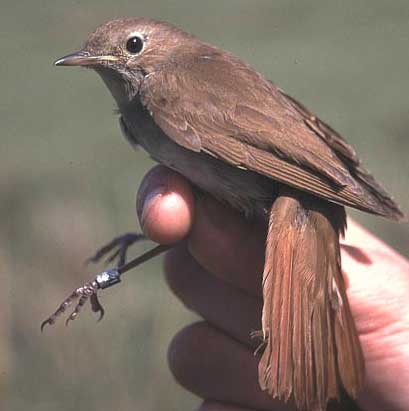
Nightingale ( Luscinia megarhynchos)

Agesilaus being invited once to hear a man who admirably imitated the nightingale, he declined, saying he had heard the nightingale itself. Plutarch Life of Agesilaus II.


Nightingale ( Luscinia megarhynchos)

Nightingale

Scientific classification
Kingdom: Animalia
Phylum: Chordata
Class: Aves
Order: Passeriformes
Family: Muscicapidae
Genus: Luscinia
Species: L. megarhynchos
Binomial name
Luscinia megarhynchos
(Brehm, 1831)

The Nightingale (Luscinia megarhynchos) is a small passerine bird that was formerly classed as a member of the thrush family Turdidae, but is now more generally considered to be an Old World flycatcher, Muscicapidae. It, and similar small European species, are often called chats.

It is a migratory insectivorous species breeding in forest in Europe and Asia. The distribution is more southerly than the very closely related Thrush Nightingale Luscinia luscinia. It nests low in dense bushes. It winters in southern Africa.

The Nightingale is similar in size to the European Robin, at 15-16.5 cm length. It is plain brown above except for the red-sided tail with red side patches. It is buff to white below. Sexes are similar.

The male Nightingale is known for his singing, to the extent that human singers are sometimes admiringly referred to as nightingales; the birdsong is loud, with an impressive range of whistles, trills and gurgles. Although it also sings during the day, the nightingale is unusual in singing late in the evening; its song is particularly noticeable at that time because few other birds are singing. This is why its name (in several languages) includes "night". Recent research has shown that the birds sing even more loudly in urban or near-urban environments, in order to overcome the background noise. The most characteristic feature of the song is a loud whistling crescendo. It has a frog-like alarm call.

Eastern races have paler upperparts and a stronger face-pattern, including a pale supercilium.

The Nightingale (aêdôn) appears in Aristophanes' The Birds

In Greek mythology, Aedon, daughter of Pandareus, was the wife of Zethus. The pair had one daughter, Itylus. Aedon accidentally killed her and was stricken with grief and guilt. In pity, the gods turned her into a nightingale, which cries with sadness every night. Alternatively, she was the queen of Thebes, who attempted to kill the son of her rival, Niobe, also her sister-in-law, and accidentally killed her own daughter instead and thus, the gods again changed her into a nightingale.

What else can I that am old and lame do but sing to God? Were I a nightingale, I should do after the manner of a nightingale. Were I a swan, I should do after the manner of a swan. But now, since I am a reasonable being, I must sing to God: that is my work: I do it, nor will I desert this my post, as long as it is granted me to hold it; and upon you too I call to join in this self-same hymn. The Golden Sayings of Epictetus

Odyssey XIX, 518.

Just as Pandareus' daughter,
the nightingale of the green woods, sings out
her lovely song when early spring arrives,
perched up in thick foliage of the forest, 
and pours forth her richly modulating voice
in wailing for her child, beloved Itylus, 
lord Zethus' son, whom with a sword one day
she'd killed unwittingly—that's how my heart
moves back and forth in its uncertainty.

Cyprus, Nature

List of Cyprus birds

Retrieved from "http://en.wikipedia.org "

All text is available under the terms of the GNU Free Documentation License

 
Web www.mlahanas.de
www.hellenica.de

Ancient Greece

Medieval Greece / Byzantine Empire

Modern Greece

Science, Technology , Medicine , Warfare
, Biographies , Life , Cities/Places/Maps , Arts , Literature , Philosophy ,Olympics, Mythology , History , Images

Science, Technology, Arts
, Warfare , Literature, Biographies
Icons, History

Cities, Islands, Regions, Fauna/Flora ,
Biographies , History , Warfare
Science/Technology, Literature, Music , Arts , Film/Actors , Sport , Fashion

Cyprus - World

Greek-Library - Scientific Library