|
|
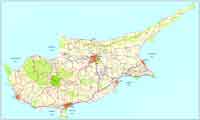
Evrychou ( Greek : Ευρύχου) is a community in the Nicosia District of Cyprus. Evrychou is located in Nicosia District and it is the agricultural centre of the "Solea" region. It is located about 50 km south-west of Nicosia and 30 km from mount Troodos. The village is built at the east bank of the Karkotis (or Klarios) River, at an average altitude of 440 metres. The climate of the region is very nice, typical Mediterranean and so the cultivations found around the village vary from fruit-bearing trees (mainly apple, pear, plum, apricot, and peach trees) to citrus-trees, almond and olive trees. There are also cultivations of vines, vegetables and cereals. Transportation and nearest places Evrychou is connected by road to Kato Flasou (about 3 km) in the north-east, to Temvria (about 2 km) in the south-west, and to Korakou (about 2 km) in the west. The Nicosia -- Troodos road connects the village both with the capital as well as with the mountainous resorts of Troodos. Other Evrychou has a Regional Elementary School, a High School (Gymnasio & Lykeio Soleas), a Senior High School, a Fire Station, a Health Centre, a Police Station, an office of the Game & Fauna Department, and a branch of the Nicosia District Agricultural Office. Furthermore, the Metropolitan Bishop of Morfou has transferred his temporary headquarters in the village after the 1974 Turkish Invasion. The Morfou Diocese was transferred to Evrychou and is housed in the premises of the Old Elementary School after it was renovated and some new apartments were added. Since old times, a regional office of the Department of Land & Surveys and a Court operated and still operate until today. References * Θεοχάρης Κινάνης Ευρύχου - Ιστορία & Παράδοση, Λευκωσία 2005, ISBN 9963-9170-0-3
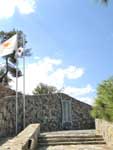
Evrychou, Photo : Augusta Stylianou Artist
From Cyprus: historical and descriptive. From the earliest times to the present day. Franz von Löher 1878 Whilst it was still light we reached Evrychu. This, the prettiest and most populous village in Cyprus, is situated in a lovely valley surrounded by fruitful and luxuriant pastures, whilst above it tower majestic groups of picturesque mountains. Evrychu lies 1700 feet above the level of the sea, and contains seven hundred inhabitants; amongst these, however, not more than a hundred families pay taxes. This luxuriant valley might readily produce enough to support ten times the number of people now dwelling there. When we arrived, evening service was being performed in the church, and it is no exaggeration to say that the whole of the inhabitants were around its walls, from the youngest child to the most infirm of its old men and women. This open-air gathering had a fine and solemn effect. The people themselves appeared to me to differ in many respects from the short, stout inhabitants of the coast and plains, who look as thought heat and perspiration had baked the dust and dirt into their skins. The people of Evrychu, on the contrary, are well grown and finely made, and their complexions fresh and blooming. Amongst the women and girls I noticed a great number of pretty faces. There can be no doubt as to the fact that these people are descended from the old Greek settlers, whilst those in the open country and on the sea coast are descended from a mixed race of Italians, Syrians, and Negroes. In the more frequented parts of the island, traces of successive races were rapidly swept away, whilst here in the mountain valley the people have for generations lived comparatively unchanged and undisturbed. My opinions concerning the descent of the people were strengthened by further observations, and all along the mountain range I noticed a strong likeness to the Greeks of several islands in the Archipelago; the type, however, not being quite so pure (no doubt owing to intermarriage), nor faces and figures quite so beautiful and slender. As for manners, well would it be if our awkward English race could imitate the grace with which these villagers performed the most ordinary act. When we arrived amongst them the appearance of such an unexpected party might have been supposed to have created quite a sensation. Nothing of the kind occurred; the men and women were grouped about, and evidently eyed us with much curiosity, but no movement betrayed their feelings or ruffled their respectful politeness. The girls stood at some distance and observed us as closely, but with graceful dignity. Such natural propriety of behavior is very striking in this population, and seems to leave the impression on the mind of their having, as we say, “seen better days.” Their peculiar customs are numerous and interesting; no sooner is a guest lodged than a woman or girl appears and offers him an apple, with the most winning grace; this is intended as a hospitable welcome. If you are given any kind of solid food a napkin is placed over your knees. A glass of water is presented to you on the open palm of the hand, and is always accompanied by a good wish, the giver remaining standing until the glass is returned, when another wish is expressed that the water may do you good. When you are about to leave, women and girls appear and throw the leaves of the olive and other fragrant plants into the fire. The parting guest is expected to go through the form of smelling these leaves, in token of his bearing away in his mind a sweet impression of the kindness he has received.
Morphou Bay as seen from Evrychou, Photo : Augusta Stylianou Artist
Evrychou, Photo : Augusta Stylianou Artist
Agia Marina Church 1872, Evrychou, Photo : Augusta Stylianou Artist
Retrieved from "http://en.wikipedia.org"

![]() |
|
|||||||||||||||||||||||||||||