|
|
Griechenland: Der Parthenon auf der Akropolis Part 1 The only way to judge of the treasures the Old Masters of whatever age have left us—whether in architecture, sculpture, or painting—with any hope of sound deduction, is to look at the work and ask oneself—"What was that like when it was new?" , Greece, was built at the initiative of and from the Perseus classics web site
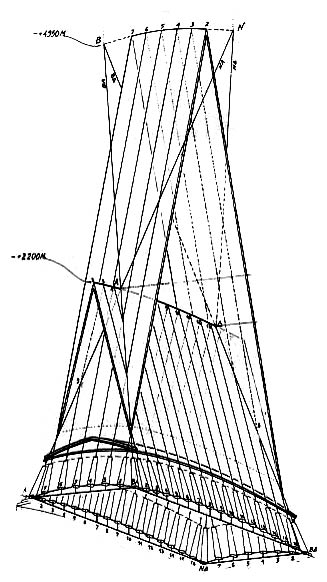
The Parthenon geometry, drawn in a way so that the curvature of the building is visible. The columns (and other elements), like in other Greek temples, are not exactly straight as they may appear. There are various optical effects such that long lines appear bend and the Greeks used a slight bending (so-called Entasis ) of the columns and of the other elements so that the optical illusion is eliminated. The bending is such that if columns at opposite sides are extended up they will cross after around 2.2 km along the one side and about 5 km on the other side. The columns are also set closer together at the corners than in the center and this also for specific reasons. Only a few decades ago ancient drawings on the walls of a temple were found, for example lines showing the shape of a column. The main important ancient source about the Parthenon and Greek architecture is Vitruvius. Unfortunately no other written sources exist. Various measurements have been performed the last decades to determine the shape of the Parthenon and various models have been used to describe it (for example conic sections, mainly the ellipse, even if we assume that conics were invented around two centuries later. What exactly the ancient Greeks used we will probably never find but the reason was harmony and perfection.
 |
|
|||||||||||||||||