|
|
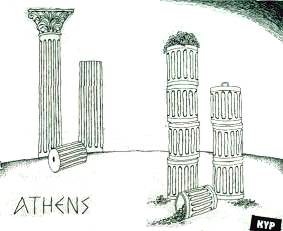
The very atmosphere seems different — clean, sharp, and bright; each year here has three hundred sunny days. We are at once reminded of Cicero’s comment on ‘Athens’ clear air, which is said to have contributed to the keenness of the Attic mind.’ [Durant, The Life of Greece, vol. II in The Story of Civilization, p. 107.] Ecological problems are not problems of our time. The building of ships in ancient Greece required immense natural resources. Homer describes that 1093 ships were send to Troy by the Greeks. Much more ships were required for the Greek colonization. Additional ships were required for the wars with Persia and later also the Romans build a very large number of ships using trees from Greece.. According to Bondyrev 2000 to 4000 oak trees (Is this number true??) are required for the construction of a single ship and the oars. With 100- 800 trees per ha area 25 to 40 ha of forest is required for the construction of a single warship (32 ha on an average). For the colonization of the Pontus 10000-12000 ships were required. With a ship lifetime of 10 years the colonization from 800 to 400 BC by the Greeks required 153.6 million ha forest. The deforestation and agricultural practices reduces the crop yield. The ecological problems are discussed by Plato and other observers. Metallurgy, ceramic industry also required significant amount of wood. Other Ecological Problems are air pollution, reduction of the wildlife etc. The pollution of rivers was also a problem in Athens. In Collection of Rivers, Kallimachos says that it makes him laugh if anyone makes bold to write that the Athenian maidens “draw pure liquid from the Eridanos,” from which even cattle would hold aloof. (Strabo 9.1.19)
For the production of Silver such as in Laurium 5000 kg of ore is required for the production of 2 to 4 kg silver. In Laurium until the 1st century BC 3500 tons of silver were produced and additional 1500 tons lead. Only after the new Greek state was formed the production of silver continued. In 1976 the production stopped as there was no silver left. Extinction of arts
 |
|
|||||||||||||||||