|
|
Griechische Medizin
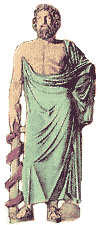
Δύσκολος ἰατρὸς ἑτερόφθαλμος ἠρώτα νοσοῦντα· πῶς ἔχεις; ὁ δὲ εἶπεν· ὁς βλέπεις. ὁ δὲ ἰατρὸς ἔφη· ἐὰν ὡς ἐγὼ βλέπω ἔχηις, τὸ ἥμυσύ σου ἀπέθανεν. An ancient Greek joke. A physician with only one eye asks a patient about his condition. The patient answers : As you see! The physician replies: Then half of you is dead. Philogelos Pneumonoultramicroscopicsilicovolcanokoniosis,One if not the longest word to appear in standard English dictionaries for a disease caused by ultra-microscopic particles of sandy volcanic dust (or is it better to call it Pneumonohypermicroscopicopsammohephaestiokoniosis?) Ancient Greek medicine played an important role for almost 1500 years. Galen was probably the most important Physician of all time and his collected work includes around 20000 pages of text. Only with Vesalius and others around 1600 AD the knowledge again was improved. Nobody knew what was the illness of the young Prince Antiochus until the famous Greek physician Erasistratus observed the typical symptoms of Sappho Medicine and Mythology Asclepios was also entrusted to Chiron the centaur for a time, and learned medicine from him. The centaur baby-sitter and pedagogue appears in many myths, for reasons which are not by any means clear. ESP communications have been posited between animals and sensitive humans, especially the very young, and this may be a part of the picture, of which we have only a part. If the horse had an aversion to plants which are poisonous to men, or showed men where sources of salt, a rare material and a necessity to all mammals, existed, stories about the horse's medical knowledge might arise; William Harris, Domestication of Animals. Greek Myth Στα ίχνη του Ασκληπιού (From Asclepius to Galen in Greek) , Medicine and Pharmacopoeia Physicians, Instruments a) Hippocrates , b) Herophilos and Erasistratus , c) Galen , d) Dioscorides of Anazarbus and Pharmacology Examples of ancient Greeks medical knowledge Anatomical studies in Alexandria: Experiments with criminals , Ancient Greek and Roman Medical Instruments The Plague of Athens (Thucydides) The Hippocratic Tradition (PDF File 258 pages, 0.6 MB) Bulletin de Médecine Ancienne / Ancient Medicine Newsletter (French Site) , References for Greek Medicine (A very large list) Asclepieion Park of Athens, The first pilot application of a Modern Asclepieion Greek Medical History on Stamps GERMAN Reports
Asklepios Medal, Asklepios Prize since 1984, University of Saarland /Germany, with Asklepios and Artemis (derived from a coin from Pergamon) Vom Ansehen des Arztes in der Antike Psychology The only difference between the immortal Greece and contemporary times is Sigmund Freud, who discovered that the human body, purely platonic at the Greece epoch, nowadays is full of secret drawers that only the psychoanalysis is capable to open. Salvador Dali Bathysiderodromophobia. The fear of subways and other things underground. I was impressed reading that Artemidorus performed some kind of statistical analysis by interviewing a large number of persons about their dreams in order to develop a theory published in his Oneirocritica. I looked what Artemidorus had to say about my dreams. Often I dream that I can fly. Did the ancient Greeks also have similar dreams? And what can I learn from Artemidorus and others? I will later include more information about the work of ancient Greeks concerning Psychology which did not start with the work of Sigmund Freud. Why so few know the pioneering work of Artemidorus? In a report about Freud it was mentioned that one of his famous books was sold only around 600 times in 10 years. If one considers how many copies of less important books are sold one understands that quality is not defined by quantity only. PSYCHOLOGY IN GREEK PHILOSOPHY Artemidorus, Sigmund Freud and Socrates Dream , Women's Dreams in Ancient Greece, The Characters of Theophrastos

![]() |
|
|||||||||||||||||