|
|
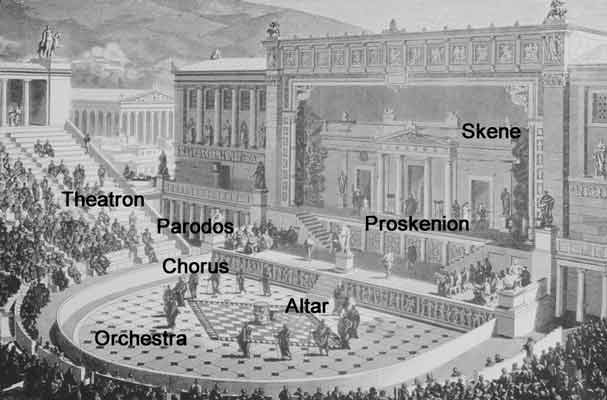
In classical drama, the skene was the background building to which was connected the platform stage, in which were stored the costumes and to which the periaktoi (painted panels serving as the background) was connected.
The evolution of the actor, who assumed an individual part and answered to the chorus (the word for actor, hypokrites, means answerer), introduced into drama a new form, the alternation of acted scenes, or episodes. With this, there arose the need for a place where the soloist could retire between appearances and change costumes, as needed, and a place for the storing of various properties. The word skene means "tent" or "hut," and it is thought that the original building for this purpose was constructed of perishable material, such as wood, and was a temporary structure. The skene broke the circularity of design in the
|
Ancient Greece
|
Medieval Greece / Byzantine Empire
|
Modern Greece
|
|
Science, Technology , Medicine , Warfare
, Biographies , Life , Cities/Places/Maps , Arts , Literature , Philosophy ,Olympics, Mythology , History , Images
|
Science, Technology, Arts
, Warfare , Literature, Biographies
Icons, History
|
Cities, Islands, Regions, Fauna/Flora ,
Biographies , History , Warfare
Science/Technology, Literature, Music , Arts , Film/Actors , Sport , Fashion
|

|
|