|
|
The Sarakatsani (or Sarakatsanoi) are a group of Greek (and Greek-speaking) transhumant shepherds, mainly located in the Pindos Mountains. The Sarakatsani traditionally spent the summer months in the Rhodope Mountains, in what is today Bulgaria, and returned south to Greece for the winter. The migration would start on the eve of Saint George's Day in April and the return migration would start on Saint Demetrius' Day, October 26th. After 1947, certain groups of Sarakatsani were not allowed to leave Bulgaria and enter Greece. They were subsequently settled in Bulgaria and they became partly Bulgarized. In Bulgaria, these Sarakatsani are known as Karakachans while in Romania they are called Saracaciani. The ethnic origins of the Sarakatsani are unclear. Whether the Sarakatsani are indeed true "Greeks", miraculous Dorian survivors or just Hellenized Vlachs, today they are firmly anchored in modern Greek life. Much of their traditional garb, songs, traditions and folklore have become integral parts of the overall Greek heritage. History Many authors have speculated on the origins of the Sarakatsani. In Monograph on Koutsovlachs (Μονογραφια περι Κουτσοβλαχων, 1865, reprinted in 1905), a Greek Epirot named Aravantinos discussed how the Arvanitovlachs were called Sarakatsani due to their Greek roots ("Τοιουτους Αρβανιτοβλαχους φερεωικους ποιμενοβιους ολιγιστους απαντωμεν εν Θεσσαλια και Μακεδονια, Σαρακατσανους καλουμενους καταχρηστικους διοτι οι Σαρακατσανοι ορμονται εξελληνων και αυτοχρημα Ελληνες εισι"). In Aravantinos' Chronography (Χρονογραφια), he elaborates more on the Sarakatsani and discusses about the "existence" of the Sarakatsani along with other actual existing groups like the Pestanianoi and the Vlachs. He also states that the Arvanitovlachs were called Garagounides or Korakounides thus increasing the supposed differences between Arvanitovlachs and Sarakatsani ("Σαρακατσιανοι η Σακαρετσανοι εχοντες την καταγωγη εκ Σαρακετσιου ... Οι Σαρακατσανοι, οι Πεστανιανοι, και οι Βλαχοι οι εκ του Συρρακου εκπατρισθεντες, οιτινες και ολιγοτερων των αλλων σκηνιτων βαρβαριζουσι. Διαφοροι δε των τριων εισιν οι Αρβανιτοβλαχοι λεγομενοι Γκαραγκουνιδες η Κορακουνιδες"). The Sarakatsani may have been bilingual in both Greek and Latin. Evidence of this can be found in texts written by authors such as Katakouzinos II, Procopius, and Kasomoulis. These authors state that before the advent of the Ottomans in southeastern Europe, Greek-speaking Greeks only lived in the coastal cities of Epirus and Aetoloakarnania, and that the remaining people who resided in the mountains were Arvanitovlachs. Other testimonies from Cousinery, Pouqeville, Heuzey, Tertsetis, Frantzis, and Deligiannis confirm that the population in Epirus, Aetoloakarnania and western Macedonia were bi-lingual. The people known today as the Sarakatsani were referred to as Roumeliotes by authors such as Georges Kavadias even though the Sarakatsani did not use that name themselves. Based on an account by Fotakos, the people currently known today as the Sarakatsani referred to themselves as Moraites when they migrated to Thessaly after the Greek Revolution. A Czech author by the name of Jirecek found the Moraitian tribe as a Latin-speaking populace that eventually became Greek-speaking (Gesty Pobulgarsky, Praze 1888 p. 220 and Das Furstentum Bulgariens 1891 p. 119). So perhaps the Sarakatsani spoke a mixed Greek-Latin language and became Greek monolinguals after the Greek Revolution.
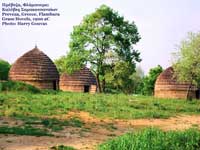
20th century accounts Many 20th century scholars have studied the linguistic, cultural, and racial background of the Sarakatsani. The Danish scholar Carsten Hoeg (1925-1926) stated that there are no traces of foreign elements in the Sarakatsani dialect. These foreign linguistic elements are neither found phonetically nor are they found in the overall grammatical structure of the dialect. Hoeg was criticised by Georges Kavadias for exaggerating the link between the 20th century Sarakatsani populace and the ancient Greeks. In terms of racial origins, the English researcher, J. K. Campbell (1964), stated that the Sarakatsani are more or less an unchanged populace. He found that the Sarakatsani were a very endogamic populace and considers them to be an isolate group. E. Makris (1990) considers the Sarakatsani to be a pre-Neolithic people. Yet "old" as they were depicted, they are not mentioned under the name of Sarakatsani until the end of the 18th century. In this respect, they seem to be quite "new." In 1987, the London based scholar John Nandris, who observed the Sarakatsani "on the ground" continuously since the 1950s, summarizes his account of this tribe by inserting them in a more complex context of nomadic people interacting with one another. Interestingly, he alludes to the Yoruk or "Yuruk" connection though he is keen not to jump to any definitive conclusion. Writes John Nandris: "A Turkic tribe of nomads, the Yuruks, moved about in Macedonia and Thrace following the Turkish occupation, and could be met in the Rhodope even up to the end of the 19th century"; while Weigand was of the opinion that Balije, who moved seasonally in Herzegovina in the region now used by Humljaci, were a Yuruk group. There are other groups such as the Meglen Vlachs or Mijaci from Rakika valley of the Black Drim, who sometimes appear to be Slavicized Vlachs; and there are the Sarakatsani who, while they have clearly spoken Greek for some time, have so much in common with the Vlach way of life that (adopting the terminology of some Greek ethnographers) they are perhaps best described as hellenophone Kutsovlachs. There were groups of them in Hoeg's time with no fixed villages, whether in summer or in winter. Hoeg also found the Sarakatsani in other parts of Greece, in the Pindus, Thessaly, Macedonia, Pelagonia and in Serbia and the Rhodope, and the present author met them in Thrace, on Vermion, and around Lake Copais in Boeotia. Hoeg attempted to find nomadism, for which there is no evidence, in Classical Greece as an equation for that of the Sarakatsani. Beuermann rejects Hoeg's rationalisations of these facts, which is relevant to the claim frequently put forward that the Sarakatsani are the 'purest of the Ancient Greek' population. There appears to be no mention of 'Sarakatsani' previous to the 18th century." The travel writer Sarah Wheeler in her book An Island Apart traces scions of the Sarakatsani in Euboea. They can also be found in the island of Poros. She writes: "I was fascinated by this elusive, aloof transhumant tribe with beguilingly mysterious origin. They fanned out all over the Balkans and have most closely associated with the Pindus and the Rodopi mountains in the northern mainland: in the fifties there were about 80.000 of them. They spent half of the year in their mountain pastures and the other half in their lowlands. Their rootlesness was balanced by an elaborate ritualization of almost every aspect of their lives, from costume to the moral code. Evia was the only island used by the Sarakatsani except Poros which was the furthest south they ever got (and perhaps Aegina too). In Evia they were, until this century, only found in the chunk of the island from the Chalkis-Kimi axis northwards about as far an Ayianna, and the cluster of villages around Skiloyanni constituted the most heavily settled Sarakatsani region on the island. There were 50 Sarakatsani families living on Mount Kandili, working as resin-gatherers encased in layers of elaborate costume. Photographs taken only few decades ago of Sarakatsani women in traditional costume sitting outside their wigwam-shaped branch woven huts. Many of them had quite an un-Greek looks, and were fair; perhaps that explains the blond heads you see now. The Sarkatsanoi were known by various names by the indigenous population, usually based on where they were perceived to have come from, and in Evia they were generally called Roumi, Romi or Roumeliotes after the Roumeli region. People often spoke of them misleadingly as Vlachs. They are settled now, mainly as farmers, with their own permanent pasture land. Their story is one of total assimilation." Summary of theories The anthropologist Georges Kavadias summarizes some of the theories about the Sarakatsani in Pasteurs-Nomades Mediterraneens: Les Saracatsans de Grece as follows: 1) The Sarakatsani are the lineal descendants of the Dorian tribes who lived in what is today Greece over three thousand years ago. This theory is endorsed by Greek historians and by a couple of Western European scholars who happen to be enthusiastic philhellene scholars too. 2) They are a branch of the nomadic Farseroti Vlachs who became Hellenized in the second-half of the 18th century under the pressure of the proselyt monk Cosmas of Aetolia (who later became sanctified). There are countles Vlach words still in use in the vocabulary of the Sarakatsani. Moreover, the Sarakatsani have the same socio-political patterns of organizing themselves as the Vlachs. Each socio-political unit was called a celnicat, in which each unit was lead by a leader known as a celnic (in Vlach) or tselingas (in its Grecized form). The word celnic/tselingas is of Slavic origin meaning 'forehead' (metopo in Greek). This theory is endorsed by Romanian and Romanians of Vlach descent scholars such as Nicolaie Iorga, Tache Papahagi and Theodor Capidan, as well by the Austro-Hungarian scholar Lajos von Thalocy.(see Aromanians) 3) They are a Christianized branch of the nomadic shepherd tribe of the Yoruk (or Yuruk) Turcomans (according to the great French sociologist Arnold van Gennep, a scholar to whom we owe the term rite of passage).
Further reading
Links Retrieved from "http://en.wikipedia.org "
All text is available under the terms of the GNU Free Documentation License Ethnic Groups

![]() |
||||||||||||||||