Macedonia (Greece)


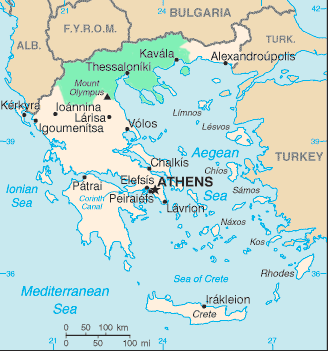
Macedonia's location in Greece

Your AdSense code

Macedonia (Greek: Μακεδονία, IPA /maceðo'nia/) is the largest and second most populous region of Greece, comprising the north of that country. Together with the Greek region of Thrace, it forms Northern Greece. It is part of a larger Balkan region also known in modern times as Macedonia. The Greek region of Macedonia comprises just over half of that larger region, the rest lying in the Former Yugoslav Republic of Macedonia and Bulgaria.

The official Greek position is that the name Macedonia is Greek and should properly apply only to the region of the historical kingdom of Macedon, which is almost entirely contained within Greece. Thus, Greece uses the term Μακεδονία or Macedonia to refer to that specific part of its northern region; other countries, particularly Bulgaria and the Former Yugoslav Republic of Macedonia, instead refer to the region as Aegean Macedonia or Greek Macedonia, reflecting their alternate position that the Greek region comprises only a portion of Macedonia, not its totality.

Local government

Macedonia is divided into three peripheries comprising 13 prefectures or nomoí. The prefectures are further divided into dēmoi (municipalities) or koinótētes (roughly equivalent to British or Australian shires). Macedonia also includes the male-only autonomous monastic republic of Mount Athos, which lies outside the jurisdiction of most Greek and European laws, most notably those regarding the equality of the sexes.

The three Macedonian peripheries are:

West Macedonia, comprising

1. Kastoria
2. Florina
3. Kozani
4. Grevena

Central Macedonia, comprising

5. Pella
6. Imathia
7. Pieria
8. Kilkis
9. Thessaloniki
10. Serres
11. Chalkidice

East Macedonia and Thrace, comprising the two Macedonian prefectures

12. Drama
13. Kavala

(The three Thracian prefectures are Xanthi, Rodhopi and Evros.)


These are overseen by the national government's Ministry of Macedonia and Thrace (known as the Ministry of Northern Greece until August 1988).

Geography

Your AdSense code

Though mostly mountainous, the region also encompasses the valleys of the Aliákmon, Axiós, Nestos, and Strymon rivers, all of which drain into the Aegean Sea. Macedonia has a population of approximately 2,450,000, and its capital and largest city is Thessaloniki, with a population of around 1,350,000.

Other major Macedonian towns and cities (Population)
1. Thessaloniki (with a population of around) 773,180
2. Kavala 63,774
3. Katerini 56,434
4. Serres 56,145
5. Drama 55,632
6. Kozani 47,451
7. Veria 47,411
8. Ptolemaida 32,775
9. Giannitsa 26.296
10. Edessa 25,619
11. Kilkis 24,812
12. Naoussa 19,870
13. Florina 16,711
14. Kastoria 16,218
15. Grevena 15,481
16. Alexandria 13,229
17. Polygyros 10,271

Demography

The region is home to a number of small but established linguistic communities, including speakers of Armenian, Aromanian, Arvanitic, Ladino, Meglenitic, Romany and Slavic languages. After the arrival of large numbers of ethnic Greek refugees from modern-day Turkey in the early twentieth century, it also became home to Greece's largest concentration of speakers of the Pontic dialect of Greek.

Before World War II, the number of Slav-speakers was higher, but many fled to Bulgaria and Yugoslavia during the war and the ensuing Greek Civil War, which ended in 1949. Human Rights Watch released a report in 1994 alleging the denial of rights to Macedonian Slavs by the Greek government. However, Greece recognises its entire citizenry only as Έλληνες Πολίτες (Greek Citizens) and deliberately refuses to recognise any ethnic divisions within its borders. Speaking a language other than Greek is generally regarded a private matter of no concern to the state. Greek is the only official language and the language of public life and education in Macedonia.

The term Macedonian (Greek: Μακεδόνας, IPA /mace'ðonas/) is commonly used in Greece in a geographical (and to a lesser extent historical) sense to refer to Greeks originating from or living in Macedonia. This is one of the main reasons cited by Greeks to explain their objection to the use of the term to describe a specific ethnonation that excludes them, as is controversially the case in the neighbouring Former Yugoslav Republic of Macedonia.

Economy and Transport


Your AdSense code

Despite its rugged terrain, Macedonia possesses some of the richest farmland in Greece in the plain of Drama and the valleys of the Strimon and Axios. A wide variety of foodstuffs and cash crops are grown, including rice, wheat, beans, olives, cotton, tobacco, fruit, grapes, wine and other alcoholic beverages. Food processing and textile weaving constitute the principal manufacturing industries. Tourism is a major industry along the coast, particularly in the Chalcidice peninsula, the island of Thasos and the northern approaches to Mount Olympus. Many tourists originate from Greece's immediate neighbors.

Thessaloniki is a major port city and industrial center; Kavala is the other harbor of Macedonia. Apart from the principal airport at Thessaloniki (Makedonia Airport), airports also exist in Kavala (M.Alexandros Airport), Kozani (Filippos Airport), and Kastoria (Aristotelis Airport). The "Via Egnatia" motorway crosses the full distance of Macedonia, linking its main cities.

Greek Struggle for Macedonia

Links

Retrieved from "http://en.wikipedia.org"

All text is available under the terms of the GNU Free Documentation License

A - B - C - D - E - F - G - H - I - J - K - L - M

N - O - P - Q - R - S - T - U - V - W - X - Y - Z

 
Web www.mlahanas.de
www.hellenica.de

Ancient Greece

Medieval Greece / Byzantine Empire

Modern Greece

Science, Technology , Medicine , Warfare
, Biographies , Life , Cities/Places/Maps , Arts , Literature , Philosophy ,Olympics, Mythology , History , Images

Science, Technology, Arts
, Warfare , Literature, Biographies
Icons, History

Cities, Islands, Regions, Fauna/Flora ,
Biographies , History , Warfare
Science/Technology, Literature, Music , Arts , Film/Actors , Sport , Fashion

Cyprus

Greek-Library - Scientific Web