|
|
MISCELLANEOUS Fibulae pins used to fasten Chitons and Chlamys and for decoration analog to modern safety pin. From the 7th century BC often made of gold and elaborately decorated along a catch plate with animals, a sphinx etc (gold pin (fibula) with 2 winged sphinxes and a lion's head Greek, seventh-fifth century BC) The Charioteer of Delphi and details of his Chiton, a version called xystis used by all chariot drivers during the race. It spans the whole body all the way to his ankles. It is fastened high at the waist with a plain belt. Two straps cross high at his upper back and round his shoulders keep the chiton fixed during the race. Women with a girdle Zone “Girdle” A narrow cord or strip of leather worn over the shoulders, under the arms and tied at the waist or simply around the waist and/or hips as a means of controlling the fullness of the Chiton. The famous Charioteer statue is girded using the first means. Zone, worn both by men and women just above the hips, to be distinguished from the second girdle worn by women just under the breast. The zone kept the chiton in place and furnished the means for regulating its length, since it could be drawn under the girdle so as to leave the feet unimpeded. The girdles of women were often simple cords, but they might be elaborate and handsomely elaborated. The soldiers girdle commonly caller Zostir, was a substantial belt of metal, or of leather plated with metal, worn about the loins to secure the lower part of the cuirass and fastened by hooks. Phrases: elabon tis zonin ton... "grasped some by the girdle" the sign among Persians that one had been condemned to death or eis zonin dedomenai "given for girdle money" as we should say, pin money. (White and Morgan, illustrated dictionary of Xenophon's Anabasis) Strophion / Rom. Cestus Girdle
Mycenaen bronze brooches
Skeiadeion
Umbrellas are known at least since 2400 BC (image discovered in the Mesopotamia region), in Cyprus since 1000 BC. William Sangster, Umbrellas and their History: In Greece, as Becker tells us in his "Charicles," the Parasol was an indispensable adjunct to a lady of fashion. It had also its religious signification. In the Scirophoria, the feast of Athene Sciras, a white Parasol was borne by the priestesses of the goddess from the Acropolis to the Phalerus. In the feasts of Dionysius (in that at Alea in Arcadia, where he was exposed under an Umbrella, and elsewhere) the Umbrella was used, and in an old has-relief the same god is represented as descending ad inferos with a small Umbrella in his hand, like Vishnu before mentioned.
There was also another festival in which they appeared, though without any mystical signification. In the Panathenaea, the daughters of the Metoeci, or foreign residents, carried Parasols over the heads of Athenian women as a mark of inferiority, ---------------------- Kynodesme (“dog leash”) A leather strip (a string around the foreskin “akroposthion” ) binding the penis (called by the Athenians kyon or dog). Used for example by athletes who running nude can be painful. An image of an athlete with a kynodesme Herakles, Dyes and Pigments According to Julius Pollux (Onomasticon I, 45-49), writing in the second century AD, purple dye was first discovered by Herakles, or rather, by his dog, whose mouth was stained purple from chewing on snails along the Levantine coast, the area most famous in antiquity for its purple dye (A nymph called Tyros observed the purple colour: charmed at first sight with the beauty of the colour, she said that she would see Hercules no more, till he brought her a suit dyed the same colour. Hercules, to satisfy his mistress, collected a great number of these shells, and succeeded to stain a robe of the colour the nymph had demanded. J. C. Lettsom). Palaephatus (De Incred 62) also attributes the discovery of purple dye to Herakles and locates it at Tyre in the mid-second millennium B.C. King Phoenix received a purple-dyed robe from Herakles and decreed that the rulers of Phoenicia should wear this colour as a royal symbol. Brendan Burke Early purple dye production on Crete The story is also described by John Malalas in his Chronographia, who considers Heracles "the philosopher", from Tyros as the inventor: Ἐν δὲ τοῖς χρόνοις τῆς βασιλείας τοῦ Φοίνικος ἦν Ἡρακλῆς ὁ φιλόσοφος, ὁ λεγόμενος Τύριος, ὅστις ἐφεῦρε τὴν κογχύλην· ἐωριζόμενος γὰρ ἐπὶ τὸ παράλιον μέρος τῆς Τύρου πόλεως εἶδε ποιμενικὸν κύνα ἐσθίοντα τὴν λεγομένην κογχύλην, ὅπερ ἐστὶ μικρὸν εἶδος θαλάσσιον κοχλιοειδές, καὶ τὸν ποιμένα, νομίζοντα αἱμάσσειν τὸν κύνα, λαβόντα ἀπὸ τῶν προβάτων πόκον ἐρέας καὶ καταμάσσοντα τὸ καταφερόμενον ἐκ τοῦ στόματος τοῦ κυνὸς καὶ βάπτοντα τὸν πόκον. ὁ δὲ Ἡρακλῆς, προσεσχηκὼς μὴ εἶναι αὐτὸ αἷμα, ἀλλὰ βάμματος παραξένου ἀρετήν, ἐθαύμασε· The Phoenicians actually is a name given by the Greeks to the people called the Sidonians according to one interpretation from the greek word "Phoinos" i.e. dark red probably due to the color of the textile they produced. gnafeus γναφεὺς (a cleaner of clothes) καὶ μετεμορφώθη ἔμπροσθεν αὐτῶν, καὶ τὰ ἱμάτια αὐτοῦ ἐγένετο στίλβοντα λευκὰ λίαν, οἷα γναφεὺς ἐπὶ τῆς γῆς οὐ δύναται οὕτως λευκᾶναι (And his raiment became shining, exceeding white as snow; so as no fuller on earth can white them) Mark 9.3, New Testament Epinetron (Επίνητρον)- a pottery thigh protector that women wore over her leg when roving wool. Images: 1 , 2
JEWELRY
Cabinet des Médailles, BNF, Paris, France, Gold earring with filigrane decoration. Taras, third quarter of the 4th century BC.
Ancient Greece: Ear Ring, part of a Diadem, Bracelet (Hellenistic period) Greek Jewelry, Pontika (Ukraine)
Dyfri Williams, Jack Ogden, Greek Gold: Jewelry of the Classical World , Metropolitan Museum of Art
John Boardman, Greek Gems and Finger Rings: Early Bronze to Late Classical INFLUENCE OF ANCIENT GREEK FASHION
Why is Napoleon depicted with his hand in his coat? Aeschines (a Greek orator) postulated that speaking with one's arm outside the toga was considered ill-mannered. Miller says that the hidden hand was a feature of some statues of the ancient Greeks and Romans and that later painters based their poses on classical models. A number of textbooks on oratory published in the eighteenth century, following Aeschines, recommended this gesture. Although Miller doesn't mention it, it is possible that the great French actor Talma, who reportedly trained Napoleon in Imperial comportment, may have been familiar with these works. Tom Holmberg http://www.napoleonseries.org/index.cfm The Eclipse of Classisism: John William Godward Goddess: The Costume Institute at The Metropolitan Museum of Art Some stories about Greek fashion
Quotations What spirit is so empty and blind, that it cannot recognize the fact that the foot is more noble than the shoe, and skin more beautiful that the garment with which it is clothed? CLEONICE But how should women perform so wise and glorious an achievement, we women who dwell in the retirement of the household, clad in diaphanous garments of yellow silk and long flowing gowns,decked out with flowers and shod with dainty little slippers? Greek dress was in its essence inartistic. Nothing should reveal the body but the body. Oscar Wilde Demades, one of the demagogues, publicly taunted Phocion, saying: "Let us simply adopt the whole Spartan constitution here in Athens." To this, Phocion replied: "You, with your perfume and your fancy clothes, are the perfect man to speak in favor of such a proposal." Plutarch, Phocion Miletus imported wool from the local Anatolian countryside, ran it through textile mills, built an impressive clothing industry, and sowed 80 colonies from the Black Sea and Egypt to Italy. With her sixty colonies to the north, Miletus traded clothware for flax, timber, fruit and metals. What's more, Miletus was part of a web of hundreds of additional Greek colonies (including those of relative backwaters like a town called Athens). These were perched, as Plato said, "like frogs" on the shores of Europe's and Western Asia's central seas. So Miletus' commerce stretched from Russia to France, Spain and North Africa, and it sucked in goods from the distant east as well. According to Will Durant, Miletus' resulting wealth became "a scandal" throughout the Mediterranean Howard Bloom Greece, Miletus and Thales - The Birth of the Boundary Breakers - 3,000 BC to 550 BC.
At seven years of age, I carried the sacred vessels; at ten, I pounded barley for the altar of Athene; next, clad in a robe of yellow silk, I played the bear to Artemis at the Brauronia; Aristophanes, Lysistrata Mythological stories IMAGES A young girl with Chiton and Himation 4th century BC Sketch of a Peplos, Chiton, Himation and Chlamys for comparison statue of a young woman wearing a peplos; Roman copy of Hellenistic original so-called “Dancers of Herculaneum”, 5 statues of women wearing the Doric peplos gold pin (fibula) with 2 winged sphinxes and a lion's head Greek, seventh-fifth century BCE, London, Victoria & Albert Museum. Credits: Barbara McManus, 2002 http://www.perseus.tufts.edu/cgi-bin/image?lookup=1992.11.0050&type=vase with a chiton decorated with crosses, boots with curled flaps, and himation with striped border hung over his arms. His long hair is bound up in a heavy bunch at the nape of his neck by a fillet wound twice about his head and tied at the back Women spinning images Wearing the Peplos and the Chiton Eros and Aphrodite textile, Late antique, Kelsey Museum 22170 Domestic scene, one woman showing a piece of cloth to the other.
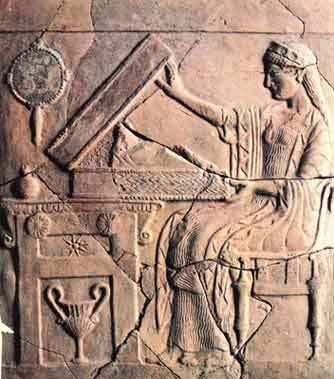
A relief from a Greek colony in Calabria, a woman opens a case probably with clothes, National Museum of Reggio Calabria, 490-450 BC (Image from a Greek school Project) See also: LINKS Ancient Greek Dress (Metropolitan Museum) The Goddess. Pandora's Box: The Chiton, Peplos, and Himation Today! (Ancient Greek Fashion for the modern woman) THE HISTORY OF COSTUME - INDEX By Braun & Schneider c.1861-1880 The Cleopatra Costume on Stage and in Film Ancient Greek Fashion for Centaurs The Kanephoros and Her Festival Mantle in Greek Art, Linda Jones Roccos See also: Roman Clothing Part 1 , Roman Clothing Part 2 (Contains also information about the Peplos and the Chiton) A page on Roman dress, including pictures of Roman and Byzantine clothes. Ancient Roman Bikinis , Roman Shoes The Clothed Body in the Ancient World (A conference in the UK) BOOKS Goddess: The Classical Mode; By Harold Koda exhibition catalogue for the Metropolitan Museum of Art costume institute. It shows the influence of ancient Greek and Roman fashion in more modern times on women's costume

![]() |
||||||||||||||||||