|
|
His (Plato) disciples were, Speusippus the Athenian, Zenocrates of Chalcedon, Aristotle the Stagirite, ..., and numbers of others, among whom there were also two women, Lasthenea of Mantinea, and Axiothea of Phlius, who used even to wear man's clothes, as we are told by Dicaearchus.
Woman spinning, filling a baket "Kalathos" with yarn, Pottery images
Woman spinning, filling a baket ....
Istos (ἱστός) Reconstruction of a weaving device See also Istos (loom) These devices were used much earlier (probably up to 7000 BC from loom weights found ).(Weaving on the Warp-Weighted Loom, References and Links)
Epinetron, woman with an epinetron, Epinetron (Επίνητρον) - a pottery thigh protector that women wore over her leg when roving wool. Minoan Fashion
Snake Goddess, Woman with a sacral knot, "known also as "Parisiana" the girl from Paris / France"
Minoan Traders in Egypt, Minoan women, Reconstruction Archaic Fashion Do you think that Greek art ever tells us what the Greek people were like? Do you believe that the Athenian women were like the stately dignified figures of the Parthenon frieze, or like those marvellous goddesses who sat in the triangular pediments of the same building? If you judge from the art, they certainly were so. But read an authority, like Aristophanes, for instance. You will find that the Athenian ladies laced tightly, wore high-heeled shoes, dyed their hair yellow, painted and rouged their faces, and were exactly like any silly fashionable or fallen creature of our own day. The fact is that we look back on the ages entirely through the medium of art, and art, very fortunately, has never once told us the truth.—Oscar Wilde , The Decay of Lying
Different color reconstructions of a Greek women sculpture. The umbrella like hat is a meniskos and is used as a weather and bird protection (But, if your award is against us, don't fail to have metal covers fashioned for yourselves, like those they place over statues; else, look out! for the day you wear a white tunic all the birds will soil it with their droppings. Aristophanes LEADER OF SECOND SEMI-CHORUS, Birds). The Peplos Kore See also other Korai and their clothes Classical and Hellenistic Fashion MEN Chiton ( Exomis version short chiton with right arm left free for activity. Used by workers or slaves or by the Amazons [in Greek Art] with part of the breast exposed ). Xystis a chiton version used by all chariot drivers during the race. It spans the whole body all the way to his ankles See: Charioteer of Delphi
Fisherman with an Exomis Chitoniskos a short chiton, sometimes worn over another chiton: they wore short tunics which stopped above the knees, about as thick as the linen of a bed-sack Xenophon Anabasis (χιτωνίσκους δὲ ἐνεδεδύκεσαν ὑπὲρ γονάτων, πάχος ὡς λινὸν στρωματοδέσμου) warrior wearing a short cuirass over a short -sleeved chitoniskos , Image Left: A winged youth, wearing winged boots, a chitoniskos, and a taenia Right: a bearded warrior, wearing chitoniskos and pilos (a helmet) Chlaina (χλαῖνα): a woolen cloth for men carried in the winter over the shoulders
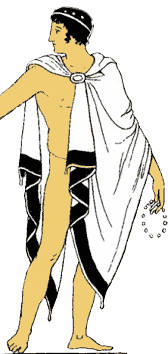
Chlamys, a small mantle was used for travel or riding. It was fastened with a fibula in front or on one shoulder. Boy Wearing a Chlamys (Tralles c. 250 BC)
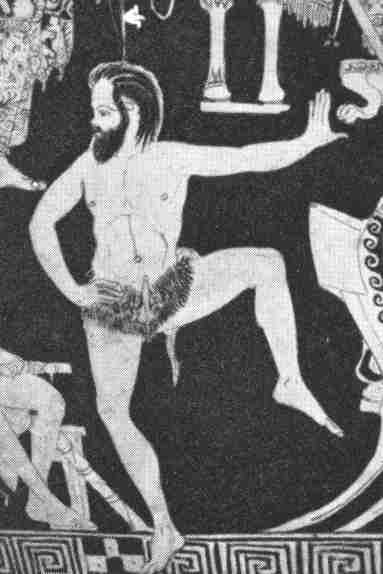
Himation “mantle” Perizoma (περιζωμα), a kind of simple underwear (cotton or linen or other material, a hair skirt, perizoma , worn by members of the satyr chorus,seen in a late-fifth-century BC vase by the Pronomos painter: Naples, Museo Nazionale Archeologico, 3240; Beazley, ARV (n. 3), 2: 1336, no. 1; illustrated in Arias, Hirmer, and Shefton, History (n. 3), plate 218. Podeia, a kind of socks produced by a material from plants, according to Theophrastus. Called impilia by the Romans. The sculpture The Ephebe of Tralleis wears such socks.

![]() |
|||||||||||||||||||||||