|
|
This article covers the events of, reaction to, and historical legacy of Roman Emperor Constantine I's legalization, legitimization, and conversion to Christianity Christianity's status in the empire before the Edict of Milan Contrary to popular imagery, hunting Christians was not the first priority of the Roman Empire. Only under the specific direction of reigning emperors and at times of particular crisis (which were put down to the Christians not worshipping the state gods) were persecutions enforced:
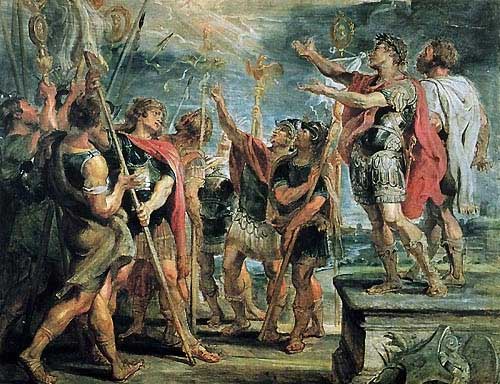
In the end, many Christians kept their religion to themselves even during times of peace, because it was all too likely that the peace would soon be replaced by violence, and that those who had revealed themselves as Christians might be remembered as such during later trials Constantine's conversion Sincerity? Constantine is best known for being the first Roman Emperor to embrace Christianity, although he may have continued in his pre-Christian beliefs as well, and some scholars doubt the historicity of his conversion, because even Church tradition argued that he was not baptised until his deathbed, and it was only witnessed by the same Christian leaders that made the subsequent claims of his conversion. In the eyes of many Christian apologists that delay islikely to be linked to a then widely held belief that only pre-baptismal sins could not be forgiven, so many postponed baptism as long as they could. Constantine even turned to preaching in later life, giving his own sermons in the palace before his court and invited crowds, preaching harmony at first, but gradually turning more confrontational with the old pagan ways. The reason for this later "change of heart" remains conjectural. Constantine's conversion, by Rubens. Constantine's vision The traditional story of Constantine's conversion is presented as Constantine seeing an omen in the sky whilst marching along with his troops — in front of the sun, the shape of an ambigram cross with two Greek letters, chi and rho (the first two letters of the name of Jesus Christ in Greek) and the inscription In hoc signo vinces (with/in this sign, you will conquer) before his victory in the Battle of Milvian Bridge on October 28, 312. Either upon seeing this vision or upon being instructed to use the emblem he had just seen as a standard in a dream afterwards [citation needed], Constantine is said to have instituted a new standard to be carried into battle, the labarum, which many Christians see as a purely Christian symbol, though the other major religion of the time - of Sol Invictus - also used a similar symbol. There are at least three different surviving ancient versions of this battle in greater detail, not all of them are by prominent Christian apologists: Panegyric of Constantine, sees the vision as from Apollo as Constantine's patron [citation needed] Lactantius, Of the manner in which the persecutors died, 44; Eusebius of Caesarea, The life of Constantine, 24-31; Zosimus, New History, 2 (43,44) (this version seems to have numerous owls as an omen of victory, and is by a hostile pagan). It should be noted that historical sources of the 4th century Roman Empire seem to be unusually rich in omens, magic, hexes and spells, while lacking in critical inquiry. A suspicion of literacy and higher learning which began at least a century before had grown. These may have been the results of the fear and high mortality rates caused by the first and second outbreak of the Antonine Plague (165 - 180 and 251 - 266 respectively).
Other influences Family influence is also thought to account for Constantine's later, more personal adoption of Christianity: Helena is said to be "probably born a Christian" though virtually nothing is known of her background, save that her mother was the daughter of an innkeeper and her father a successful soldier, a career that excluded overt Christians. Helena became known later in life for numerous pilgrimages.
Constantine's edicts and actions Along with his co-Emperor Licinius, Constantine was the first to grant Christianity the status of an allowed religion (religio licita). Their so-called Edict of Milan of 313 removed penalties for professing Christianity , under which many had been martyred in previous persecutions of Christians (ie legalized it), and returned confiscated Church property. However, it neither made paganism illegal nor made Christianity a state-sponsored religion, but instead granted religious freedom. There is no historical evidence that an Edict of Milan was ever issued as a concrete or formal document [citation needed]. Licinius after returning to his Eastern portion of the Empire, notes that he had agreed certain matters about religious tolerance with Constantine. He does not mention an Edict of Milan and we have no surviving writing from Constantine on this topic. Nevertheless, the term Edict of Milan is a good shorthand to signify the new policy of religious tolerance, so is still used even by scholars who doubts its existence.
Public office After the Edict, new avenues were opened to Christians, including the right to compete with pagan Romans in the traditional cursus honorum for high government positions, and greater acceptance into general civil society. Constantine respected cultivation, and his court was composed of older, respected, and honored men. Leading Roman families that refused Christianity were denied positions of power, yet pagans still received appointments, even up to the end of his life, and two-thirds of his top government was non-Christian.[1]
Army Considered a critical component of Roman society, the army was a prime target for conversion. Exerting his absolute power, Constantine had the army recite his composed Latin prayer in an attempt to convert them to Christianity, which failed. It was unpopular in the army both because it accepted women, and because the soldiers generally were members of other religions such as those of Mithras and Isis.
Church building He began a large building program of churches in the Holy Land, which while greatly expanding the faith also allowed considerable increase in the power and wealth of the clergy. New churches were allowed to be built, often under Constantine's (or his mother Helena's) patronage, under which the church prospered. He gave the Lateran Palace to the Pope, ordered the building of:
 |
|
||||||||||||||