Arkalochori

Periphery: Crete
Prefecture : Heraklion

Arkalochori (older form Arkalochorion) is a modern city in Crete, SE of Heraklion city, part of the Arkalochori municipality and also an archaeological site of a Minoan sacred cave in eastern Crete. The sacred cave was used from 2500 to 1450 BC.

Arkalochori is 3 km south from the recently discovered Minoan palace at the small village of Galatas.[2] G. Rethemiotakis[3] has associated the votive objects of the cave with the Galatas palace.


Division of the municipality , population 10897 (2001):

  • Arkalochorion / Δ.δ. Αρκαλοχωρίου [ 3.927 ]
    • Arkalochorion / το Αρκαλοχώριον [ 3.346 ]
    • Agia Semni / η Αγία Σεμνή [ 20 ]
    • Archontikon / το Αρχοντικόν [ 186 ]
    • Zinta / η Ζίντα [ 147 ]
    • Milliarision / το Μιλλιαρήσιον [ 2 ]
    • Mousouta / η Μουσούτα [ 101 ]
    • Choumerion / το Χουμέριον [ 125 ]
  • Garipa / Δ.δ. Γαρίπας [ 650 ]
    • Garipa / η Γαρίπα [ 517 ]
    • Drapetion / το Δραπέτιον [ 133 ]
  • Demation / Δ.δ. Δεματίου [ 417 ]
  • Inion / Δ.δ. Ινίου [ 661 ]
    • Inion / το Ίνιον [ 370 ]
    • Machaira / η Μαχαιρά [ 235 ]
    • Monastirakion / το Μοναστηράκιον [ 56 ]
  • Karavados / Δ.δ. Καραβάδου -- ο Καραβάδος [ 301 ]
  • Kasanos / Δ.δ. Κασάνου [ 538 ]
  • Kastelliana / Δ.δ. Καστελλιανών [ 732 ]
    • Kato Kastelliana / τα Κάτω Καστελλιανά [ 290 ]
    • Ano Kastelliana / τα Άνω Καστελλιανά [ 193 ]
    • Tsoutsouros / ο Τσούτσουρος [ 115 ]
    • Favriana / τα Φαβριανά [ 83 ]
    • Filippoi / οι Φίλιπποι [ 51 ]
  • Lefkochorion / Δ.δ. Λευκοχωρίου [ 405 ]
    • Lefkochorion / το Λευκοχώριον [ 186 ]
    • Ano Poulia / η Άνω Πουλιά [ 70 ]
    • Kalon Chorion / το Καλόν Χωρίον [ 56 ]
    • Kato Poulia / η Κάτω Πουλιά [ 86 ]
    • Chandrou / η Χανδρού [ 7 ]
  • Nipidotos / Δ.δ. Νιπιδιτού [ 615 ]
    • Nipidotos / ο Νιπιδιτός [ 282 ]
    • Roussochoria / τα Ρουσσοχώρια [ 333 ]
  • Panagia / Δ.δ. Παναγίας -- η Παναγία [ 606 ]
  • Panorama / Δ.δ. Πανοράματος [ 496 ]
  • Partira / Δ.δ. Παρτίρων [ 555 ]
    • Partira / τα Πάρτιρα [ 404 ]
    • Mikra Episkopi / η Μικρά Επισκοπή [ 0 ]
    • Badia / η Μπαδιά [ 68 ]
    • Tourloti / η Τουρλωτή [ 83 ]
  • Patsideros / Δ.δ. Πατσιδερού -- ο Πατσίδερος [ 278 ]
  • Skinias / Δ.δ. Σκινιά [ 716 ]
    • Skinias / ο Σκινιάς [ 611 ]
    • Vakiotai / οι Βακιώται [ 22 ]
    • Lagouta / η Λαγούτα [ 83 ]

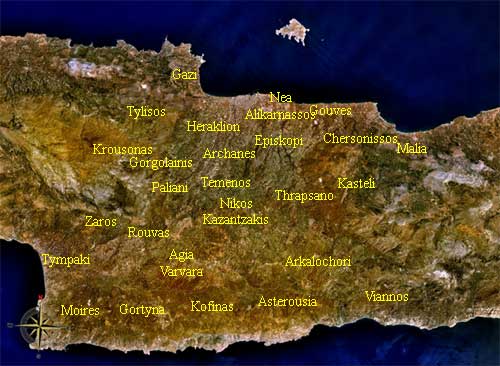
Arkalochori municipality, Satellite image

Archaeology

The Arkalochori cave first came to scholarly attention in 1912, when peasants collected 20 kilos of Bronze Age weapons from the cave known locally as "the treasure hole"[4] and sold them for scrap metal in the port town of Candia (Iraklion). The ephor Joseph Hadjidakis, the first explorer of the central cave chamber of three, was rewarded with the discovery of masses of bronze votive weapons, and a silver double axe.[5] No gold was reported to the Ministry until 1934, when a rabbit unearthed a gold labrys that was found by a child; the village turned out to rifle the site.[6] Prof. Spyridon Marinatos immediately took charge of the site[7] and discovered the side chambers, which had been blocked with debris from the collapse of the cave's natural roof; there were found, undisturbed, hundreds of bronze axes, twenty-five gold ones and seven of silver, a hoard of bronze long swords, the longest (to 1.055 m) discovered in Europe,[8] and daggers and gold simulacra of weapons, cast "bun" ingots of copper alloy, a small altar, and pottery sherds that enabled the deposits to be given a range of continuous occupation[9] from the late third millennium BCE to Late Minoan II (ca. 1500 to 1425 BCE). The warlike implements, both actual weapons and their votive simulacra, are in strong contrast to the entirely peaceable finds at other Minoan cave sites.[10]

The cave was not forgotten after the collapse, and votive offerings continued to be deposited at its mouth.

At the Arkalochori cave, among the bronze and gold double axes, the second-millennium bronze Arkalochori Axe excavated by Marinatos in 1934. It has been suggested that these might be Linear A but Professor Glanville Price agrees with Louis Godart that "the characters on the axe are no more than a 'pseudo-inscription* engraved by an illiterate in uncomprehending imitation of authentic Linear A characters on other similar axes."[11]

The Psychro cave also contained labrys votive offerings.

Notes

1. ^ "Δείτε τη Διοικητική Διαίρεση" (in Greek). 09-09.
2. ^ Galatas is also a village in the Peloponnesus.
3. ^ Rethemiotakis, "To neo minoiko Anaktoro ston Galata Pediados kai to 'Iero Spilaio' Arkalochoriou", in A. Karetsou, ed. Krites Thalassodromoi 1999:99-111
4. ^ The hill has remained sacred, though now associated with the prophet Elias
5. ^ Hadjidakis, "A Minoan sacred cave at Arkalokhori in Crete", Annual of the British School at Athens 19 (1912-13:35-47).
6. ^ Elizabeth Pierce Blegen, "News items from Athens", American Journal of Archaeology 39 (1935:134).
7. ^ His suggestion that Arkalochori suited the birth cave of Zeus better than the Dictaean cave, who lies farther from Lyktos (modern Castelli Pediados), mentioned by Hesiod, was made from the start.
8. ^ The "immensely long swords... with their sharply angular, finely grooved and elegant inscised designs", which "have poor relations in the Cyclades", were categorized as a Cretan invention by N. K. Sandars, "The First Aegean Swords and Their Ancestry", American Journal of Archaeology 65.1 (January 1961), pp. 17-29.
9. ^ Some scholars, such as Ellen Adams (Adams, "Power and Ritual in Neopalatial Crete: A Regional Comparison" World Archaeology 36.1, (March 2004:26-42, esp. p. 33f) see the gold axes as a hoard deposited at a single time; the lack of figurines at Arkalochori is noted.
10. ^ Martin P. Nilsson, The Minoan-Mycenaean Religion (Lund, 1950:73ff) contains detailed descriptions of the site and findings.
11. ^ Price, Glanville (2000). Encyclopedia of the languages of Europe. Wiley-Blackwell. p. 384. ISBN 978-0631220398.
References

* Jones, Donald W. 1999 Peak Sanctuaries and Sacred Caves in Minoan Crete ISBN 91-7081-153-9


http://www.ypai.gr/atlas/thesi_uk.asp?idthesis=569

Retrieved from "http://en.wikipedia.org"
All text is available under the terms of the GNU Free Documentation License

A - B - C - D - E - F - G - H - I - J - K - L - M

N - O - P - Q - R - S - T - U - V - W - X - Y - Z

Ancient Greece

Medieval Greece / Byzantine Empire

Modern Greece

Science, Technology , Medicine , Warfare
, Biographies , Life , Cities/Places/Maps , Arts , Literature , Philosophy ,Olympics, Mythology , History , Images

Science, Technology, Arts
, Warfare , Literature, Biographies
Icons, History

Cities, Islands, Regions, Fauna/Flora ,
Biographies , History , Warfare
Science/Technology, Literature, Music , Arts , Film/Actors , Sport , Fashion

Cyprus

Greek-Library - Scientific Web