|
|
"Sea power is of great importance"
The Hellenic Navy (Greek: Πολεμικό Ναυτικό, Polemikó Naftikó) is the naval force of the modern nation of Greece (Hellenic Republic). The modern Greek navy has its roots in the naval forces of Admiral Miaoulis and Lady Bouboulina, which fought in the Greek War of Independence. During the periods of monarchy (1833-1924 and 1936-1973) it was known as the Royal Hellenic Navy (Βασιλικό Ναυτικό, Vassilikó Naftikó).
The Hellenic Navy, (Greek: Πολεμικό Ναύτικο), is the naval force of the modern nation of Greece (Hellenic Republic). The modern Greek navy has its roots in the naval forces of Admiral Miaoulis and Lady Bouboulina, which fought in the Greek War of Independence.
 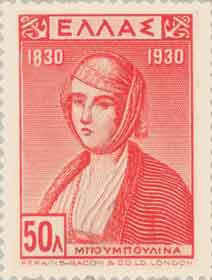
Andreas Miaoulis and "Lady" Laskarina Bouboulina
History
See main article: History of the Hellenic Navy
The navy of the Revolution
The naval forces of the 1821 revolution were composed of ships owned by shipowners of the revolted islands and ports. Since the largest part were from the islands of Hydra, Spetsai and Psara it has been called the three island fleet. Some money from the second revolutionary loan was spent in ordering warships abroad, among them steamships. These ships were organised by Ioannis Kapodistrias into the national fleet, based in the island of Poros.
Development in the 19th century
King Othon expanded the fleet by ordering new vessels abroad and constructing several auxiliary ships in Poros. From his time also dates the first effort to create an independent naval officer academy in 1845. The great reorganization of the fleet was undertaken by the governments of prime minister Charilaos Trikoupis. Trikoupis invited a French mission to retrain the officers, refounded the naval academy, the Scholē Naftikōn Dokimōn (Σχολή Ναυτικών Δοκίμων) in 1884, and ordered 3 battleships (the Ydra, Spetsai and Psara) that ensured supremacy over the Ottoman Empire. However, during the Greco-Turkish War of 1897 the fleet mostly stayed in port due to the incompetence of its leadership.
Balkan Wars and First World War
After the 1909 Goudi pronunciamento Greece bought several ships, most prominently among them the armoured cruiser Georgios Averof, which liberated the Aegean islands and twice defeated the Ottoman fleet during the First Balkan War. Major purchases from overseas included the two American pre-dreadnought battleships of the Mississippi class, bought in 1914, named Lemnos and Kilkis and a Chinese light cruiser which was named Helli.[1]
During World War I, the fleet, for the third time in its history, was confiscated by the Allies due to the Greek National Schism. When Greece eventually entered the war on the Allied side in 1917, what was left of it was returned.
Inter-war years
During the interwar years and especially after the Asia Minor catastrophe the financial situation of Greece allowed for new, primarily light, ships to be ordered, such as submarines and destroyers, and increased emphasis was laid on training. During the late 1930s, the regime of Ioannis Metaxas did make an effort to improve its condition but it was stopped short by World War II.
The Second World War
On August 15, 1940, an Italian submarine torpedoed the light cruiser Elli without any prior declaration of war. After Italy attacked on land on October 28, 1940, the Royal Hellenic Navy joined action with the British Royal Navy against the Regia Marina having as its main mission to secure internal communications in the Aegean and to impede the supply of Italian troops in Albania via the Adriatic. With the collapse of Greece following the German attack on Greece in April 1941, a large part of the fleet escaped to Alexandria, led by the elderly Averof. There it joined the British Mediterranean Fleet, continuing the fight against the Axis. Although its operations were primarily focused in the Mediterranean, Greek Navy ships took part in convoy escort duty in the Atlantic and the Indian Oceans, as well as at the Allied landings at Normandy. With the withdrawal of German troops from Greece in October 1944, the Fleet returned home.
Post-war activities
Remaining loyal to the Royal government, the Navy participated in the Greek Civil War (1946-1949). With Greece's entry into NATO, the Navy came to rely more on ships and weapons of US origin, and a very close cooperation was developed with the USN. Aside from its role inside the Atlantic Alliance, since the 1960s, with the renewed deterioration of the Greco-Turkish relations, the Navy focused itself increasingly to countering the Turkish threat, a role which forms the main task of the Hellenic Navy to this day. Recently, Greek ships have participated in the Gulf War and in the international naval forces supporting Operation Enduring Freedom in the Indian Ocean.Greek Navy participates in Unifil with the HS Kanaris Elli class, to patrol against arms smugglers. Four of the Elli class frigates will be decomissioned by the end of 2007.
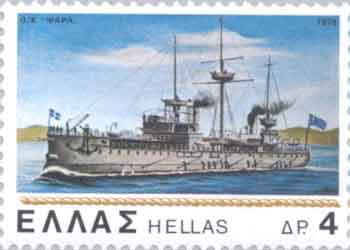
Battleship Psara
Organization
- Γενικό Επιτελείο Ναυτικού (ΓΕΝ) Hellenic Navy General Staff
- Αρχηγείο Στόλου (ΑΣ) Fleet Headquarters
- Ναυτική Διοίκηση Αιγαίου (ΝΔΑ) Aegean Group
- Ναυτική Διοίκηση Ιονίου (ΝΔΙ) Ionian Group
- Ναυτική Διοίκηση Βορείου Ελλάδος (ΝΔΒΕ) Northern Greece Group
- Διοίκηση Ναυτικής Εκπαίδευσης (ΔΝΕ) Navy Training Command
- Διοίκηση Διοικητικής Μέριμνας (ΔΔΜΕ) Administrating Provision Command
- Ναύσταθμος Σούδας Souda Navy Station
- Ναύσταθμος Σαλαμίνας Salamina Navy Station
Combat Arms
- Διοίκηση Φρεγατών (ΔΦΓ) Frigate Command
- Διοίκηση Κανονιοφόρων (ΔΚΦ) Gunboat Command
- Διοίκηση Ταχέων Σκαφών (ΔΤΣ) Fast Attack Craft Command
- Διοίκηση Υποβρυχίων (ΔΥ) Submarine Command
- Διοίκηση Αμφιβίων Δυνάμεων (ΔΑΔ) Amphibious Assault Forces Command
- Greece does not have a marine corps established as a separate branch attached to the naval service, instead, the Army Special Forces Command includes the 32nd Marine Brigade (32 Ταξιαρχία Πεζοναυτική); the Navy provides the landing craft etc.
- Διοίκηση Υποβρυχίων Καταστροφών (ΔΥΚ) Underwater Demolition Command
- Ναυτική Συνεργασία Fleet Air Arm
- Διοίκηση Ελικοπτέρων Ναυτικού (ΔΕΝ) Naval Helicopter Command
- 353 Μοίρα Ναυτικής Συνεργασίας (353 ΜΝΑΣ) 353rd Tactical Support Squadron
| Combat Support Arms
- Διοίκηση Ναρκοπολέμου (ΔΝΑΡ) Minesweeper Command
| Combat Service Support
- Σχολή Εξάσκησης Ναυτικής Τακτικής (ΣΕΝΤ) Naval Tactical Training School (under Fleet Headquarters) |}
Fleet
FrigatesSurface Fleet

HS "Hydra" (F-452) at HMNB Portsmouth, UK
- 4 x Frigates Class Meko-200HN
- HS Hydra (F 452) Φ/Γ Ύδρα
- HS Spetsai (F 453) Φ/Γ Σπέτσαι
- HS Psara (F 454) Φ/Γ Ψαρά
- HS Salamis (F 455) Φ/Γ Σαλαμίς
- 10 x Frigates Class Standard
- HS Elli (F 450) Elli-class Φ/Γ 'Ελλη
- HS Limnos (F 451) Elli-class Φ/Γ Λήμνος
- HS Adrias (F 459) Φ/Γ Αδρίας
- HS Aegeon (F 460) Φ/Γ Αιγαίον
- HS Navarinon (F 461) Φ/Γ Ναυαρίνον
- HS Kountouriotis (F 462) Φ/Γ Κουντουριώτης
- HS Bouboulina (F 463) Φ/Γ Μπουμπουλίνα
- HS Kanaris (F 464) Φ/Γ Κανάρης
- HS Themistoklis (F 465) Φ/Γ Θεμιστοκλής
- HS Nikiforos Fokas (F 466) Φ/Γ Νικηφόρος Φωκάς
Fast Attack Craft Missile
- 5 x FACM Class Super Vita
- PCFG Roussen (P67) ΤΠΚ Ρουσσέν
- PCFG Daniolos (P68) ΤΠΚ Δανιόλος
- PCFG Krystallidis (P69) ΤΠΚ Κρυσταλλίδης
- PCFG Grigoropoulos (P70) ΤΠΚ Γρηγορόπουλος (under construction)
- PCFG Ritsos (P71) ΤΠΚ Ριτσος (under construction)
- 4 x FACM Class La Combattante III
- PCFG Laskos (P 20) ΤΠΚ Λάσκος
- PCFG Blessas (P 21) ΤΠΚ Μπλέσσας
- PCFG Mikonios (P 22) ΤΠΚ Μυκόνιος
- PCFG Troupakis (P 23) ΤΠΚ Τρουπάκης
- 5 x FACM Class La Combattante IIIb
- PCFG Kavaloudis (P 24) ΤΠΚ Καβαλούδης
- PCFG Degiannis (P 26) ΤΠΚ Ντεγιάννης
- PCFG Xenos (P 27) ΤΠΚ Ξένος
- PCFG Simitzopoulos (P 28) ΤΠΚ Σιμιτζόπουλος
- PCFG Starakis (P 29) ΤΠΚ Σταράκης
- 6 x FACM Class La Combattante IIa
- PCFG Botsis (P 72) ΤΠΚ Βότσης (P 72)
- PCFG Pezopoulos (P 73) ΤΠΚ Πεζόπουλος (P 73)
- PCFG Blaxavas (P 74) ΤΠΚ Βλαχάβας (P 74)
- PCFG Maridakis (P 75) ΤΠΚ Μαριδάκης (P 75)
- PCFG Tournas (P 76) ΤΠΚ Τουρνάς (P 76)
- PCFG Sakipis (P 77) ΤΠΚ Σακίπης (P 77)
PCF Tyfon (P 56)
Submarines
- 4 x Glaukos class (Type 209 (1100) Submarine - Neptune I upgrade)
- Glaukos (S-110) Υ/Β Γλαύκος
- Nireus (S-111) Υ/Β Νηρεύς
- Triton (S-112) Υ/Β Τρίτων
- Proteus (S-113) Υ/Β Πρωτεύς
- 4 x Poseidon class (Type 209 (1200) Submarine - Neptune II upgrade)
- Poseidon (S-116) Υ/Β Ποσειδών
- Amfitriti (S-117) Υ/Β Αμφιτρίτη
- Okeanos (S-118) Υ/Β Ωκεανός
- Pontos (S-132) Υ/Β Πόντος
Named after Greek Sea gods
Landing Ships
- 5 x Landing Ships Jason Class (LST)
- LST Chios (L 173) Α/Γ Χίος
- LST Samos (L 174) Α/Γ Σάμος
- LST Ikaria (L 175) Α/Γ Ικαρία
- LST Lesbos (L 176) Α/Γ Λέσβος
- LST Rodos (L 177) Α/Γ Ρόδος
- 4 x Fast Landing Ships Class Zubr/Pomornik (LCAC)
- LCAC Kefallinia (L180) ΠΤΜ Κεφαλληνία
- LCAC Ithaki (L181) ΠΤΜ Ιθάκη
- LCAC Kerkira (L182) ΠΤΜ Κέρκυρα
- LCAC Zakinthos (L183) ΠΤΜ Ζάκυνθος
Gunboat Ships
- 3 x Gunboats Class Thetis
- FS/PG Νiki (P 62) Κ/Φ Νίκη
- FS/PG Doxa (P 63) Κ/Φ Δόξα
- FS/PG Eleftheria (P 64) Κ/Φ Ελευθερία
- 2 x Gunboats Class Osprey 55
- PG Armatolos (P 18) Κ/Φ Αρματωλός
- PG Navmachos (P 19) Κ/Φ Ναυμαχός
- 2 x Gunboats Class Osprey HSY-55
- PG Kasos (P 57) Κ/Φ Κάσος
- PG Polemistis (P 61) Κ/Φ Πολεμιστής
- 4 × Gunboats Class Osprey HSY-56A
- PG Mahitis (P 266) Κ/Φ Μαχητής
- PG Nikiforos (P 267) Κ/Φ Νικηφόρος
- PG Aititos (P 268) Κ/Φ Αήττητος
- PG Krataios (P 269) Κ/Φ Κραταιός
- 2 x Gunboats Class Asheville
- PC/PG Tolmi (P 229) Κ/Φ Τόλμη
- PC/PG Ormi (P 230) Κ/Φ Ορμή
Minesweepers/Mine-Layers
- 6 x Minesweepers - Coastal
- MSC Alkyon (M 211) Ν/Α Αλκυών
- MSC Avra (M 214) Ν/Α Αύρα
- MSC Aidon (M 240) Ν/Α Αηδών
- MSC Kichli (M 241) Ν/Α Κίχλη
- MSC Kissa (M 242) Ν/Α Κίσσα
- MSC Pleias (M 248) Ν/Α Πλειάς
- Mine-Sweepers/Hunters Class Hunt
- MSC/MSH Europe (M 62) Ν/ΘΗ Ευρώπη
- MSC/MSH Kallisto (M 63) Ν/ΘΗ Καλλιστώ
Auxiliary Vessels
1 x AOR Etna class
- AOR Prometheus (A 374) ΠΓΥ Προμηθεύς
2 x ex german LUNEBURGType 701C class,replenishment ships
- AO Axios (A 464) Π/Φ Αξιός
- AO Aliakmon (A 470) Π/Φ Αλιάκμων
Aircraft Origin Type Versions In service[2] Notes
Aérospatiale Alouette III France helicopter SA 319B 2
AB212ASW Italy antisubmarine helicopter AB 212ASW 10
Lockheed P-3 Orion United States maritime patrol P-3B 5
Sikorsky S-70 United States naval helicopter S-70B-6 11
---------------------------
Future plan
4 x Papanikolis class (Type 214 submarine)
- Papanikolis (S-120) Υ/Β Παπανικολής (It will be commissioned by the first half of 2007)
- Pipinos (S-121) Υ/Β Πιπίνος
- Matrozos (S-122) Υ/Β Ματρώζος
- Katsonis (S-123) Υ/Β Κατσώνης
Recently decommissioned ships
See also: List of decommissioned ships of the Hellenic Navy
Fast attack craft torpedo
- 4 x FACT Class Jaguar
- PCF Hesperos (P 50) (ex German SEEADLER P6068), decommissioned 21 December 2004
- PCF Kyklon (P 53) (ex German GREIF P-6071), decommissioned 7 October 2005
- PCF Lelaps (P 54) (ex German KONDOR P-6070), decommissioned 21 December 2004
- PCF Tyfon (P 56) (ex German GEIER P-6073), decommissioned 7 October 2005
Mine-Sweepers
- MSC Klio (M 213) Class A (decommissioned 3 October 2006)
- MSC Erato (M 60) Class Castano (decommissioned 3 October 2006)
Designations Explanation
- F: Frigates
- FACM: Fast Attack Craft Missile
- FACT: Fast Attack Craft Torpedo
- FFG: Guided Missile Frigate
- FS: Fast Ship
- L: Landing ships
- LCAC: Landing Craft Air Cushion
- LST: Landing Ship Tank
- M: Mine Warfare Ships
- MSC: Mine Sweeper Craft or Mine Sweep Craft
- MSH: Mine Sweeper/Hunter
- P: Patrol ships
- PC: Patrol Craft
- PCF: Patrol Craft Fast
- PCFG: Patrol Craft, Fast, Guided missile
- PG: Patrol Guard
- S: Submarines
History of the Hellenic Navy
Hellenic Navy Ships
Military of Greece
Hellenic Navy | Hellenic Army | Hellenic Air Force
Links
Retrieved parts from "http://en.wikipedia.org/"
All text is available under the terms of the GNU Free Documentation License
|
Ancient Greece
|
Medieval Greece / Byzantine Empire
|
Modern Greece
|
|
Science, Technology , Medicine , Warfare
, Biographies , Life , Cities/Places/Maps , Arts , Literature , Philosophy ,Olympics, Mythology , History , Images
|
Science, Technology, Arts
, Warfare , Literature, Biographies
Icons, History
|
Cities, Islands, Regions, Fauna/Flora ,
Biographies , History , Warfare
Science/Technology, Literature, Music , Arts , Film/Actors , Sport , Fashion
|

|
|