- Ancient Pydna
- http://www.factmonster.com/ce6/history/A0840609.html
- Mapquest - Pydna, street map not yet available
- Coordinates: 40° 34' 39'' N 25° 22' 19'' E
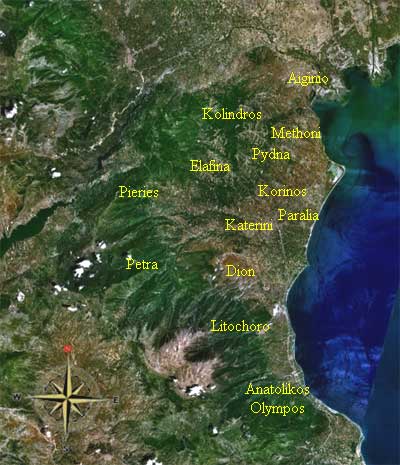
Pydna (in Greek: Πύδνα, older transliteration: Púdna), also Pidna was a Greek city in Ancient Macedonia, the most important in Pieria. Modern Pydna is a municipality in the northeastern part of the prefecture of Pieria. Pydna is situated in a fertile land and is north of the Pierian plain. The hills and mountains dominates the west while beaches and the Thermian Gulf dominates the east. Pydna is linked with GR-1/E75 with its interchange to its west and in Kitros. The old highway ran through Pydna. Pydna is located N of Larissa, NE of Katerini, ESE of Veria and WSW of Thessaloniki.
Nearest places
Ancient Pydna Pydna was part of the Kingdom of Macedonia under Alexander I of Macedon (Thucydides I 131 1), found it its independence. Pydna was besieged by the Athenians in 432 BC. Pydna was surmised again by Archelaus in 410 BC. The population was moved 20 stadia towards the interior of the plains and was refounded (Diodorus of Sicily 13.14). The Athenians sieged Pydna in 364 BC and eight years later in 356 BC, Philip II of Macedon retook Pydna in spite of a secret agreement that bound it in Athens. Cassander sieged Pydna in 317 BC and put an end to its queen mother Olympias. The Battle of Pydna occurred on June 22, 168 BC and the Roman General Aemilius Paullus Macedonius defeated Perseus with a Roman victory. The site of the city is discussed, according to epigraphic indices corresponding to a Byzantine tradition at the village of Kytros rather in Alonia. The Macedonian tomb was discovered and explored by L Heuzey during the famous archaeological expedition in 1867.
Modern Pydna
Pydna today is a town that is located near the archaeological site. Other Pydna has schools, a few lyceums, a gymnasium, banks, a post office, beaches located to the east, and a few squares (plateies).
Division of the municipality of Pydna
Alonia Alonia is a village founded by refuges from Kars Trapezounta, other refuged followed some settled in the village Koukos. Until 1926 the village was known as Salonia Koukos. Palaiostani Palaiostani is a village of Pydna, part of the synonymous district together with Mikri Milia. In the past Palaiostani was known as Palionestani. The name means "it will be resurrected" as the village around 1600 was destroyed by a fire an rebuild. The religious festival honouring Agia Paraskevi (the saint and name of the main church) is celebrated 26 July each year, with dances and songs . Mikri Milia is a settlement of the district of Palaiostani . The main church is Agios Gerasimos. The population of the village was 41 (2001), actually it is around 30 . The monastery Panagia Makryrachi is in the region , founded in the byzantine period, destroyed during the Greek war of independenceof 1821 and was damaged by the Germans during occupation in 1944. It was rebuild later and operates with 3 monks. Historical population
Mayors of Pydna 1999 - 2003 Dimitrios Vasileiadis References
Alonia
Kitros
Sfendami Sfendami (old Form Sfendamio)
Links
See also
![]() |
|
||||||||||||||||||||||||||||||||||||||||||||||||||||||