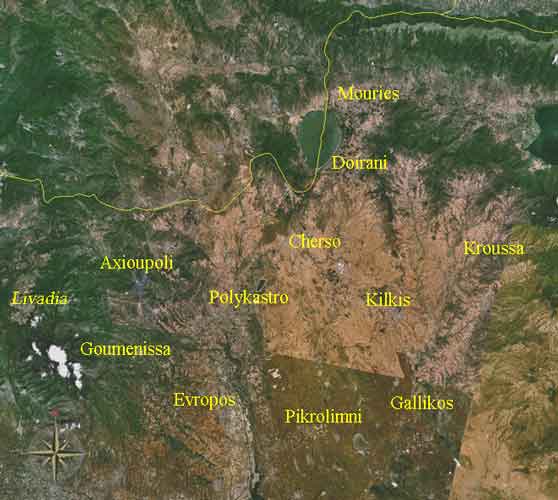
Goumenissa (Greek: Γουμένισσα) is a small traditional town, part of the synonymous municipality, capital of Paionia Province of Kilkis Prefecture in Central Macedonia, Greece. The town sits on the southeastern part of the Paiko mountain range.

Located 69 km northwest of Thessaloniki, 539 km north of Athens and 20 km north of the ancient capital of Macedonia , Pella. Its exact location is 40° 56min 38sec N 22° 26min 39sec E

Goumenissa is also the seat of the Bishop of Diocese of Goumenissa, Axioupolis and Polykastron (Greek: Ιερά Μητρόπολις Γουμενίσσης, Αξιουπόλεως & Πολυκάστρου.

There are a lot of versions of the origin of the name Goumenissa. Most likely is that according to the local tradition, robbers hung the Abbot (Greek: Ηγούμενο egoumeno) of the abbey, and the city's name (goumen che-a), which means place of Abbot derived from this; later it became Goumenissa.

Goumenissa has splendid narrow streets lined with traditional houses and is renowned for a wide range of things; apart from its preindustrial monuments built beside lush springs, there are traditional wineries which prove the expertise of this small country town to produce good quality wine. Its multifarious identity accounts for the unfailing enthusiasm overwhelming the different kinds of tourists Goumenissa attracts. Its folklore museum, its impromptu brass bands as well as its customs, events and fetes, all of them are reflective of the traditional lifestyle that has resisted the course of time.

Central Square, The French Fountain

Division of the municipality with a population 6819 in 2001.


History

The ancient city Europos was 6km from the city of Goumenissa. The so-called Kouros of Europos was discovered in the archaeological site of Europos

Hellenistic Era

Goumenissa possesses a small part from the land of the Paionians (Ancient Greek Παίονες, Paiones), the exact boundaries of which, like the early history of its inhabitants, are very obscure. According to the national legend (Herodotus v. 16), they were Teucrian colonists from Troy. Homer (Iliad, book II, line 848) speaks of Paionians from the Axios fighting on the side of the Trojans, but the Iliad does not mention whether the Paionians were kin to the Trojans. Homer gives the Paionian leader as a certain Pyraechmes (parentage unknown); but later on in the Iliad Homer mentions a second leader, named Asteropaeus, son of Pelagon.


Roman Era

After the Roman conquest of Macedon in 146 BC, Paionia east and west of theAxios formed the second and third districts respectively of the Roman province of Macedonia (Livy xiv. 29). Centuries later under Diocletian, Paionia and Pelagonia formed a province called Macedonia secunda or Macedonia salutaris, belonging to the Praetorian prefecture of Illyricum.

Ottoman Era

In the period of Ottoman domination the area was characterized self-governed town and acquired privileges. From then Goumenissa developed in economic, cultural and religious centre

The Macedonian Struggle

Greek Military Unit during conflicts in Giannitsa Lake, Macedonian Struggle

Since 1899, the Bulgarian guerrillas of the Internal Macedonian-Adrianople Revolutionary Organization (commonly known by the abbreviation IMRO) turned against Ottoman authorities with the slogan "autonomy for Macedonia". The guerrillas purported to be protectors of all Christians in the area, for this reason they initially did not bother Greece. But gradually, increasing tensions emerged among the followers of the Patriarchate of Constantinople (the patriarchalists, mostly, but not only, Greeks) and those of the Bulgarian Exarchate (exclusively Bulgarians); this brought to the assassination by the IMRO of members of pro-Greek and pro-Serbian parties.

From 1900 onwards, the danger of Bulgarian control had upset the Greeks of Macedonia. As Ion Dragoumis wrote in his calendar ‘‘I am thinking how these communities of Greece outside of the Greek Kingdom can affiliate in our state. Why wait their liberation only from Greece? Let them work as Greece didn’t exist and then she will help them.’’

While Dragoumis concerned himself with the financial organisation of the efforts, Bishop Germanos collaborating with the Ottomans animated the Greek population against the IMRO and formed committees to promoting the Greek national interests. The fighters for the greek cause labelled themselves "Macedonomachoi" (Macedonian Fighters) and were portrayed by Greek writer Penelope Delta in her novel "Ta Mystika tou Valtou" (The Secrets of the Swamp) as well as in the book of memoirs "The Macedonian struggle" by Germanos Karavangelis. These Greek forces were often backed up by the Turkish authorities and armed forces and occasionally operated together against the IMRO.The rioting in Macedonia, the atrocities of Bulgarian guerrilla troops against locals who considered themselves as Greeks and especially the death of Pavlos Melas in 1904 (he was the first Greek officer to enter Macedonia with guerrillas) caused intense nationalistic feelings in Greece. This led to the decision to send more guerrilla troops in order to thwart Bulgarian efforts to entice all of the Slavic speaking majority population of Macedonia with their propaganda (not only the exarchists but also the patriarchists). Conflicts ended after the revolution of Young Turks in July, 1908, as they promised to respect all ethnicities and religions and generally to provide a constitution.

Liberation

On October 23, 1912, during the course of the First Balkan War Goumenissa was liberated and incorporated into the Greek Kingdom


Modern Era

Duyring World War I, late 1915, Franco-British divisions marched on Paionia Province. A French Division camped in Goumenissa and built a military hospital and a power station.

The population exchanges among Greece, Turkey, and Bulgaria after 1923 resulted in the replacement by Greek refugees from Asia Minor and Romilia region of most of the Slavic and Turkish elements.Greek Macedonia experienced radical demographic transformations with the arrival of the Greek refugees; the Greeks, who had been the 43% in 1913, were estimated to be the 89% of the population of Greek Macedonia in 1928. The Slavic minority in Greek Macedonia, who were referred to by the Greek authorities as “Slavomacedonians”, “Slavophone Greeks” and “Bulgarisants”, were subjected to a gradual assimilation by the Greek majority. Their numbers were reduced by a large-scale emigration to North America in the 1920s and the 1930s and to Eastern Europe and Yugoslavia following the Greek Civil War (1944-1949).

During World War II Goumenissa and Central Macedonia were occupied (1941–- 1944) by Germany.

In the 50s there was a massive emigration to the United States, Australia, Canada, West Germany and other Greek cities, mainly to Thessaloniki and Athens. In the 80s many civil war refugees were allowed to re-emigrate.

19th Century Houses

Monasteries

  • Monastery of the Virgin Mary at Goumenissa (Est. 1100) Belongs to: Diocese of Goumenissa
  • Monastery of St. Nikodimos at Pentalofon (Est. 1981) Dependency of: the Monastery of Simonos Petra, Mount Athos
  • Monastery of St. Raphael, Nicholas & Irene at Griva (Est. 1992) Belongs to: Diocese of Goumenissa
  • Monastery of St. George at Anydron (Est. 1991) (nuns monastery) Belongs to: Diocese of Goumenissa

Landmarks

Winery

  • Central Square
  • The French Fountain
  • Square of St. George
  • Small Square
  • Folklore Museum of Goumenissa
  • Silk Factory
  • Boutari Winery, Aidarinis Winery, Domaine Tatsis, Distillery Dimitri Kambouri
  • Two Rivers
  • Traditional mountainous settlement of Kastaneri

Cathedral of St. George, 1869

Economy

Goumenissa is a famous wine producing region with Appellation d’origine de Qualite Superieure ,centre of a region that has been renowned for the quality of its wines for hundreds of years.

Transportation

Goumenissa is accessed

  • From Athens with GR-1/E75 to Polykastron Interchange
  • From Thessaloniki with E86 to Gefyra Junction then E75 to Polykastron Interchange or E86 to Intetchange after 1km from Nea Pella
  • From Igoumenitsa and Alexandroupolis with GR-4/GR-2/E90 (Via Egnatia motorway) to Chalastra Interchange then E75 to Polykastron Interchange
  • From FYROM with E75 to Polykastron Interchange
  • By bus from Athens and Thessaloniki Bus to Kilkis
  • By railway from Thessaloniki and Central Europe to Polykastron Station 15km from Goumenissa Greek Railways
  • By air from Makedonia Airport SKG Thessaloniki.If you have a private plane Polykastron Airport 15km from Goumenissa

Goumenissa as filming location

Marcello Mastroianni in the film The BeeKeeper


1986 The Bee Keeper (greek Ο Μελισσοκόμος) Director:Theo Angelopoulos
Cast: Marcello Mastroianni, Nadia Mourouzi

1981 The Factory (greek Το Εργοστάσιο)(french L 'Ucine) Director: Tasos Psaras
Cast: Vasilis Kolovos, Dimitra Hatoupi

Sport Clubs

Club, Sport, Founded League, Venue

  • Paiko Goumenissas (Πάικο Γουμένισσας), Football, 1950, A' Erasitehniki: Hellenic Football Federation, Stadium of Goumenissa
  • Makedonikos Grivas (Μακεδονικός Γρίβας), Football, ,B' Erasitehniki: Hellenic Football Federation ,Stadium of Griva
  • Heracles Karpis (Ηρακλής Κάρπης), Football, , B' Erasitehniki: Hellenic Football Federation Stadium of Karpi
  • Astrapi Stathis (Αστραπή Στάθη), Football , ,Γ' Erasitehniki: Hellenic Football Federation, Stadium of Stathis
  • Keravnos Filyrias (Κεραυνός Φιλυριάς), Football Γ' Erasitehniki: Hellenic Football Federation ,Stadium of Filyria
  • A.O.K.(Αθλητικός Όμιλος Καλαθοσφαιριστών), Basketball ,1981 Γ : Hellenic Basketball Federation Gym, Stadium of Goumenissa
  • Α.Ο.Γ. (Αθλητικός Όμιλος Γουμένισσας), Athletics, 1981, Hellenic Amateur Athletic Association, Stadium of Goumenissa

Climate

Month Jan Feb Mar Apr May Jun Jul Aug Sep Oct Nov Dec
Avg Maximum temp[°C] 9 10 13 18 23 28 31 30 26 21 14 10
Avg Minimum temp[°C] 1 2 5 7 12 16 18 18 15 11 6 2
Rainfall (mm) 40 38 43 35 43 30 22 20 27 45 58 50
Record temperatures [°C] 20 22 25 31 36 39 42 39 36 32 27 26

Province Paionia
Population 6819
Area 200.33 km²
Elevation 268 m
Postal code 613 00
Area code 2343
Licence plate code ΚΙ
Mayor Stylianos Papapanagiotou

Links

Municipalities and communities of the Kilkis Prefecture

Axioupoli | Cherso | Doirani | Evropos | Gallikos | Goumenissa | Kilkis | Kroussa | Mouries | Pikrolimni | Polykastro

Livadia

Retrieved from "http://en.wikipedia.org/"
All text is available under the terms of the GNU Free Documentation License

A - B - C - D - E - F - G - H - I - J - K - L - M

N - O - P - Q - R - S - T - U - V - W - X - Y - Z

Ancient Greece

Medieval Greece / Byzantine Empire

Modern Greece

Science, Technology , Medicine , Warfare
, Biographies , Life , Cities/Places/Maps , Arts , Literature , Philosophy ,Olympics, Mythology , History , Images

Science, Technology, Arts
, Warfare , Literature, Biographies
Icons, History

Cities, Islands, Regions, Fauna/Flora ,
Biographies , History , Warfare
Science/Technology, Literature, Music , Arts , Film/Actors , Sport , Fashion

Cyprus

Greek-Library - Scientific Web