|
|
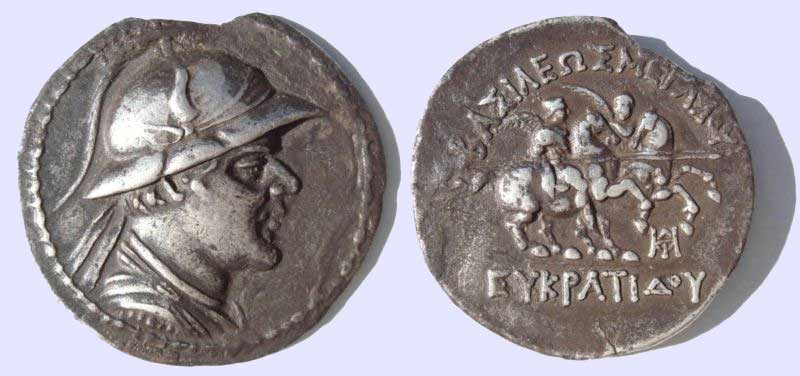
Silver tetradrachm of King Eucratides I (171-145 BC)
Obv: Bust of Eucratides. Helmet decorated with a bull's horn and ear.
Rev: Depiction of the Dioscuri, each holding palm in left hand, spear in righthand. Greek legend: BASILEOS MEGALOY EUKRATIDOY "Great King Eucratides". Mint monogram below.
Characteristics: Diameter 32 mm. Weight 15.9 g. Attic standard. One of the largest Hellenic coins ever minted.
Eucratides I (ca. 170 BC - 145 BC) was one of the
References
- "The Shape of Ancient Thought. Comparative studies in Greek and Indian Philosophies" by Thomas McEvilley (Allworth Press and the School of Visual Arts, 2002) ISBN 1581152035
- "Buddhism in Central Asia" by B.N. Puri (Motilal Banarsidass Pub, January 1, 2000) ISBN 8120803728
- "The Greeks in Bactria and India", W.W. Tarn, Cambridge University Press.
Retrieved from "http://en.wikipedia.org/"
All text is available under the terms of the GNU Free Documentation License
|
Ancient Greece
|
Medieval Greece / Byzantine Empire
|
Modern Greece
|
|
Science, Technology , Medicine , Warfare
, Biographies , Life , Cities/Places/Maps , Arts , Literature , Philosophy ,Olympics, Mythology , History , Images
|
Science, Technology, Arts
, Warfare , Literature, Biographies
Icons, History
|
Cities, Islands, Regions, Fauna/Flora ,
Biographies , History , Warfare
Science/Technology, Literature, Music , Arts , Film/Actors , Sport , Fashion
|

|
|