|
|
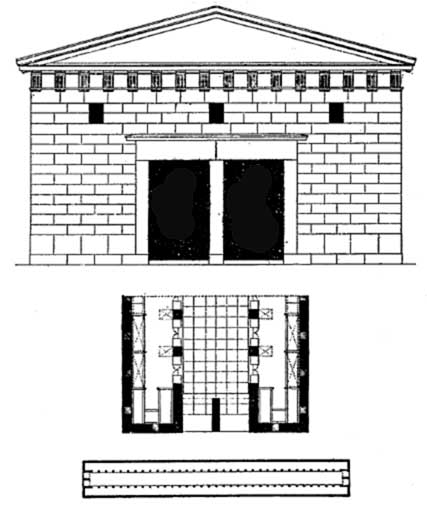
Philon Arsenal Philon (Φίλων), Athenian architect of the 4th century BC, is known as the planner of two important works: the portico of the great Hall of the Mysteries at Eleusis and an arsenal at Athens. Of the last we have exact knowledge from an inscription. E. A. Gardner (Ancient Athens, p. 557) observes that it "is perhaps known to us more in detail than any other lost monument of antiquity." It was to hold the rigging of the galleys; and was so contrived that all its contents were visible from a central hall, and so liable to the inspection of the Athenian democracy. He is known to have written books on the Athenian arsenal and on the proportions of temple buildings, but these are now lost. Strabo Now in early times Munychia was walled, and covered with habitations in a manner similar to the city of the Rhodians, including within the circuit of its walls both the Peiraeus and the harbors, which were full of ship-houses, among which was the arsenal, the work of Philon. And the naval station was sufficient for the four hundred ships, for no fewer than this the Athenians were wont to despatch on expeditions References This article incorporates text from the Encyclopædia Britannica Eleventh Edition, a publication now in the public domain.
G. A. Steinhauer : "La découverte de I’arsenal de Philon", in TROPIS IV, Athens, 471-480 , 1996 Retrieved from "http://en.wikipedia.org/ "
 |
|
||||||||||||||