|
|
Part 1 - Ancient Greece
Michael Lahanas
Portraits and Biographies
|

Alcibiades had a dog which cost him seventy minas, and was a very large one, and very handsome. His tail, which was his principal ornament, he caused to be cut off, and his acquaintances exclaiming at him for it, and telling him that all Athens was sorry for the dog, and cried out upon him for this action, he laughed, and said, "Just what I wanted has happened then. I wished the Athenians to talk about this, that they might not say something worse of me.", Plutarch Alcibiades
There was one boy, and," he added slowly, "one peculiar incident. It occurred in my last year at Portora. The boy was a couple of years younger than I—we were great friends; we used to take long walks together and I talked to him interminably. I told him what I should have done had I been Alexander, or how I'd have played king in Athens, had I been Alcibiades. As early as I can remember I used to identify myself with every distinguished character I read about, but when I was fifteen or sixteen I noticed with some wonder that I could think of myself as Alcibiades or Sophocles more easily than as Alexander or Cæsar. The life of books had begun to interest me more than real life....Oscar Wilde
A review of some ancient Greek and Roman literature suggests that the Greek general Alcibiades (c. 450 - 404 B.C.) possessed personality traits that enable a DSM-IV TR (Diagnostic and Statistical Manual of Mental Disorders ) diagnosis of antisocial personality disorder with narcissistic features to be formulated Dr Kathleen Evans
|

Alexander the Great, UK Stamp 2003
Alexander wept when he heard from Anaxarchus that there was an infinite number of worlds; and his friends asking him if any accident had befallen him, he returns this answer: “Do you not think it a matter worthy of lamentation that when there is such a vast multitude of them, we have not yet conquered one?” Plutarch
|

Alexander the Great with a Globe (a flat Earth actually) divided in Europe, Asia and Africa (the so called T and O medieval map) , his feets upon a lion and a dragon ("Over the asp and basilisk you shall go, and trample the lion and dragon under foot.", Psalm 91).
|

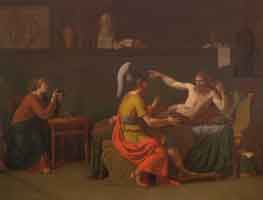
Pericles and Anaxagoras, Belle Augustin-Louis

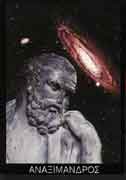
Anaximander (Αναξίμανδρος )
Anaximenes (Αναξιμένης )
Anaximenes of Lampsacus
Anaxinus of Oreus, executed after Demosthenes claims that he was a Macedonian spy
Anaxiphales
Anaxippus
Andocides
Andreas of Lacedaemon, stadion race winner 64 BC
Androclus of Messenia, stadion race winner 768 BC
Andromachus
Andromachus, father of Timaeus
Andromachus of Ambracia, stadion race winner 60 BC
Andromachus from Crete, physician of the emperor Nero (inventor of the antidot Theriaca Andromachi)
Andromenes of Corinth, stadion race 308, 304 BC
Andronicus Cyrrhestes
Andronicus of Rhodes
Androsthenes of Cyzicus
Androsthenes of Thasos
Androtion
Aneristus, Lacedaemonian ambassador to Persia
Angelion
Anochas of Tarentum, stadion race winner 520 BC
Antagoras of Rhodes
Antalcidas
Anthemius
Anthestion of Argos, stadion race winner 52 BC
Anticles of Messenia, stadion race winner 748 BC
Anticles , Athenian commander
Anticleides
Anticrates of Epidaurus, stadion race winner 600 BC
Antidotus
Antigenidas
Antigone of Macedonia
Antigonus of Macedonia, stadion race winner 292, 288 BC
Antigonus of Carystus
Antigonus I Monophthalmos (Αντίγονος Α' Κύκλωψ ή Μονόφθαλμος)
Antigonus II Gonatas (Αντίγονος Β’ Γονατάς)
Antigonus III Doson
Antigonus of Cumae
Antileon
Antimachus of Colophon
Antimachus of Elis (Dyspontium), stadion race 772 BC
Antimachus of Teos
|
|