- City Portal
- Mapquest - Komotini, street map not yet available
- Coordinates: 41 ° 7' 2'' N 25° 24' 4''
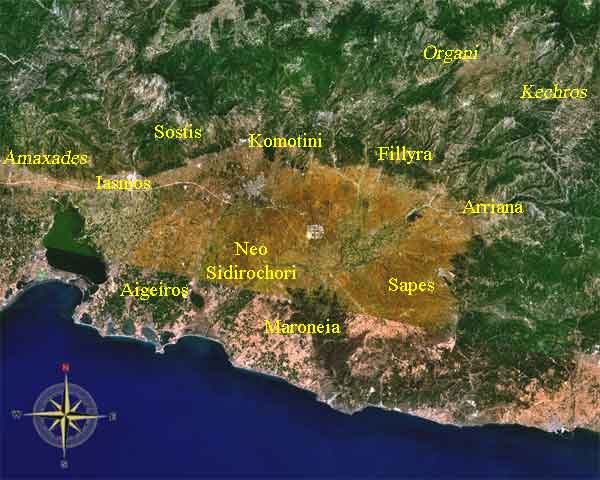
Komotini ( Greek: Κομοτηνή) is the current capital of the Greek department of Thrace, located in the north-east of Greece, Rodopi Prefecture. In the Byzantine Era, the city was known as Koumoutzina or Komotina and in the Ottoman Era, Komotini was known as Goumoutzina. It is the centre of the administrative district of East Macedonia-Thrace, the centre of the prefectural administration of Rodhopi, Evros and the capital of the Prefecture.
Also based in the city is the Democritus University of Thrace first opened in 1973.
The city is level, built on the Thracian Valley and next to the feet of the Rodopi plateau at an altitude of 32-38m. There is little urban planning, paricularly within the Old Town. Exceptional to this rule are the most recently constructed quarters. Trying to abolish the image of the oriental slum, the inhabitants of the city have been endeavouring to highlight its European image. According to the 2001 census, the city's population amounts to 52,500, a number that excludes the approximately 13,000 resident students, trainees and soldiers.
Tsanaklios School, Google Earth (in the center) The city's history is practically contemporary with that of Via Egnatia, the Roman road which connected Dyrrhachium with Constantinople and grew with that trade route, firstly under the shadow of Maximianopolis and then under Ottoman occupation, while the Christian element was acutely suppressed. During the first Balkan War, Bulgarian forces capture the city, only to surrender it back to the Greek army during the second Balkan War on July 14, 1913. The Treaty of Bucharest, however, hands the city back to Bulgaria and Greece decides to respect it. Despite the different devices schemed by the residents, in order to avoid Bulgarian occupation, the city remained in the jurisdiction of Bulgaria until the end of WWI. In 1920 Komotini is rendered to Greece after a diplomatic victory from the prime minster of Greece that time Eleftherios Venizelos and Charisios Vamvakas. The population is made up of desecendants of refugees from Armenia and Greek refugees from Asia Minor.
Komotini today In the heart of the city has hte full-greek park of Agia Paraskevi and the open-roof theatre which welcomes many cultural shows including politistiko kalokairi (πολιτιστικό καλοκαίρι = political summer), regional thratre, anoichto panepistimio (') or open university, etc. One of the permanent political places in Komotini. 6 km NW of Komotini finds Nymfaia forests. One village with recreation, trails, games, playgrounds, sports and environmental studies. The forests which passed by a paved roads which lead to the Byzantine fortress and the historical fort of Nymfaia. Komotini has several museums including the Archaeological, Byzantine and folklore museums. The population is extremely polyglot for a city of this size and it is made up of local Greeks, Greek refugees from Asia Minor , Turkish-speaking muslims, Pomaks, gypsies, descendants of Armenian refugees, and recent refugees from the countries of the former USSR (mainly Georgia, Armenia, Russia and Kazakhstan). Other Komotini is the administrative seat of the Eastern Macedonia and Thrace region, the Democritus University (third biggest in the country) and numerous governmental organisations. It has primary schools, gymnasia, lyceums, a Police Academy, Army bases, 7 University departments, banks, a post office, 3 Sports centres, a train station (Thessaloniki - Drama - Alexandroupoli) an Intercity Bus Station and several squares (plateies). Komotini also has one of the biggest and better organised Industrial Areas in Greece. Transport Komotini does not have a civilian airport but is well-served by two airports. The nearest one is in Alexandroupoli (65km) and the other is in Kavala (110km). It has good rail and bus links to all continental Greek cities and the good provincial road network has been supplemented by the new Egnatia Motorway. Archaeological museum The local museum is the window to the history of Komotini. You can wonder the numerous exhibhts in all of Greek Thrace. From the recent exhibits, the museums features Byzantine and folklore museum and the agricultural straw objects agriculture and domestic uses in the museum, basket makers of the Romas.
Division of the municipality
Historical population
Sports Teams
Links Komotini Archaeological Museum Ecclesiastical Museum of the Holy Bishopry of Maroneia and Komotini
![]() |
|
||||||||||||||||||||||||||||||||||||||||||||||||||||||||