|
|
The beauty of the nature which surrounds them
increases the impatience of the enemies to conquer the region
and the pain of the besieged losing it.
Whoever dies today dies thousand times
Dionysios Solomos , The Free Besieged
| Statistics

|
| Prefecture: |
Aitolia-Acarnania |
Location:
Latitude:
Longitude: |
38.38/38 °22'51' N lat.
21.428/21 °25'45' E long |
| Area |
280.2 km² |
Population: (2001)
- Total
- Density ¹
- Rank |
17988
64.2 /km ²
|
Elevation:
-lowest:
-centre:
-highest: |
Gulf of Patras
9 m(centre)
about 600 to 800 m |
| Postal code: |
302 00 |
| Area/distance code: |
26310 |
| Municipal code: |
0218 |
| Car designation: |
ME (Messolonghi) |
| 3-letter abbreviation: |
MES |
Periphery:West Greece
Prefecture : Aitolia-Acarnania
 
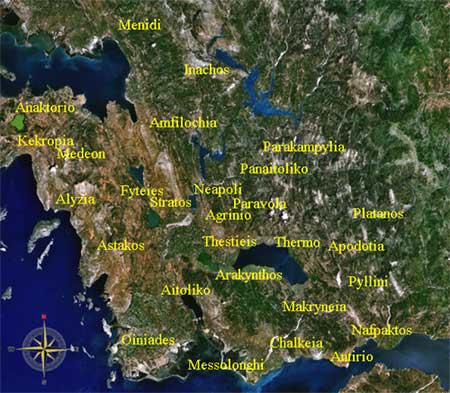
Messolonghi (Greek: Μεσολόγγι, Mesolóngi, older forms Messolongi, Missolonghi, Mesolongion) is a town of about 12,000 people (as of 1991 census) in central Greece. The town is the capital of Aetolia and Acarnania and is also the second largest town. It is the seat of the municipality of Iera Poli Messolonghiou. Messolonghi is linked and is bypasses since the 1960s with GR-5/E55. The road to Astakos is to the northwest and is also accessed to GE-48 to the east. It is located S of Agrinio, SSW of Karpenisi, WSW od Amfissa, W of the Rio-Antirio Bridge, W of Nafpaktos, E of Aitoliko and SE of Astakos. The town was founded in the 16th century and is located between the Acheloos and the Evinos rivers. The town contains a port on the Gulf of Patras (Patra or Patrai). It trades in fish, wine, and tobacco. The Arakynthos mountains lie to the northeast. The town is almost canalized but houses are within the gulf and the swamplands.
The Messolonghi Lagoon lies to the west and is also a swampy area. In the ancient times, the land was part of the gulf. The town had a train station which used to link the railway line linking to Ioannina and became abandoned in the 1980s.
In the ancient times, the land was part of the gulf. The town had a train station which used to link the railway line linking to Ioannina and became abandoned in the 1980s.
Messolonghi was a major stronghold of the Greek insurgents in the Greek War of Independence. Its inhabitants successfully resisted a siege by Turkish forces of the Ottoman Empire in 1822-–23 and held out heroically against a second siege from 1825 to 1826, when the Ottoman forces captured the town. The famous English poet Lord Byron, who supported the Greek struggle for independence, died there in 1824. He is commemorated by a cenotaph and a statue located in the town.
The Siege of Missolonghi. Lithograph 58 cm x 78 cm National Historical Museum, Print Collection. From I. Gennadius and Fr. Boissonas, Histoire picturale de la guerre de l’indépendence Hellénique par le general Makriyannis notice historique, Geneva, Paris, 1926.

"LA GRECE SUR LES RUINES DE MISSOLONGHI" , Greece on the Ruins of Messolonghi, 1826, 209x147 cm, Delacroix Eugène (Charenton-Saint-Maurice 1798 - Paris 1863). Bordeaux, musée des Beaux-Arts, France
Theodoros P. Vryzakis, The sortie from Missolonghi
The Byron Chronology, 1823-4 Greece and death in Missolonghi
Historical population
| Year |
Population |
Municipal population |
| 1981 |
11375 |
- |
| 1991 |
10916 |
16859 |
| 2001 |
12225 |
17988 |
Sites of interest
Museum of the History and the Art of the Holy City of Mesolongi, website
1926 Stamp, 100 years since the siege of Messologhi, headstone from the tomb of Markos Botsaris,

The tomb of the heroes in Messolonghi
Other
Messolonghi has a schools, lyceums, gymnasia, churches, banks, a police station, a water tower, a post office, a junior soccer team, and a square (plateia).

Byron in Messolonghi
Municipality of Messolonghi , population 17988 in 2001
- Messolonghi / Δ.δ. Μεσολογγίου [13791]
- Messolonghi / το Μεσολόγγι [12225]
- Agios Symeon / ο Άγιος Συμεών [3]
- Agrilia / η Αγριλιά [552]
- Arvanitaiika / τα Αρβανιταίικα [103]
- Archaia Alikarna / η Αρχαία Αλίκαρνα [29]
- Vasiladi (island) / το Βασιλάδι (νησίδα) [0]
- Zesti / η Ζεστή [144]
- Theodorakaiika / τα Θεοδωρακαίικα [50]
- Karitsa / η Καρίτσα 33
- Komma (island) / το Κόμμα (νησίδα) [0]
- Mesokampos / ο Μεσόκαμπος [181]
- Babakoula / η Μπαμπακούλα [9]
- Nea Ydragogeia / τα Νέα Υδραγωγεία [55]
- Notios Diavlos / ο Νότιος Δίαυλος [1]
- Prokopanistos (island) / ο Προκοπάνιστος (νησίδα) [0]
- Schinos / ο Σχίνος [17]
- Schoinias (island) / ο Σχοινιάς (νησίδα) [0]
- Tourlis (island) / η Τουρλίς (νησίδα) [110]
- Trelangatha / τα Τρελάγκαθα [276]
- Chounista / η Χούνιστα [3]
- Agios Georgios / Δ.δ. Αγίου Γεωργίου [877]
- Agios Thomas / Δ.δ. Αγίου Θωμά [624]
- Agios Thomas / ο Άγιος Θωμάς [520]
- Agraforrachi / η Αγραφορράχη [36]
- Metochi / το Μετόχι [17]
- Paspaliareika / τα Πασπαλιαρέικα [51]
- Ano Koudounion / Δ.δ. Άνω Κουδουνίου [105]
- Ellinika / Δ.δ. Ελληνικών [480]
- Evinochorion / Δ.δ. Ευηνοχωρίου [1706]
- Ano Mousoura / Δ.δ. Μουσούρων -- τα Άνω Μούσουρα [212]
- Retsina / Δ.δ. Ρετσίνων [193]
- Kato Retsina / τα Κάτω Ρέτσινα [147]
- Trypes / οι Τρύπες [46]
Persons
Spyridon Trikoupis (1788-1873), father of Charilaos Trikoupis
Lord Byron in Greece his heart was buried in Missolonghi April 1824
John Lykoudis (1910 Missolonghi -1980) major and medical doctor involved in the treatment of peptic ulcer disease
Links
| Northwest: Aitoliko |
North: Arakynthos |
Northeast: Makrynia |
| West: Messolonghi Lagoon |
Iera Poli Messolongiou |
East: Chalkia |
|
South: Gulf of Patras |
|
|
Ancient Greece
|
Medieval Greece / Byzantine Empire
|
Modern Greece
|
|
Science, Technology , Medicine , Warfare
, Biographies , Life , Cities/Places/Maps , Arts , Literature , Philosophy ,Olympics, Mythology , History , Images
|
Science, Technology, Arts
, Warfare , Literature, Biographies
Icons, History
|
Cities, Islands, Regions, Fauna/Flora ,
Biographies , History , Warfare
Science/Technology, Literature, Music , Arts , Film/Actors , Sport , Fashion
|

|
|