Edessa

Periphery: Central Macedonia
Prefecture : Pella

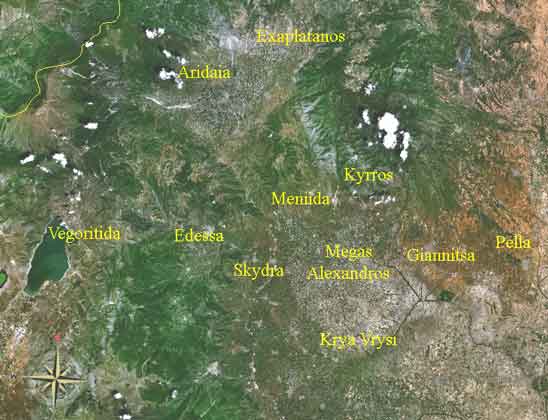
Edessa Google Earth

Edessa City Falls

Edessa (Greek: Έδεσσα is a town , population 18253 (2001) inhabitants in northern Greece, the capital of the Pella prefecture, part of the Edessa municipality. Edessa is also the home of the Marketing and Administration Department of the University of Macedonia. Website

Name

Statistics
Prefecture: Pella (capital)
Province Edessa
Location:
Latitude:
Longitude:

40.7975/40°47'55" N
22.046/22°2'44" E
Population: (2001)
  18.253
Elevation:
 -lowest:
 -centre:
 -highest:

about 200 m
320 m(centre)
southern part
Postal code: 582 00
Area/distance code: 11-30-23810 (030-23810)-2
Municipal code: 4104
Car designation: EE
3-letter abbreviation: EDE Edessa
Name of inhabitants: Edessan sing.
-s pl.
Address of administration: 1 Egon Square
Edessa 582 00
Website: www.edessacity.gr

The name Edessa was ascribed an Illyrian origin by U. Wilcken, in his biography of Alexander the Great (noted by Walter Bauer 1934; 1971; ch. 1), the "town of the waters", due to its copious water resources and its tourist attraction of the waterfalls, located in the actual town center. The Ancient Macedonian name "Edessa" was commemorated by Seleucus I Nicator in refounding an ancient city in northern Mesopotamia: see Edessa, Mesopotamia. The name of the city in Slavic is "Voden/Воден" (derived from voda/вода, i.e. water), in Turkish the city can be known as either "Edessa" or "Vodine", and in Aromanian the city can be known as either "Edessa" or "Vudena", which comes from an alternative Greek name for the city Βοδενά Vodená.

History

Archaelogical remains have been discovered on the site of ancient Edessa, just below the modern city. The walls and the agora have been unearthed so far. A colonade with inscription in Greek dates from Roman times. The city achieved certain prominence in the first centuries AD, being located in the Via Egnatia. From 27 BC to 249 AD it had its own mint. St. Vassa and her three children were put to death in the 3rd Century AD.

Very little is known about the fate of the city after 500 AD. Its bishop Issidoros participated in the Ecumenical Council of 692. After the slavic settlements of the 6th-8th century, the name of "Edessa" disappears and what remains of the city (a fortress in the acropolis of the ancient city) is renamed "Vodena". It is known as such to the 11th century Byzantine historian John Skylitzes. It is mentioned as both Edessa and Vodena by emperor-historian John VI Kantakouzenos who laid siege to the city in the 1340s. Conquered by the Sebs of Stephen Dusan at that time, it fell to the Ottomans along with the rest of Macedonia around 1390.

Edessa

After more than 500 years of Ottoman rule, Edessa was liberated by the Greek Army on 18 October 1912. At that time, it was already well on its way to becoming a major industrial center in Macedonia. Four large textile factories were in operation by 1914, employing the abundant waterfalls as a source of energy. In addition, a large segment of the population specialised in silk production, allowing Edessa to enjoy a high standard of living in the interwar period (1922-1940).

The town suffered during the last days of German occupation in 1944. As a retaliation for the shooting of one soldier by resistance fighters, the Nazis put Edessa to fire. Half of the city, including the Cathedral and the First Primary School, were destroyed and thousands of people were left homeless.

In the postwar period Edessa gradually lost its competitive advantage in industry and declined economically and in population. In the beginning of the 21st century, it is a city based on services (mostly linked to its function as capital of the Pella Prefecture) and tourism.

Karanos Waterfall

Communications

Television

TAS

Other

Edessa has schools, lyceums, gymnasia, banks, a train station (Florina - Edessa - Veria), a sports centre, a post office, and squares (plateies) including Egon Square.

Historical population

Year Population Municipal population

1928 13115
1940 12377
1951 14940
1961 15534
1971 13967
1981 16642
1991 17128 25051
2001 18253 25619

References

  • F. Papazoglou, Les villes de Macédoine romaine = The Cities of Roman Macedonia, BCH Suppl. 16, 1988, 127-131.

Division of the municipality

  • Edessa / Δ.δ. Έδεσσας [ 18.832 ]
    • Edessa / η Έδεσσα [ 18.253 ]
    • Ekklisochori / το Εκκλησιοχώρι [ 415 ]
    • Kaisariana / τα Καισαριανά [ 116 ]
    • Proastion / το Προάστιον [ 48 ]
  • Agras / Δ.δ. Άγρα -- ο Άγρας [ 883 ]
  • Vryta / Δ.δ. Βρυτών -- τα Βρυτά [ 506 ]
  • Karydia / Δ.δ. Καρυδιάς [ 893 ]
    • Karydia / η Καρυδιά [ 438 ]
    • Kerasies / οι Κερασιές [ 455 ]
  • Mesimerion / Δ.δ. Μεσημερίου -- το Μεσημέριον [ 930 ]
  • Nision / Δ.δ. Νησίου -- το Νησίον [ 415 ]
  • Platani / Δ.δ. Πλατάνης -- η Πλατάνη [ 465 ]
  • Rizarion / Δ.δ. Ριζαρίου -- το Ριζάριον [ 1.129 ]
  • Sotira / Δ.δ. Σωτήρας [ 592 ]
    • Sotira / η Σωτήρα [ 226 ]
    • Lykoi / οι Λύκοι [ 64 ]
    • Margarita / η Μαργαρίτα [ 209 ]
    • Palaia Sotira / η Παλαιά Σωτήρα [ 2 ]
    • Samarion / το Σαμάριον [ 91 ]
  • Flamouria / Δ.δ. Φλαμουριάς [ 974 ]
    • Flamouria / η Φλαμουριά [ 675 ]
    • Agia Foteini / η Αγία Φωτεινή [ 299 ]

Flamouria

Flamouria (gr. word for Small-leaved Lime or Small-leaved Linden or Tilia cordata tree) is a village (alt. 315 m) c. 10 km SW of Edessa . Before 1928 Flamouria was known as Podos. The Flamouria municipal district includes also the village Agia Foteini. The villages of the district were destroyed by Ottoman forces during the Greek war of independence of 1821.

Links

Retrieved from "http://en.wikipedia.org"
All text is available under the terms of the GNU Free Documentation License

A - B - C - D - E - F - G - H - I - J - K - L - M

N - O - P - Q - R - S - T - U - V - W - X - Y - Z

Γεωγραφία της Ελλάδας

 
Web www.mlahanas.de
www.hellenica.de

Ancient Greece

Medieval Greece / Byzantine Empire

Modern Greece

Science, Technology , Medicine , Warfare
, Biographies , Life , Cities/Places/Maps , Arts , Literature , Philosophy ,Olympics, Mythology , History , Images

Science, Technology, Arts
, Warfare , Literature, Biographies
Icons, History

Cities, Islands, Regions, Fauna/Flora ,
Biographies , History , Warfare
Science/Technology, Literature, Music , Arts , Film/Actors , Sport , Fashion

Cyprus

Scientific Web